
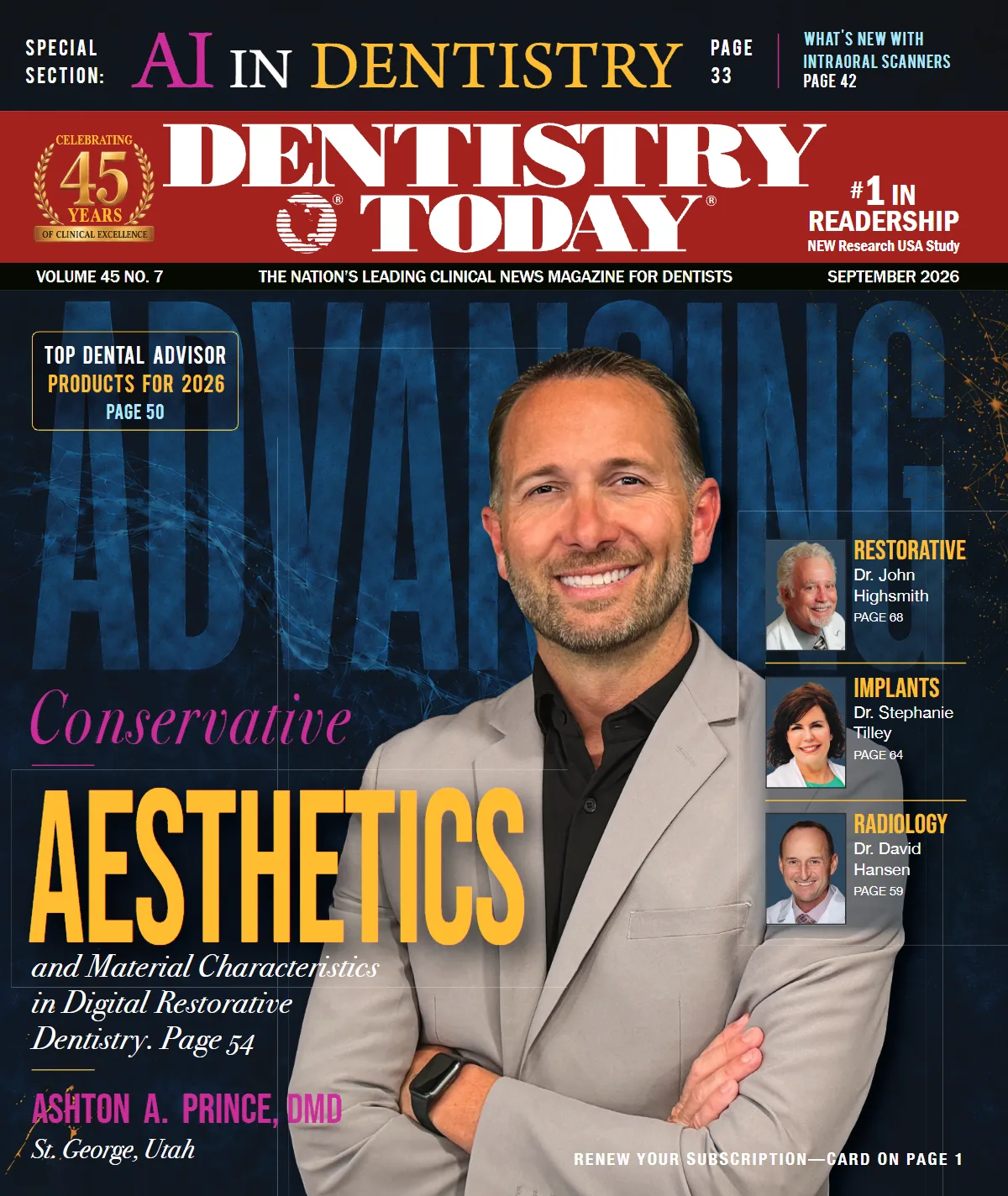
September 2026 · 77 pages
Dentistry Today — September 2026
Clinical articles, techniques, product news and continuing education for dentists. Read the full issue free in the digital edition.
Inside this issue
Excerpts from the issue. Open the digital edition to read any page in full.
- Page 6
I n my years of practice, many new materials come across my office with claims of superiority. Despite my educational background, I have had to turn to others for opinions and evaluation. One of my trusted resources has been DENTAL ADVISOR. It was founded to provide dentists with unbiased information when choosing products and equipment. The company’s initial mission was to “Improve Patient Care through Research and Education,” a goal it has maintained throughout its history. DENTAL ADVISOR was founded in 1983 by John Powers, PhD, the longtime COO who currently serves as the Legacy Advisor, and the organization is…
- Page 8
MONTH 2026 8 T here are moments in my life that divide me into a before and after. These moments are not the kind marked by celebration or achievement, but the kind that was uninvited and altered my trajectory in ways I couldn’t fathom. For me, that moment came with a diagnosis. Not my own, but my younger and only sibling, Manu’s. The diagnosis: Oral cancer. Ironic as a dentist, isn’t it? Before that word carried personal weight, it lived in my world as something clinical, something I was trained to identify, something I screened for, something I mentioned during…
- Page 10
VIEWPOINT ways that align neatly with textbook expectations. My brother’s diagnosis did not come early. I guess there was part denial on his end: “This can’t be cancer. I am only 32.” It was diagnosed at stage 2, with node involvement. Late detection does not just change prognosis; it changes the entire experience of illness. Manu did have multiple surgeries, chemo/radiation, and immunotherapy; however, the cancer was aggressive and consumed him inside out within a year and a half of diagnosis. In healthcare, we often discuss early detection in terms of survival rates and outcomes. We cite 5-year survival statistics…
- Page 12
SPECIAL ADVERTISING SECTION PRODUCT PROFILE es are one of the most important areas of infection prevention in the dental practice. The narrow tubing that delivers water to handpieces, air-water syringes, ultrasonic scalers, and other chairside equipment can create an ideal environment for biofilm formation, especially when water remains stag - nant overnight, over weekends, or during periods of non-use. Without a comprehensive waterline maintenance protocol, microbial contamination can quickly exceed recommended safety thresholds. The Centers for Disease Control and Prevention recommends that water used in nonsurgical dental procedures meet Environmental Protection Agency drinking water standards, including bacteria levels of ≤500…
- Page 14
SPECIAL ADVERTISING SECTION PRODUCT PROFILE F or decades, menopause was treated as a conversation belonging almost exclusively in the gynecologist’s office. Today, clinicians increasingly recognize it as a whole-body transition that can affect sleep, mood, bone density, muscle health—and the mouth. Dentists may be among the first healthcare pro - fessionals to encounter these changes. A patient may not arrive saying, “Menopause is affecting my oral health.” She is more likely to report dry or burning mouth, altered taste, increased sensitivity, inflamed gums, facial discomfort, jaw stiffness, headaches or a nightguard that no longer provides enough relief. Individually, these complaints…
- Page 15
SEPTEMBER 2026 • dentify the primary driver. Is there acute pain or inflammation? Is the condition predominantly muscular, articular or dental? Is chronic guarding restricting movement? Does the patient require collaboration with a physician, physical therapist or oral surgeon? From Protection to Functional Care Traditional interventions—including occlusal appli - ances, behavioral modifications, physical therapy, medication and home care—remain important. A nightguard can protect the dentition from grind - ing, but protection is not necessarily the same as rehabilitation. “A nightguard can help protect the teeth, but it does not necessarily rehabilitate the muscles responsible for jaw movement and stability. When…
- Page 16
QUICK TECHNIQUE SPECIAL ADVERTISING SECTION servation has become a widely accepted standard of care following routine extractions, particularly where implant placement is anticipated. However, cases involving the surgical removal of impacted mandibular third molars are frequently managed without any regenerative intervention. Unmanaged third molar sockets, particularly those with follicular pathology, can lead to osseous defects distal to the second molar resulting in chronic periodontal pocketing and long-term compromise of the adjacent dentition. 1,2 The OsteoGen Plug (Impladent LTD) is a novel and highly effective modality to address these challenges. The plug’s unique physical and biological properties were used to manage…
- Page 18
QUICK TECHNIQUE SPECIAL ADVERTISING SECTION f ago, I wrote about my grandson taking a hockey puck directly to the mouth during a pond hockey game in Michigan. No helmet. No mouthguard. Just an 8-year-old kid having fun until a puck fractured both maxillary centrals, teeth Nos. 8 and 9, exposing the pulp chambers (Figure 1). At the time, my biggest concern was not simply rebuilding the teeth. It was protecting the pulp long enough to allow the roots to continue developing naturally. The x-rays showed immature root formation, and the last thing I wanted was to begin endodontic treatment before…
- Page 20
TECHNOLOGY LINDON, Utah— Lumos 3DX is a high-resolution dental imaging system that brings advanced diagnostics directly to the point of care. With a mobile, cloud-connected design and an intuitive interface, the system helps dental teams work faster, communicate more clearly, and treat with greater confidence. Lumos 3DX delivers chairside tomosynthesis and Intelligent Imaging—bridging the gap between 2D and CBCT—so clinicians can visualize anatomy with greater clarity, explain findings with confidence, and plan treatments in real time, according to Valkyrie BioScience. This is imaging built for how dentistry actually works: fast, flexible, and focused on the patient. The system offers high-resolution…
- Page 22
TECHNOLOGY 22 SCOTTSDALE, Ariz– ClikTech, LLC has announced the introduction of several new products to its ClikRay line, including the new HandiBarEZ autoclavable, singlering/single-rod positioning system designed to work with all standard biteblocks. With one simple instrument, clinicians can capture anterior, posterior, horizontal bitewing, and vertical bitewing radiographs without changing components. The integral high-impact plastic rod is engineered at an optimal length for use with both handheld and wall-mounted x-ray systems, providing exceptional versatility while simplifying radiographic procedures. The company also introduced ClikRay ENDODONTICS, a comprehensive line of innovative biteblocks specifically designed for both vertical and horizontal endodontic radiography, and…
- Page 23
TECHNOLOGY 23 SPOTLIGHT BOULDER, Colo— Cleartooth offers the most robust and dependable, turn-key 2D imaging system, supporting accurate decision-making in modern dentistry. Cleartooth Digital X-Ray optimizes every step of the radiographic process, from acquisition to review, removing inefficiencies that interrupt patient care. It simplifies everyday dental workflows with minimal clicks, improving speed and efficiency during exams and keeping all images properly mounted, oriented, and organized. Reliability is critical in a busy clinical environment. Using its own purpose-built networked data platform, all information is automatically preserved and immediately accessible everywhere, reducing the risk of lost images, downtime, or treatment delays. When…
- Page 24
INNOVATIONS AMERICAN FORK, Utah— Spry EnamelMax Toothpaste delivers advanced enamel support through a clinically informed, modern formulation designed for today’s preventive-focused dental practice. Built around xylitol, EnamelMax helps shift the oral environment away from acid-producing bacteria while supporting saliva’s natural protective role. What sets EnamelMax apart is its targeted combination of L-arginine and sodium trimetaphosphate (STMP), ingredients recognized in scientific literature for supporting enamel integrity, maintaining a healthy oral pH, and helping protect tooth surfaces from daily acid exposure. Available in both fluoride and fluoride-free options, EnamelMax supports comprehensive enamel care without harsh abrasives or unnecessary chemical additives. Soothing aloe…
- Page 26
INNOVATIONS 26 SALT LAKE CITY — The LEAP (Laser Endodontic Ablation Procedure) is a next-generation laser-assisted root canal disinfection system designed to deliver predictable, reliable, and affordable complete bacterial elimination while simplifying clinical workflow. LEAP integrates the Picasso Pro diode laser, proprietary LEAP disinfection solution, and specially engineered LEAP fiber tips to create a complete laser-driven canal disinfection protocol, according to AMD Lasers. All LEAP elements and the overall protocol have been FDA approved. Independent laboratory research demonstrates greater than 99.99% bacterial reduction against Enterococcus faecalis , one of the most persistent pathogens in endodontic infections. The LEAP system combines…
- Page 29
INNOVATIONS 29 SPOTLIGHT GOLETA, Calif— The Isolite System is your all-in-one solution for efficient dentistry. From visibility to moisture control and patient compliance, every feature is designed to help you do better dentistry, in less time. In fact, practices using Isolite are reducing procedure times by up to 50%, according to Zyris. Isolite provides continuous, hands-free isolation and suction of both quadrants in the operative field. This means clinicians can focus entirely on the procedure at hand, reducing fatigue and improving precision. Dental professionals have more challenges than ever to make their practice successful—Isolite can help you save time, increase…
- Page 30
The 2026 Greater New York Dental Meeting (GNYDM) at the Jacob K. Javits Convention Center will be held from November 27 through December 1. Explore the latest dental products, technologies, and services from hundreds of exhibitors and discover various innovative solutions to enhance your practice. Earn continuing education credits through 200+ seminars, hands-on workshops, free main stage events, specialty education tracks, focused 1- to 2-hour sessions, and scientific poster presentations led by renowned dental educators. And there’s so much more to experience. Connect with colleagues and industry experts, unwind with a happy hour right on the show floor, and enjoy…
- Page 32
Researchers at Hiroshima University in Japan have found that the number of natural teeth a patient has may provide clues about long-term survival following surgery for pancreatic ductal adenocarcinoma (PDAC). The study included 339 patients who underwent pancreatic surgery at Hiroshima University Hospital between 2014 and 2022. The findings were published in the Journal of Hepato-Biliary-Pancreatic Sciences . Patients with 21 or more natural teeth had a median overall survival of 60.7 months, compared with 39.1 months for patients with 20 or fewer teeth. The association remained statistically significant after researchers accounted for factors including tumor stage, lymph node metastasis,…
- Page 33
SEPTEMBER 2026 • Image: shutterstock.com John Flucke, DDS I won’t ever forget the meeting. I was in a private conference room in Chicago at the Midwinter meeting about a decade ago with a couple of tech-loving friends and 2 young men I’d just met who had requested to meet with us to “show you what we’re working on.” They connected a laptop to a projector and showed a full screen image of a digital radiograph. They began talking about how diagnosis was currently being done with digital x-rays. Things like brightness, contrast, colors, all kinds of filters. They showed the…
- Page 34
N ot long ago, every practice waited on film. Bite the tab, walk it to the darkroom, dip it in developer and fixer, and hope the image came out clean the first time. Add up the film, the chemicals, and the minutes lost on every single patient, and it was real money and real time spent on process instead of care. Digital sen - sors changed that almost overnight. The image is on the screen before the patient sits back up, and nobody misses the darkroom (Figure 1). Documentation is stuck exactly where imaging used to be. Every hour a…
- Page 36
I ntraoral scanning has become the standard of care in restorative dentistry, with more than 70% of U.S. practices now relying on digital scanners in place of traditional impressions.* Even so, a scan that looks complete chairside can still contain a problem that only becomes obvious once it reaches the lab, such as an undercut, a margin hidden by tissue, or insufficient occlusal clearance. When that happens, the fix usually means calling the patient back for a rescan, adding an appointment neither the practice nor the patient wanted. Dandy, a digital dental lab whose chairside scanning tools support instant, virtual…
- Page 38
Anna Maria Zamorano, DDS, MBA C urodont Repair Fluoride Plus is helping dentistry shift from a reactive, surgical model of care to proactive, noninvasive restorative care for early-stage caries, without drilling or artificial filling materials. Its biomimetic approach is designed to treat early lesions by facilitating fluoride-enhanced hydroxyapatite formation throughout the depth of the lesion, enabling the restoration of mineral density and helping preserve natural tooth structure. Curodont’s clinical effectiveness does not depend on artificial intelligence. Dentists can identify suitable lesions through clinical examination, patient histories and traditional radiographic interpretation. What’s more, Curodont can be used on patients at any…
- Page 40
V ELMENI, a dental artificial intel - ligence company developing connected clinical and admin - istrative workflows for dentistry, recently announced that it has received 510(k) clearance from the U.S. Food and Drug Administration for VELMENI for DENTISTS (V4D) 3D. The FDA clearance, issued under 510(k), expands VELMENI’s den - tal AI portfolio into 3-dimensional conebeam computed tomography, or CBCT, imaging. VELMENI for DENTISTS (V4D) 3D is designed to assist qualified dental professionals in reviewing and analyzing dental CBCT scans through AI-assisted anatomical segmentation, visualization, measurements, and image reconstruction. By bringing 2D dental radiograph analysis and 3D CBCT intelligence into…
- Page 42
What’s New With Intraoral Scanners SHINING 3D Scanner Allows End Users to Send, Upload for Design, and Download Files Effortlessly The SHINING 3D Aoralscan ELF sets a new standard for chairside digital dentistry. Designed around 3 core principles; Ergonomics, lightweight, and functional hardware weighing less than a computer mouse. Its ultra-light, palm-adaptive design reduces wrist fatigue during extended clinical procedures while optimizing patient comfort. Connectivity is effortless featuring a single USB Type-C cable that powers the device directly, eliminating cumbersome power boxes and cluttered cords. To accommodate varying clinical scenarios, the ELF includes 3 interchangeable tip sizes (Mini, Standard, and…
- Page 44
WHAT’S NEW WITH INTRAORAL SCANNERS 44 Align Technology More Comfort, More Convenience Using This Intraoral Scanner iTero Lumina intraoral scanner delivers precision for restorative workflows with proprietary Multi-Direct Capture technology, offering 3X wider field of capture and 25 mm maximum distance for smooth, accurate scans. Advanced soft - ware enables effortless, uninterrupted scanning at 2X speed in a 50% smaller wand—ideal for crowns, bridges, dentures, and complex cases. iTero solutions free patients from uncomfortable PVS impressions and help patients visualize treatment outcomes and progress—which goes a long way toward increasing case acceptance and practice growth. For more information, call (800)…
- Page 46
WHAT’S NEW WITH INTRAORAL SCANNERS 46 Aidite USA Technology Co. Ltd Scanner Helps Practices Move Efficiently From Scanning to Restorative Design and Production The Aidite Rapid 5 Intraoral Scanner combines precision, speed, and intuitive operation to support efficient digital workflows in the dental practice. With full-arch scanning in approximately 60 seconds and 10-μm precision, Rapid 5 captures detailed intraoral data while helping clinicians streamline digital impression taking. A 25-mm depth of field supports comprehensive data capture, including challenging areas and implant cases. Weighing less than 6 oz the lightweight, ergonomically balanced handpiece is designed for comfortable handling and reduced fatigue…
- Page 48
WHAT’S NEW WITH INTRAORAL SCANNERS 48 Ori Imaging Fast, Accurate, Best Value in Scanning The Ori 3.0 is an intraoral scanner built to be fast, accurate, and easy to use. It scans a full arch in 30 seconds and a quadrant in 15, at ±12-μm accuracy, in true color, with built-in AI Scan Assist guiding every scan from day one. It captures soft tissue cleanly, so one scanner handles crowns, bridges, clear aligners, and dentures. The workflow is open. Practices own the hardware outright and export open .STL, .PLY, and .OBJ files, so scans can go to any lab with…
- Page 50
Top DENTAL ADVISOR Products for 2026 A s we celebrate the 20th anniversary of the DENTAL ADVISOR Awards, I am filled with gratitude for the people, partnerships, and purpose that have shaped our organization throughout the years. This milestone is more than a celebration of longevity. It is a celebration of our unwavering commitment to evidencebased dentistry and the trust that dental professionals around the world have placed in DENTAL ADVISOR. For 43 years, DENTAL ADVISOR has served as an independent voice in dentistry, providing clinicians with objective evaluations of products, materials, and technologies. Our mission is very simple, to…
- Page 51
SEPTEMBER 2026 • formulated for maximum zirconia bond strength without additional primers. This cement has among the best-in-class self-adhesive zirconia bond strength based on DENTAL ADVISOR testing and is able to be combined with adhesives such as BeautiBond Xtreme to other substrates and low retention restorations for enhanced bond strength and versatile application. This product also includes a silane in the cement for enhanced self-adhesive bond strength to glass ceramics. *Shofu’s OneGloss polishers also were honored by DENTAL ADVISOR. yris Hands-Free HVE: Isolite Pro (800) 560-6066 | zyris.com TOP FEATURES: Isolation with protection: Continuous suction for moisture control, better visibility,…
- Page 54
T he evolution of dental materials science continues to redefine what is possible at the chairside level. Since the early integration of CAD/CAM into restorative dentistry, as dental professionals we have witnessed dramatic improvements in the precision, aesthetics, and efficiency with which indirect restorations can be quickly designed and delivered. 1 As CAD/CAM has confirmed its valuable daily use over the past years, what was once a technology reserved for the clinical laboratory has become a cornerstone of the modern, productivity-focused practice, and with that expansion has come an understandable demand for materials that rise to meet it. 2 As…
- Page 56
TECHNOLOGY 56 toration replacement and a partial-coverage CAD/CAM ceramic restoration designed and delivered in a single appointment—the patient was informed of the more complex clinical findings and potential need for more extensive procedures. Conservative measures were considered first due to the clinical presentation of the occlusal surface. The patient was also given the opportunity to ask questions and was provided with the always extremely important informed consent prior to treatment. The decision was made to proceed with removal of the existing decay, further adjustments to the tooth, and placement of a more definitive ceramic onlay for a more predictable restorative…
- Page 57
TECHNOLOGY SEPTEMBER 2026 • sion system (Dentsply Sirona), capturing the preparation, opposing arch, and buccal bite registration (Figures 6 and 7). The partial coverage crown or onlay was designed with attention given to occlusal anatomy, functional wear patterns, interproximal contacts, and natural emergence profile. A T-block Ceramir restoration block was selected due to the need for greater translucency, allowing for the shade to correspond to the patient’s natural dentition. The material was placed in the CEREC MCXL milling unit (Dentsply Sirona) and fabricated in approximately 6 minutes. Following milling, the restoration was placed upon the prepared tooth to check for…
- Page 58
C ertainly, the advent of digital diagnosis and treatment planning has allowed the dental practitioner a certain degree of confidence and competence in not only determining which surgical and prosthetic cases can be attempted but also can be used to maximize any positioning issues and anatomic restraints in real time. Technology has allowed us to promote high quality dentistry with significant predictability to restore function and aesthetics to our patients. Quality of life is enhanced with improved chewing and overall health. Education explaining all benefits and risks to our procedures can be virtually done, thus creating a better result. The…
- Page 59
SEPTEMBER 2026 • INTRODUCTION Few innovations have influenced implant dentistry as profoundly as CBCT. Three-dimensional evaluation of bone volume, ridge morphology, vital anatomical structures, restorative space, and implant position has made implant treatment more predictable and safer. 1-4 Yet surgery remains dynamic. Extraction findings may differ from preoperative expectations, an osteotomy may approach a cortical plate, sinus elevation may not proceed as anticipated, or the clinician may want to confirm implant position before continuing. This creates an intraoperative imaging gap. CBCT provides comprehensive 3D information before surgery, but obtaining another scan during treatment may require covering the surgical site, moving…
- Page 60
RADIOLOGY 60 Implant Placement and Osteotomy Verification Accurate implant placement requires maintaining the planned trajectory while respecting surrounding anatomy. Dense cortical bone, limited visibility, or unexpected tactile feedback may create uncertainty regarding depth or angulation. Focused tomosynthetic images can verify osteotomy trajectory or implant position before treatment is completed, allowing correction when necessary, rather than relying solely on postoperative imaging. This may be especially relevant when the osteotomy is adjacent to a vital structure or when limited access makes visual assessment difficult. Confirmation before final seating creates an opportunity to modify the osteotomy or implant position while the site remains…
- Page 61
RADIOLOGY 61 nents, fractured prosthetic screws, or previous grafting. Conventional imaging can be limited by superimposition, while metallic artifacts may reduce CBCT diagnostic value in localized regions. 11-14 Focused sectional imaging may assist localization, confirm retrieval, or document implant-related complications. Representative indications and the specific questions that chairside tomosynthesis may address are summarized in Table 2. Workflow Advantages The principal advantage of chairside tomosynthesis may be workflow rather than image quality. Traditional 3D imaging requires the patient to travel to the scanner; a mobile system brings imaging to the patient. This can preserve the operative field, surgical setup, team concentration,…
- Page 62
RADIOLOGY 62 assessments, CBCT supplies comprehensive 3D information when indicated, and tomosynthesis can be inserted selectively when a focused intraoperative question cannot be adequately answered by 2D imaging. This distinction reflects different imaging objectives. Before surgery, the clinician needs broad anatomical assessment. During surgery, the question is often limited to one relationship that must be confirmed before proceeding. The conceptual contribution of chairside tomosynthesis is therefore its ability to make 3D imaging available as an intraoperative resource. The practical significance is that the clinician can obtain additional sectional information at the point of care without changing the fundamental diagnostic role…
- Page 64
T here was a time when implant dentistry was considered experimental. The surgical and prosthetic procedures were often challenging and expensive. This is no longer the case, as implant dentistry has become mainstream not only within the profession but also with the public, who have become aware of the tremendous advantages in form, function, and overall health that dental implants can provide. Dental implant-supported prostheses have become a predictable, cost-effective means of restoring function and aesthetics for the edentulous patient. Many options are available to the practitioner, which need to be discussed in detail to properly meet the patient’s expectations.…
- Page 65
SEPTEMBER 2026 • Proper oral hygiene is important to the long-term success of the nylon attachments. The abutments are cleaned to prevent any plaque buildup in the socket of the abutment. A soft nylon brush or end-tufted brush works well. A nonabrasive gel toothpaste and irrigation can be used effectively. Prosthetic design is created with a clear understanding of the patient’s expectations and financial ability. A “teeth first” approach allows the practitioner to determine if treatment is even possible and how the patient will respond to the final product. Communication between the practitioner and laboratory technician is critical to functional…
- Page 66
IMPLANTS 66 foramen was identified, and care was taken to avoid injury to the neurovascular bundle. The bone reduction guide was placed on the labial surface of the mandibular alveolar bone. Then, 1.5 mm fixation drills were used to create an osteotomy, and the fixation pins were inserted through the guide into the bone. A bur or diamond will follow the edge of the guide to remove the necessary hard tissue to provide a predictable prosthetic solution for the patient. The bone reduction and implant placement were planned using planning software, leading to the surgery, and were based on the…
- Page 67
IMPLANTS SEPTEMBER 2026 • tive CBCT analysis indicated the position of the dental implants (Figure 17). The patient received a new lease on life with greatly improved function, aesthetics, and confidence (Figure 18). DISCUSSION This digital dental workflow included radiology evaluation, medical clearance, and surgical and prosthetic planning, ensuring proper bone reduction and implant placement for a predictable prosthetic solution that met the patient’s expectations. Eating better, speaking clearly with precise enunciation, and a younger look with a bright smile were attained. Proper diagnosis and planning were completed with the dental laboratory to ensure proper angulation and positioning of the…
- Page 68
Treatment planning in implant and aesthetic dentistry often assumes a controlled environment—carefully staged procedures, thoughtful sequencing, and predictable outcomes. Occasionally, however, a well-executed treatment can be dramatically altered by an unforeseen event. When that happens, clinicians are forced to revisit foundational treatment decisions and balance biology, aesthetics, and patient expectations under far less predictable conditions. This case illustrates such a situation. What began as a straightforward aesthetic and functional rehabilitation became a complex decision-making process following traumatic injury to recently restored anterior teeth. The critical question became whether to replace the teeth with implants or attempt to preserve them despite…
And 2 more pages — read the whole issue.