
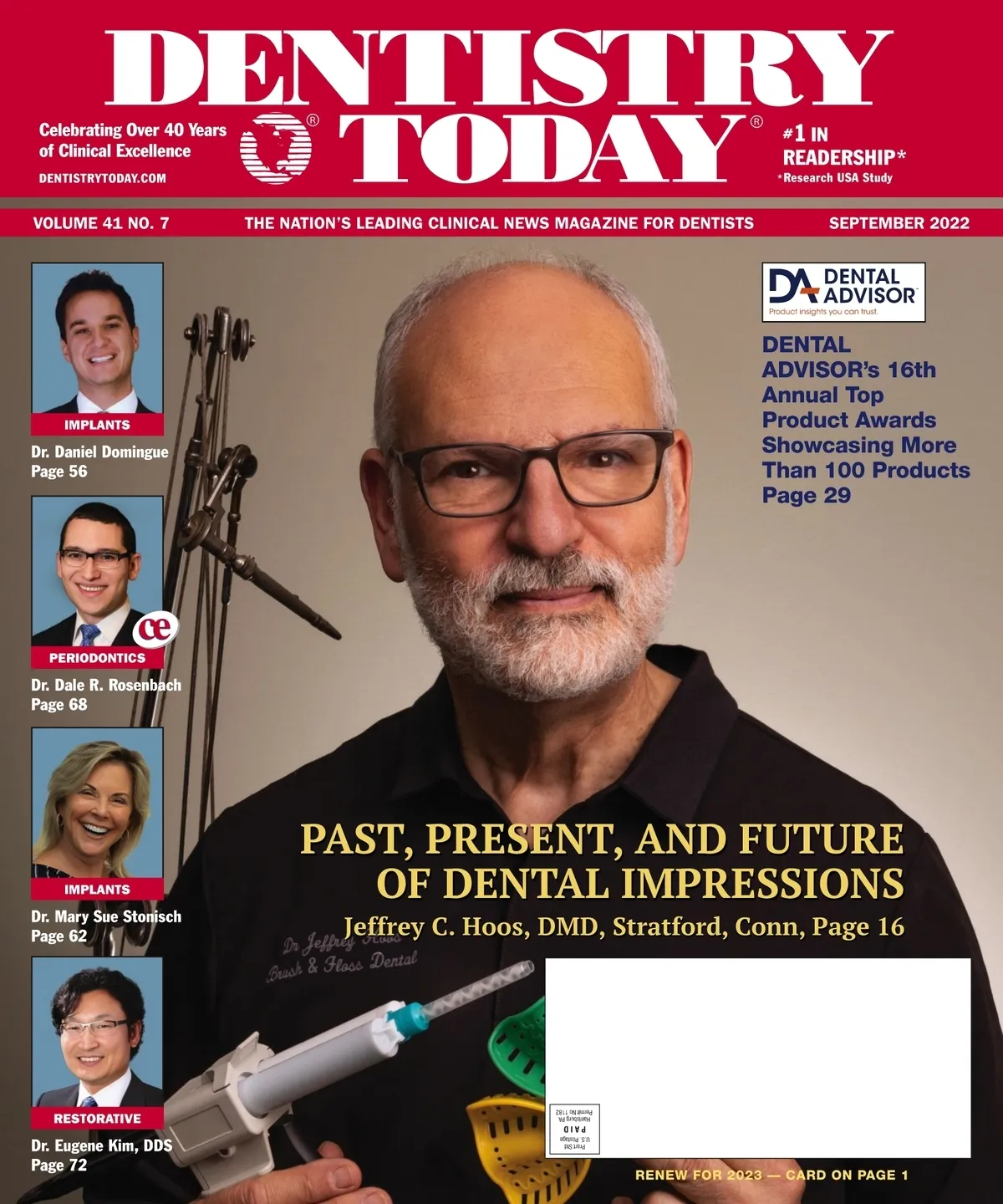
September 2022 · 92 pages
Dentistry Today — September 2022
Clinical articles, techniques, product news and continuing education for dentists. Read the full issue free in the digital edition.
Inside this issue
Excerpts from the issue. Open the digital edition to read any page in full.
- Page 6
EDITOR'S PAGE I've Got a Lot to Learn "To be able to try new, potentially better ways of doing things, you have to be willing to stick your neck out." This quote by our cover author, Dr. Jeff Hoos, defines his entire career. If you run into Jeff at a meeting, you will notice an odd pin on his jacket. With an undergraduate degree in zoology, he is the president and sole member of the Giraffe Society, which has become its logo. Jeff has been in dental practice for 42 years and has always been ahead of the curve. Certainly,…
- Page 8
Keeping Up With Insurance Management Editor's note: last month, we looked at insurance-free options. Here we have Teresa Duncan, one of the top insurance authorities in the profession, with some hints and important ideas for those of you at work with dental insurance. Teresa Duncan, MS Insurance management has become significantly more time-consuming than ever before. Concerns shared by most offices center around task management and deciphering patient benefits. It is not just participating offices that struggle — even fee for service practices feel the pressure to be accurate with estimates and financial conversations. Experienced insurance coordinators are fine-tuning their…
- Page 10
VIEWPOINT continued from page 8 sending the screenshot to reflect the primary payment. Most carriers will accept this screenshot as long as it provides the same information as a printed EOB. Do I need to Check Benefits for Every Patient Appointment? We track down plan benefits so we can provide our best estimate of the patient's portion. Every time we get this right, our confidence level grows. It's a time-intensive task, however. Frustrated team members tell me that they check this for every patient, every appointment. That's overkill. For his or her first appointment this makes sense, but not for…
- Page 12
DirectaDentalGroup DIRECTA topdental ORSING parkell physics forceps RØNVIG TrollDental Sendoline CONTACTEZ Sendoline - founded in 1917, is a Swedish company that develops and manufactures dental products in the field of endodontics and was acquired by DirectaDentalGroup in 2021. Sendoline's products make endodontics easier for the dentist, more ergonomic and patient friendly, this remains their core focus. Directa is excited to bring this product line to the USA market. Sendoline FOCUS S1 System Flagship products S1 System is a complete, compact, reciprocating single file system allowing you to carry out root canal treatments using a single mechanical instrument. The unique S-Profile…
- Page 14
Forensic Odontology Derek Draft, DDS, welcomes the opportunity to educate Dentistry Today readers about what it means to be a forensic odontologist. Q: What is forensic odontology? A: Its basic definition is the scientific application of dental knowledge to criminal and civil law matters. We are often involved in 4 main categories of cases: identification, age assessment, civil litigation, and bitemark analysis. Most of our work is usually scientific identification in cases where the human remains are not identifiable via other methods such as visuals or fingerprints. Q: What does it take to be involved in forensic odontology? A: Basically,…
- Page 16
Dental Impressions 1952 to 2022 Balancing the Art, Science, and Business of Dentistry INTRODUCTION As I contemplate my 42 year career, I am struck by how much progress has been made in the field of dentistry in general and dental impressions in particular. Two other observations also strike me: First, it is virtually impossible for younger dentists to fully appreciate just how far the practice of dental impressions has come in the past 70 years. Second, many dentists of all ages are uncertain about the role—and even the true science—of conventional dental impressions in the era of digital dentistry. This…
- Page 18
Figure 1. Copper bands for impression taking. Figure 2. Digital impressions. Figure 3. Initial impression with high-durometer VPS (Honigum [DMG America]). Figure 4. Honigum body (DMG America) syringed onto VPS while still seated in the mouth (blue). Figure 5. The amount of light body necessary. Figure 6. Patient closed (with help). Figure 7. Final impression (blue and yellow). Figure 8. Custom tray mimicking the patient's old denture. Figure 9. The final denture impression reproduced tissue landmarks in great detail in a single visit. Dental Impressions 1952 to 2022... continued from page 16 handle than mixing them up manually on a…
- Page 19
Moreover, hemorrhaging could recur spontaneously or when the cord was removed. And the hemostatic agents used to address the hemorrhaging contained sulfur that could inhibit the setting of VPS impression materials. Yet another problem was that saliva could flood the field if the assistant was unable to maintain adequate suction and isolation, which was not uncommon for some patients. Making final impressions of subgingival finishes can still be a challenge, even under the best of circumstances. Fortunately, the H&H impression technique eliminates the need for retraction of the gingival tissue, the need to apply hemostatic agents, the need for syringe-able…
- Page 20
TECHNOLOGY offer many advantages in many areas of dentistry, not every dental practice can afford to incorporate all of the digital technology that's available. Fortunately, the dental laboratories will be able to digitize the impressions the practice makes using conventional impression materials. Figure 18. Implant abutments make digital scanning impractical. Figure 19. Final implant prosthesis. Figure 20. Master impression for a combination case. Figure 21. Single-crown impression "pulled" in a master impression. THE RELEVANCE OF ANALOG IMPRESSIONS on the opposite arch; and (3) practice biting back into the tray to make sure he or she does it properly. By the…
- Page 21
TECHNOLOGY 21 a master impression was taken using a high-diameter VPS impression and a light body impression material to pick up all of the details. Note the detail of the crown preparation first and then the master impression for the major connector framework. You might want to take a hybrid approach that involves conventional impressions, scanning them, and having your lab use its digital technology to fabricate the prosthesis using printed materials. We're combining the best of both worlds and analog and digital dentistry. THE HYBRID APPROACH TO IMPRESSION TAKING A good example of how analog and digital impression taking…
- Page 22
Chair Provides Comfortable Patient Experience, Efficient Environment for Clinicians ENGLEWOOD CLIFFS, NJ–Hiossen's most advanced healing unit chair, the K3, is ergonomically designed to allow streamlined interactions among dentists, dental assistants, and patients. Designed by clinicians and biomedical engineers, the K3 unit chair provides a comfortable patient experience and an efficient work environment for doctors. Flexible integration of the delivery system allows for easy access to patient treatments and care. The durability of every chair is ensured by using only materials of the highest quality. By also running through 10,000 rounds of height adjustments and 5 years of power on/off testing…
- Page 24
Practice Management Software Features Advanced Integration SCOTT, La.–DentalEye software from Dentron Systems is the performance creator a digitized practice has been waiting for. It controls operating costs by advanced integration with most x-ray sensors, cameras, digital panoramic devices, phosphor plate scanners, and bridges seamlessly to your practice management software. DentalEye offers simple, efficient image management. Take advantage of advanced image manipulation and optimization using world-class, proprietary image filtering. Compare and contrast current exams with any past examination, side by side. For more information, call Dentron Systems at (225) 612-8300, visit dentronsystems.com, or email sales@dentronsystems.com. FREE info, Company Meets Handpiece Repair…
- Page 26
Company Offers Customized Guides for Scans ENGLEWOOD CLIFFS, NJ–The DENTIS Digital Guide Center from Dentis USA is making it easier than ever for doctors to utilize this game-changing innovation without having to invest in the equipment or take time to design the guides. The process is simple: Send a CBCT scan and an intraoral scan to one of Dentis USA's Digital Guide Centers, where a team of experts will design the guide. The digital design is then sent back to you for approval. Once approved, Dentis USA will print it and ship it directly to your office. It's an efficient…
- Page 28
Improving Product Quality and Innovation for Nearly 40 Years Nearly 40 years ago, DENTAL ADVISOR started as a small group of dental professionals who saw a need for unbiased, evidence-based, and clinically relevant information on dental restorative products, infection control products, and dental equipment. Throughout the years, DENTAL ADVISOR has continued to evolve into what it is today. DENTAL ADVISOR is an industry-defining resource, challenging dental professionals and dental product distributors to push their limits on improving product quality and innovation. Current owners, Dr. Sabiha S. Bunek, DDS (CEO and editor-in-chief), and co-founding member Dr. John M. Powers, PhD (president),…
- Page 42
Surgical Guides Optimize Implant Positioning IRVINE, Calif.-Glidewell is now offering tissue and bone-supported surgical guides to help dentists optimize implant positioning for cases where a fixed or removable implant restoration is planned. The Digital Treatment Planning (DTP) line extension provides prosthetically driven implant positioning and a smooth, predictable surgical procedure for fully edentulous patients. The DTP service is available for all major guided implant systems and is a key element of Glidewell Implant Solutions, which provide dentists with everything they need to succeed in implant dentistry, from live and online continuing education, to dental implants, to cutting-edge restorations. This implant-to-crown…
- Page 43
INNOVATIONS 43 Dietary Supplement Provides Support for Implants ST. LOUIS—MediNiche's BONE-TITE is the first osseointegration support supplement for dental implant patients. It is an over-the-counter dietary supplement product developed in conjunction with prosthodontists, periodontists, and other dental professional experts in bone metabolism and bone growth for use with patients that may require nutritional insurance before and after dental implant procedures. BONE-TITE provides key vitamins, minerals, and nutrients known to be helpful for proper bone and soft tissue grafting and overall healing during implant osseointegration. The BONE-TITE formula is built around a bone-building formula of key nutrients that are associated with…
- Page 44
Toothpaste Flavors Brighten Teeth Without Bleaching or Abrasion MESA, Ariz.—Curaprox's new peach + apricot and watermelon flavors offer bright colors and surprising flavors. The key feature is gentle enzymatic whitening provided by glucose oxidase. It visibly brightens teeth without bleaching or abrasion—simple and beautifully natural. There's no aggressive foaming agent like SLS (sodium lauryl sulfate), and no troublemakers like microplastics—just menthol power pearls for long lasting fresh breath. Hydroxyapatite protects sensitive tooth root surfaces and xylitol is effective against bacteria. With an RDA of 50, these vegan toothpastes are ultraeffective, yet completely gentle. They make boring oral hygiene an enjoyable…
- Page 46
Dental X-Ray Sensor Provides Amazing Images and Compatibility MESA, Ariz.-The DentiMax Dream Sensor is known for delivering superior diagnostic x-rays at the highest resolution possible. It has received high marks in clinical reviews, including a 96% in its DENTAL ADVISOR clinical evaluation. The sensor shows extraordinary anatomical details with reduced noise and improved tissue contrast for accurate diagnoses. It also provides a large active image area of 900 mm², allowing one to capture root teeth in the x-ray. The sensor has open compatibility and works with most imaging software and dental sensors on the market. It is simply a plug-and-play…
- Page 47
INNOVATIONS 47 SPOTLIGHT Warming Dispenser Produces Enhanced Physical Properties for Composites DANBURY, Conn.—Compex HD from AdDent delivers the perfect flow at an optimal temperature for all restorative and cementation procedures. Having the optimal composite temperature at the point of delivery makes all the benefits of using warmed composite better, including enhanced physical properties. It reduces cure time to as little as 5 seconds and will reduce shrinkage/stress and microleakage. It saves time with fewer composite adjustments during placement. It is easy to load and unload. Compex HD warms quickly, thus there is no down time for larger procedures. This time-saving…
- Page 48
SmileFast—The Revolution in Composite Resin Smile Makeovers FIGURE 1. Pretreatment teeth. FIGURE 2. Teeth isolated and ready for bonding. FIGURE 3. SmileFast stent with pre-separation. FIGURE 4. SmileFast stent placed restoring all 8 teeth simultaneously. FIGURE 5. Restored teeth immediately after stent removal. FIGURE 6. Final restored teeth at the 2-week review visit. SmileFast is the groundbreaking way of delivering composite veneers directly to teeth that has turned the dental industry on its head within the United Kingdom and has now finally reached the United States. Those keeping abreast of the latest innovations in dental products will have likely seen…
- Page 49
the excitement around this new brand. But this was just one aspect of a much broader and more comprehensive treatment delivery concept. The SmileFast concept teaches on composite, orthodontics, ceramics, and occlusion—as all are part of a patient journey to a better smile and they all need to be understood and offered to comprehensively strengthen patient satisfaction. The pre-separated stent is amazing—literally game-changing—but it's just one solution to a broader scope of practice. Tom, the SmileFast team, and I are passionate about demonstrating to the dentists who have taken the course that SmileFast is more than just a composite solution.…
- Page 50
Industry News Bernie Jaroslow, Beloved Member of Whip Mix's Marketing Team, Dies at 69 Bernie Jaroslow Bernie Jaroslow, 69, of Louisville, died July 30. The beloved dental community member joined the Whip Mix team in 2011, taking on the role of creative leader for their marketing team. He was the go-to guy for marketing and technical storytelling. As a trained CDT, he shared a comprehensive understanding of complex applications of dental products. He enjoyed a distinguished career with some of the industry's leading companies. At Whip Mix, Jaroslow brought his smile, his laugh, and a humble spirit to work, day…
- Page 51
OraFit All aligners are not alike. Discover clear aligners with excellent clarity, strength, and gentle, consistent teeth-moving forces1,2 REALIGN YOUR EXPECTATIONS. VISIT HCP.MYORAFIT.COM INDICATION: The OraFit Custom Clear Aligner System is indicated for use in the alignment of permanent teeth through orthodontic treatment of malocclusion and malocclusion. IMPORTANT SAFETY INFORMATION: CustomClear®Aligners: The OraFit Custom Clear Aligner System is contraindicated in patients who: • Are allergic to plastics • Have active periodontal disease. • Have untreated caries. • In rare occurrences, patients may be allergic to the thermoplastic polyurethane material of the aligners. Advise patients that if they develop an itching,…
- Page 52
Eating Problems Among Home Care Clients A new study from the University of Eastern Finland shows that eating problems are common among older home care clients. All clients studied were 75 or older and living in the eastern part of Finland. The study examined the prevalence and determinants of eating problems when screened by a clinical nutritionist and a dental hygienist. Eating problems were divided into loss of appetite, problems with chewing, problems with swallowing, and oral health-related. The researchers found that all reported eating problems were associated with the participants' poorer nutritional status and decreased food intake. Edentulous participants…
- Page 54
Steps to Maximize Outcomes and Visualize Complications Drilling a hole into hard tissue and threading a screw into it is not the most difficult of procedures. We can practice this on models during participation courses as we learn about dental implant surgical techniques. Preparing teeth and making an impression for a dental laboratory design and fabricate some type of restoration, whether it be a crown or veneer, is routine in most dental practices. These preparation designs are taught early in dental school. The real art of dentistry today is ideally understanding what the final result will function and look like.…
- Page 56
Ten Steps to Bone Reduction in a Full-Arch Surgical Guide INTRODUCTION In 2021, Mijritsky et al,1 including other well-known clinicians like Scott Ganz, published the largest retrospective study on guided surgery, called "Variety of surgical guides and protocols for bone reduction prior to implant placement: a narrative review." It details the largest review study, dating back from 1988 to 2020 and complying every surgical guide design with bone reduction and the advantages of guided surgery. The paper presents several compelling benefits of a guided approach in full arch surgery over conventional freehand approaches, such as decreased treatment time, greater accuracy…
- Page 57
DentalEye The leading software for managing images in the modern dental practice. COMPATIBILITY Integrates seamlessly with most sensors, cameras, phosphor plate systems, and panoramic/cephalometric systems. PRACTICE MANAGEMENT Bridges into all major Practice Management software. USERS Used by over 59 dental schools across the globe, and by the United States Air Force & Veterans Administration. FUNCTIONALITY Compare side by side views of images from current and past exams. See both intraoral camera images & radiographs in the same module. COST COMPARISON Save thousands compared to other imaging solutions with options of subscription (support included), or purchasing an eternal license. Options available…
- Page 60
Ten Steps to Bone Reduction... continued from page 58 adjust the implant trajectories to be as parallel as possible in the arch. 6. For fixed conversion cases, place implants as close as possible to the cingulum of the anterior teeth and emerging through occlusal tables of the posterior teeth. Care should be taken to maximize the A-P spread between implants to minimize cantilevers. 7. Bone segmentation is performed with Diagnocat software to turn the patient's jaws into accurate STL models (Figure 5). 8. Place lateral stabilization pins between implant positions to stabilize the guide (Figure 8). 9. Design a guide…
- Page 62
Biomimetically Driven Dentistry INTRODUCTION We live in a society where our appearance plays a major role in our ability to succeed. A beautiful and healthy smile can make a measurable difference in our self-confidence and self-esteem. However, what people are born with is difficult, if not impossible, to recreate once destroyed. In other words, it is difficult to reproduce nature with the unnatural. Man-made materials in dentistry have not been scientifically proven to exceed the capabilities of a natural dentition until now. With the advent of minimally invasive dentistry and prepless procedures, we are now able to simulate nature functionally…
- Page 64
Biomechanically Driven Dentistry continued from page 62 Maxillary Incisal Edge Position Adding simple wax to the upper centrals and cuspids allows us to establish a desired anterior tooth length. One to 2 mm of visibility is desired for maxillary central incisors in repose and zero display of maxillary cuspids.² A normal range for tooth visibility in an average smile is 6 to 10 mm, which is adjusted based on lip mobility. Evaluation of Ellen's smile revealed that an additional 3 mm could be added to the centrals and 4 mm to the cuspids. Similarly, the Golden Shimbashi is a golden…
- Page 66
Figure 17. Lower 6 anteriors bonded, and occlusion adjusted. Figure 18. Occlusion finessed. Figure 19. Anterior incisors do not hold shimstock. Figure 20. Cuspids, pre-molars, and molars all hold shimstock. Biomechanically Driven Dentistry continued from page 64 contamination, and in the cases where oral hygiene is inadequate, it can control bleeding (size 000 regular Ultrapak Cord [Ultradent Products]). The infinity margin of these fine restorations may have resin overflow, which may require micro-finishing Figure 21. Postoperative retracted view. Figure 22. Before and after smile. Figure 23. Before and after profile. Figure 24. Before and after uppers. Figure 25. Before and…
- Page 68
Test 258 dentalCEtoday.com PERIODONTICS A Simpler Approach to the Connective Tissue Graft This article shows an approach to harvesting connective tissue from the palate and using it as a graft for either a tooth or an implant. Dale R. Rosenbach, DMD, MS, received his DMD degree from New Jersey Dental School and his MS in periodontics and implant dentistry from Columbia University. He is a diplomate of the American Board of Periodontology. He has authored numerous peer-reviewed articles and has lectured extensively across North America on topics related to periodontics and implant dentistry, including soft tissue grafting procedures. He is…
- Page 69
Figure 1a. The incisions for this technique consist of a mesiodistal incision a few millimeters from the gingival margin and vertical incisions on the mesial and distal. A trap door flap was lifted to provide access to the underlying connective tissue (CT), from which a graft was taken. Figure 1b. After the graft was harvested, the trap door flap was sutured back into place for primary closure with three 4-0 horizontal mattress sutures, which resulted in a much lower risk for postoperative bleeding complications. Figure 2. This technique consists of a single mesiodistal incision a few millimeters from the gingival…
- Page 70
PERIODONTICS atal epithelium was 0.43 mm, with a range of 0.1 to 0.8 mm. Traditionally, a CT graft is taken from the area deep to the epithelium via surgical access. Some techniques use a trap door(Figure 1), while others utilize a long mesial distal flap, double parallel slit, or a single slit with a single vertical incision, through which the graft is cut from the surrounding tissue and removed.11-13 (Figure 2). Collecting the CT graft in these ways tends to be more difficult than the process for a free gingival graft because of technique sensitivity. If the trap door flap…
- Page 71
TEST 258 Expiration date of this CE article is September 1, 2024 To submit Continuing Education (CE) answers, use the answer sheet below. Or, use our easy online option at dentaltoday.com. This article is available for 2 hours of CE credit. The following 10 questions were derived from "A Simpler Approach to the Connective Tissue Graft," by Dale R. Rosenbach, DMD, MS, and Shira Theil, DDS, on pages 68-70. Learning Objectives: After reading this article, the individual will be able to (1) know the difference between various types of soft-tissue grafting procedures, including some of the alternative surgical methods; (2)…
- Page 72
Aesthetic Improvement of Over-Retained Deciduous Canines INTRODUCTION Patients may present with over-retained deciduous anterior teeth and a desire to improve the aesthetics of their smiles. Even in cases without a dental implant is the best treatment option, the patients may not be ready for implant placement for a variety of reasons, which may include age and financial circumstances. Additionally, the patients may object to preparing adjacent teeth (traditional fixed bridges) or connecting them with resin-bonded wings. When those teeth are stable (no mobility) and have root structure in the bone, an alternative to extraction and replacement may be indicated. Aesthetics…
- Page 74
Aesthetic Improvement of... continued from page 72 any option as long as the deciduous teeth last. A crown-lengthening procedure would be needed if the deciduous canines were retained to reposition the gingival margin more apically to better blend with the adjacent teeth and yield a better length-to-width ratio aesthetically. The pros and cons of this option were reviewed and discussed with the patient. The patient indicated that he was not ready for implant treatment at this time and wished to try to maintain the canines longer while improving the aesthetics of his smile. Impressions were taken of both arches, and…
- Page 75
RESTORATIVE 75 canines after receiving full-coverage restorations. The patient presented for treatment and confirmed a desire to proceed with the restorative treatment on the deciduous canines and crown lengthening. Local anesthetic was administered via infiltration in the buccal vestibule above the canines. The old, existing composite was stripped off of the canines with a diamond bur, and the surgical stent was seated on maxillary teeth to visualize the ideal gumline on the deciduous canines. Using a 15c scalpel blade, the ideal gumline was scored in the gingiva. After the ideal gumline location was marked directly on the gingiva, a diamond…
- Page 76
Common Extraction Complications and Solutions INTRODUCTION It has been reported that the surgical extraction of a tooth is the most common surgical procedure in the United States.¹ A 2015 study by Gilberet al² found that 64% of general dentists routinely remove teeth. A common occurrence during tooth removal is a fractured root retained root (Figure 1). At least 11 studies from 1927 to 2007 examined patients with retained roots. Their studies yielded percentages of retained roots from 15% to 37%. An incidental finding was that maxillary left molars have the highest proportion of root fractures and oral antral complications.³ This…
- Page 77
Risk Assessment One governing aspect in the clinician's decision tree is the consideration of further danger to surrounding anatomy that would adversely impact the outcome by removing the root fragment. Perforation of the maxillary sinus, injury to the inferior alveolar bundle, and injury to the mental foramen are 3 common examples. This is precisely the theory behind the coronectomy approach of third molars to avoid the LAN bundle. Conclusion and Guidelines 1. Literature review does not identify the size of the remaining fragment as a factor in the final decision to leave a root fragment. 2. Non-vital fragments with periapical…
And 7 more pages — read the whole issue.