
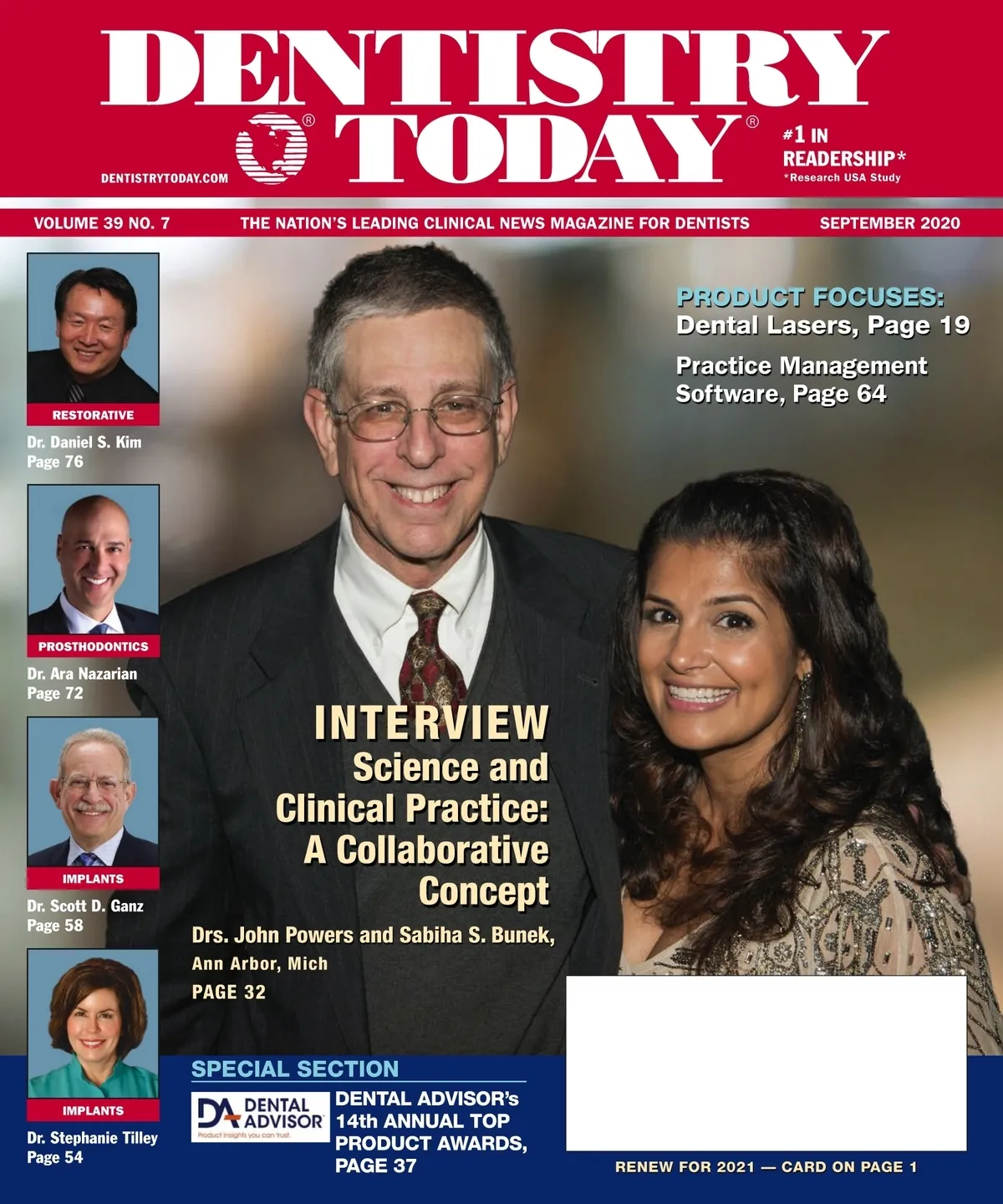
August 2020 · 84 pages
Dentistry Today — September 2020
Clinical articles, techniques, product news and continuing education for dentists. Read the full issue free in the digital edition.
Inside this issue
Excerpts from the issue. Open the digital edition to read any page in full.
- Page 6
The 'New Normal'? As we arrive into the beginning of autumn with this issue of Dentistry Today, the dental landscape certainly looks different. All of the big meetings, except for the Greater New York Dental Meeting (at the time of printing, have been rescheduled, canceled, or taken into a virtual format. Lectures have seen their in-person teaching calendar meet as an outlier. It is still not a smooth ride for the majority of dental health professionals who are continuing to adjust their practices in so many previously unforecast ways. Our academic colleagues, in the universities that are open, are moving…
- Page 8
What's Going on in Dental Schools? Background For the past 2 years, I have had the pleasure to travel around North America presenting endodontic courses. The majority of these courses have a hands-on component, and I thoroughly enjoy teaching endodontics to young dentists. However, there is a very noticeable trend that should be of great concern to the profession, and that is the apparent lack of clinical endodontic experience for many students while in dental school. Many young dentists I speak with have completed fewer than 5 clinical endodontic cases (while in dental school), and it is not unique to…
- Page 9
previous day. You save significant time and get much more from a hands-on session if you make the effort to attend the accompanying lecture. The second suggestion involves real teeth. If at all possible, try to bring sterilized, extracted, accessed teeth. Please check state regulations concerning this issue, but if you are in a location where you can bring extracted, sterilized teeth, they add much more value to the clinical experience. There are some good model teeth available, but there is nothing like a real tooth for learning a new endodontic technique. The third suggestion involves the simple advice of…
- Page 10
Working for Franchise Dentistry Michael W. Davis, DDS, elucidates matters related to working for franchise dentistry. Q: What exactly is franchise dentistry? A: A valid dental franchise must comply with federal and state statutes and deliver to potential franchisees specific disclosures required by law. A valid dental franchise must meet requirements under the Federal Trade Commission's (FTC's) Federal Franchise Rule. Further, any dental franchise must comport with the FTC's May 2008 Franchise Rule Compliance Guide. This extensive document goes into broad depth relating to company structure, protections, and disclosures for franchise buyers. If a doctor is dealing with a purported…
- Page 12
In the Air Tonight As I tell my patients, although we are creating a safe environment for them,...a lot of this is for our own safety. Paul Feuerstein, DMD Grounded. For about 20 years, I have spent time at least once a month sitting at Boston Logan International Airport or Manchester-boston Regional Airport in New Hampshire waiting to get on an airplane and go off to a dental conference. Armed with a battery of meetings to see the latest and greatest new dental technologies or teach groups about making intelligent purchase decisions related to my findings, I spent my non-clinical…
- Page 14
Laser Utilizes Exclusive Laser-Beam Delivery System BOTHELL, Wash.—The CO2 laser is the only practical soft tissue surgical laser that uses a focused laser beam directly to efficiently cut and coagulate soft tissue across all medical and dental surgical specialties. The American-made LightScalpel CO2 laser utilizes an exclusive laser-beam delivery system featuring proprietary rugged and highly flexible fiber waveguides. For added safety and convenience, the focused laser beam is spaced just 2 mm away from the tip of the handpiece, making an aiming beam not necessary while providing an exclusive, unobstructed view of the laser beam's impact on the tissue, such…
- Page 16
Steam Sterilizer's Unique Technology Allows for Safety and Reliability SAN JOSE, Calif.-The AG Neovo Healthcare Division introduced its newest addition, LouieR Series, to its dental healthcare line of products. This steam sterilizer is the first product of this series, which is named in honor of Louis Pasteur, the pioneer in the procedures of disinfection and sterilization in the 19th century, as a tribute to one of the greatest scientists. With its unique dynamic air-removal technology, it is designed to be safe, reliable, and easy to use. With time, temperature, and pressure being the most important elements when talking about accuracy…
- Page 17
TECHNOLOGY 17 Air Filtration Units Prevent Viruses From Spreading BROOKLYN, NY–According to CDC guidelines issued in June, dental professionals should consider the use of a portable HEPA air filtration unit while the patient is undergoing an aerosol generating procedure; as well as immediately following an aerosol-generating procedure, in addition to UV-C sterilization. SterAerosol provides industry-leading dental air filtration units designed to safely capture viruses like SARS-CoV-2, which causes COVID-19, and harmful aerosolized particles during and immediately following treatment. Now, and more importantly than ever, this extraoral suction effectively filters and circulates the air supply of a standard operatory in less…
- Page 18
Latest Version of Dentistry Solution Produces New Features WOBURN, Mass.-The ChairsideCAD 2.3 Matera from exocad America will have the widest range of indications for single-visit dentistry and the broadest selection of integrated open architecture devices. The software is intuitive and easy to learn, so users reliably deliver aesthetically demanding restorations in a single-patient session. ChairsideCAD (and modules) are integrated using exocad's proven and robust software platform successfully in use for more than 10 years. With ChairsideCAD 2.3 Matera, exocad intuitively expands single-visit capabilities. The new features are available with 2.3 Matera, including (1) Smile Creator for 2D/3D aesthetic planning, especially…
- Page 19
Dental Lasers NON-DIODE LASERS Millennium Dental Technologies The Perolase iPlus M:7 has the first and only scientifically proven FDA clearance for True Bone Regeneration with the LANAP protocol, which reverses moderate and severe periodontitis. It can regenerate bone around failing implants via the LANAP protocol. Maximize return on investment and patient satisfaction with a 6-month, money-back clinical results guarantee. The PerioLase performs more than 40 other clinical procedures. The technology includes a built-in power meter and Joule counter for calculating clinical algorithms for safety and efficacy. For more information, call (888) 49-LASER (495-2737) or visit the website lanap.com. FREEinfo, BIOLASE…
- Page 20
NON-DIODE LASERS than 80 countries. For more information, call toll-free at (866) 326-5674 or visit the website located at diamonddentalsupply.com. FREEinfo, Fotona From conservative dentistry, endodontics, and implantology to periodontics and soft-tissue surgery, LightWalker lasers offer one of the most comprehensive lists of clinical applications for dental lasers made today. Perfect for cosmetic dental procedures and with an optional aesthetic upgrade, the LightWalker AT/AT S model can even be used for facial skin treatments, such as wrinkle reduction. Typical treatment procedures with LightWalker are faster, easier to perform, and come with less pain and shorter healing times compared to conventional…
- Page 24
Root Caries Treatment Use of an All-Tissue Laser to Ensure Success INTRODUCTION Caries treatment at the cervical area of the tooth frequently requires some excision of gingival tissue to expose the decay, allowing for preparation of the tooth and then the placement of an adhesive restoration. The presence of cervical caries often presents with marginal inflammation that makes restoration placement challenging if there is hemorrhaging into the site during placement that leads to compromised bond strength and discoloration of the resin marginally. Various methods have been advocated for gingival modification, including dissection with a scalpel, electrosurgery, modification with a rotary…
- Page 25
thus, the Er:YAG laser selectively removes the affected dentin and leaves the unaffected dentin with an increased microhardness of residual caries affected dentin, changing its surface morphology and chemical composition.56 It has been reported that the Er:YAG laser influences the acid resistance of an irradiated substrate, providing control over the development of recurrent caries around composite resin restorations.57,131 The Er:YAG laser, when used for enamel surface preparation, produces irregular and indistinct morphologic changes that are different from those produced after acid etching.13 Thus, preconditioning with the laser was reported to significantly decrease microleakage of the enamel margins, reducing dye penetration…
- Page 26
Figure 9. The remaining decay was removed on the portion aspect of the excavation with the tip of the LiteTouch Er:YAG laser. Figure 10. The LiteTouch Er:YAG laser was set to Enamel Conditioning (under the Gentle setting) to condition the enamel margins. Figure 11. The LiteTouch Er:YAG laser tip was utilized to condition the enamel at the preparation margins in place of acid etching to improve bonding to this aspect of the preparation. the facial of the canine extended below the soft tissue; some gingiva would be excised to improve operative access to remove the carious tooth structure and place…
- Page 27
LASERS 27 The presence of cervical carries often presents with marginal inflammation.... ure 13). Next, a nanohybrid composite (Genial Sculpt [GC America]) was placed into the preparation to full contour and light cured for 20 seconds (Figure 14). Polishing was done using finishing carbide burs and diamonds (Henry Schein Dental) in a high-speed handpiece, along with water. The completed restoration can be seen in Figure 15. Note that, although the gingival edge presents with a raw cut, no active hemorrhaging was present. The patient returned 2 weeks later for initiation of the other planned dental treatment on teeth Nos. 5…
- Page 28
Solution Significantly Reduces Airborne and Surface Pathogens DALLAS–A healthcare product developer and distributor company specializing in commercializing real innovations with true impact, 2C MedTech, is partnering with CASPR Group to introduce CASPR's next-generation disinfection technology to dental offices across the globe. Previously only available to hospitals as an in-duct HVAC product, CASPR Medik is now available to dental offices as an HVAC solution, as well as a new, portable unit called CASPR Compact Medik. CASPR, which stands for Continuous Air and Surface Pathogen Reduction, was originally developed for hospitals to reduce the risk of healthcare-associated infections. Given the heightened awareness…
- Page 29
Whitening Kit Contains All Necessary Materials to Achieve Bright Smile NASHVILLE, Tenn.–SmileDirectClub's bright on premium teeth whitening kit contains everything needed to achieve a bright smile for 6 months. Its whitening pens contain the same enamel-safe whitening agent used by dentists for less than half the cost. Its pens are also 3 times faster to use than strips and are applied for just 5 minutes twice daily (data on file). The kit also includes a patented 20-LED accelerator light to boost the power of the whitening gel. The hands-free, portable light is powered by any smartphone (iPhone and Android), making…
- Page 31
Group of Products Helps Clinicians Adapt to New Normal Admira Fusion x-tra VOCO Futurabond U GrandSO Heavy Flow INDIAN LAND, SC—In order to help offices with the new normal, VOCO is highlighting products that can help reduce procedural steps, disinfection needs, and products in the operatory. These products enable dentists to do more with less and come in SingleDose packaging to reduce sanitation steps and increase efficiency. Futurabond U is VOCO's universal adhesive in a SingleDose blister pack to reduce disinfection needs. Admira Fusion x-tra is VOCO's nano-ORMOCER restorative in one universal shade to reduce procedure steps and is available…
- Page 32
Supporting Dentistry Into the Future With Integrity Since 1983, DENTAL ADVISOR has been serving the dental profession by researching and equipping their offices with scientific basis in mind and connecting data to clinical practice. DENTAL ADVISOR interacts with more than 300 dentists to gain insight on new and established dental products. Dentistry Today, which has collaborated with DENTAL ADVISOR for more than a decade to bring product information and evaluations to its readers, recently had the opportunity to speak with the co-owners of DENTAL ADVISOR, Dr. Sabiha S. Bunek, DDS, CEO and editor-in-chief, and Dr. John Powers, PhD, president, about…
- Page 36
Our goal is to identify any issues early on and work with the manufacturer.... work with manufacturers and their researchers to improve their products for the betterment of the industry, and ultimately, the patient. If you had to predict what will disrupt the industry in 2020+, what would you say it might be? JP: I believe digital dentistry will continue to shape the landscape. During the COVID-19 pandemic, we have seen 3-D printing companies charge toaccommodate shortages in PPE and testing equipment. We have seen typically innovative companies bring products back that were long ago introduced and revive them. Technology…
- Page 54
Trephine Removal of a Damaged Implant In some instances, an integrated dental implant will need to be removed and replaced. This can be the result of poor positioning, inadequate integration, periodontal issues, or functional forces. CASE REPORT An implant was placed in this patient and then in function for several years (Figure 1). The patient presented with the abutment and crown out of the mouth and epithelial overgrowth of the site. Radiographic evaluation indicated that the coronal portion of the implant had spread out, making stability of the abutment and crown no longer possible (Figure 2). The only treatment options…
- Page 56
Trephine Removal of a Damaged... continued from page 54 rpm at 25 Ncm of torque, and extensive external irrigation was done using sterile saline. Once the trephine extended about 80% from the apex of the implant body and was verified with a digital radiograph (Figure 5), the implant was easily luxated out of the socket, preserving the facial and lingual hard tissue (Figure 6). A radiograph was taken to verify the complete removal of the entire implant (Figure 7). Bone Grafting Principles, Materials, and Clinical Protocol Bone grafting is possible because bone has the ability to regenerate completely if provided…
- Page 58
Guided Applications for Partial Extraction Therapy INTRODUCTION Dental implants for replacing missing teeth have become an integral part of current conventional dentistry. Accepted protocols now include 2-stage delayed loading; one-stage delayed loading; immediate load-ing in a healed receptor site; the use of tilted implant placement; immediate loading in fresh extraction sites; and partial extraction therapy (PET), the socket shield technique (SST) or the root membrane (RM) concept. Technology has provided clinicians with enhanced tools for diagnosis and treatment planning, instrumentation for surgical intervention, improved implant surface treatments and thread design, improved abutment-to-implant connections, sophisticated dental laboratory software and CAD/CAM applications,…
- Page 60
Figure 4. The segmented root (white), with the buccal fragment (brown) within the sectioned maxillary surface model. Figure 5a. Virtual sectioning of the segmented root in Meshmixer (Autodesk) with a simulated custom implant to reach the root apex. Figure 5b. The apical position of the simulated Ankylos (Mega Gen) implant can then be positioned so as not to touch the root fragment while engaging in host bone for stability. Figure 6. Two 3-D printed templates designed on the digitized model (green): (a) one for the initial drill to section the tooth at the root apex, and (b) the second for…
- Page 61
IMPLANTS 61 Figure 14a. The CBCT cross-sectional image revealed a favorable pre-op condition for a PET procedure. Figure 14b. Using the Carestream 3D imaging software, a simulated implant (red outline) and abutment projection (yellow outline) was placed within the available bone to avoid the root fragment. Figure 15a. The base template was designed to seat firmly on the adjacent teeth, incorp-rating buccal and lingual hexagonal offsets to engage the different drill guide inserts. Figures 15b and 15c. Separate inserts were fabricated for the initial drill guide to reach the root apex to accommodate sectioning, followed by a second guide for…
- Page 62
Figure 24. (a) Depth control and rotational positioning were accurately confirmed with the "notch" indicator on the template corresponding with the insertion tool. (b) The occlusal view illustrates that the anti-rotational internal conical hex connection was positioned toward the facial. Figure 25. Using an implant-specific SmartPeg (Osstell), a baseline ISQ value of 76 was recorded, confirming sufficient initial stability to place an immediate restoration. Figure 26. (a) The prefabricated CAD/CAM abutment and transitional crown. (b) A postoperative periapical radiograph confirmed successful subcresral placement of this platform-switch design. (c) The abutment in place. (d) The soft issue contours were excellent, no…
- Page 63
Utilizing interactive treatment planning software makes it possible to plan the initial drill path.... of the implant (Figure 28a) with the definitive restoration located palatal to the root membrane, as outlined in yellow in Figure 28b. The final restoration was then delivered and exhibited excellent retention of the soft-tissue profile (Figure 29). The occlusal view revealed the cervical contours of the soft tissue (Figure 30a), and the lateral retracted view revealed excellent soft-tissue emergence profile and volume (Figure 30b). IN SUMMARY PET, RM, and socket shield concepts have gained popularity as these techniques have been refined and have proven efficacy…
- Page 64
Practice Management Software Henry Schein One Dentrix provides a comprehensive platform of integrated technology solutions. Dentrix makes it easier for dentists to manage their practices, facilitate the integration of new technology, connect revenue cycle management tools to accelerate payment collection, and grow their practices and profits through marketing campaigns that bring in new patients. Dentrix and Henry Schein One can partner with dentists by providing them with the integrated technology, the business knowledge, and a team of experts they need to solve real business problems and run a more profitable practice. For more information, call (800) DENTRIX (336-8749) or visit…
- Page 66
The Set Up: Endodontic Predictability Preparation When endodontics fails, it often fails before it even begins. In endodontics, technique isn't everything. Your endodontic preparation—I call it "The Set Up"—is just as important as technique for becoming a highly skilled endodontic clinician and optimizing your endodontic predictability. The Set Up is, in fact, the start for the successful endodontic thought process of being prepared for that which you are not prepared. In being prepared, there are 2 distinct areas that require unique skills. Introducing a different terminology, I will call them simply the "Think Box" and the "Play Box." The intent…
- Page 68
The Set Up: Endodontic Predictability continued from page 66 present: (1) vision (intended outcome), (2) structure (a plan to get there), (3) by when (deadline), and (4) measurable milestones along the roadmap (accountability). Endodontic predictability has the same 4 distinctions, and the Set Up sets this up. Beginning to follow our roadmap is the context for the next successful step. Context is decisive! The Think Box The Think Box is our brain, and this is the first essential part of the Set Up. The brain is made up of approximately 100 billion neurons. These nerve cells transmit electrochemical signals in…
- Page 69
Along your endodontic treatment journey, you will want to minimize the variables.... imagery in everything we do, whether we know it or not. It is the automatic pilot—the autonomic system working as its best. The trick is learning to recognize the made-up stories in our minds about the endodontic patient cases in front of us (during them into our consciousness) and then intentionally seeing the stories or outcomes that we want in our minds. Presto-magic! The outcomes we want and see become real. When this happens, we have applied our minds to produce intended outcomes. Now all we have to…
- Page 70
Figure 6. The dos and don'ts of rubber dam placement. (a) Pre-floss mesial and distal to the treatment tooth to be sure floss slides through easily and that there are no slices or sharp edges that could compromise the quality of the rubber dam seal. (b) Punch a hole in the rubber dam for the tooth to be treated that is slightly smaller than the tooth diameter (shown here on a very light posterior tooth). Place the hole halfway up or down, depending on if it's a maxillary or mandibular anterior tooth. (c) Do not leave a gap between the…
- Page 71
ENDODONTICS game with the rubber dam is security! The rubber dam should be punched so that the tooth punch hole is near the center of the rubber dam, allowing equal access from all angles. The rubber dam prevents the unintended swallowing of an instrument, acts as a manual file. The rubber dam also thoroughly seals the tooth from saliva leaking into the access and root canal system irrigants from leaking under the rubber dam and into the mouth. Rubber dam quality seems almost too basic to write about, but if proper attention is not given here, then our 1, 2,…
- Page 72
Offering Affordable Treatment Options In today's economy, we have seen dramatic changes in lifestyle, health, and income. Because of this, we have seen patients delay dental treatment until it finally becomes quite painful. Although patients may want full-mouth dental implant reconstructions with fixed restorations, this may not always be something that fits into their budgets. As dental providers, we need to offer our patients a variety of different treatment options in order to restore their dentition to proper form and function. This article focuses on the steps involved in providing denture and overdenture treatment, in addition to extractions, grafting, and…
- Page 74
Figure 15. A 3.75- × 13-mm Seven (MIS Implants Technologies) dental implant. Figure 16. Overdenture attachments were inserted, followed by graft material. Figure 17. Overdenture housings ready for pickup. Figure 18. Chairside hard denture reline material kit (Rebase II [Tokuyama Dental America]). Figure 19. Immediate postoperative retracted view. Figure 20. Retracted, post-op smile view. ridge at the approximate location of the mucobuccal junction. While the beak grasps the tooth, the bumper acts as the fulcrum, providing leverage and stability for the beak. Extraction is accomplished with slight wrist movement rotation in the buccal direction for about 30 to 60 seconds,…
- Page 75
PROSTHODONTICS 75 cess was to brush a thin coat of Rebase II adhesive (included in the Rebase II kit [Tokuyama Dental America]) into the area of the overdenture attachments. This is done to enhance the chemical retention between the denture base and the hard reline/pickup material. KY lubricant was then applied to the surrounding surfaces of the dentureto prevent unwanted adherence of excess material. Once the powder and liquid of the Rebase II material were mixed, the material was then placed into a plastic dispensing syringe and injected into the internal anterior portion All risks, benefits, and alternatives were fully…
- Page 76
Method for Ensuring Accurate Crown Preparations INTRODUCTION Ideally, crown preparations strike a careful balance between maximizing the preservation of natural tooth structure and creating adequate space for a strong and aesthetic restoration. Inaccurate preps can sacrifice this balance, jeopardizing the long-term viability of the restoration and the patient's oral health. On one hand, prepping too aggressively risks serious pulpal damage, whether from heat generation or exposure to bacteria due to the increased permeability of deeper dentin layers.¹ On the other hand, prepping too conservatively can lead to an embarrassing second impression at best or the fabrication of a thin and…
- Page 77
Clinical Protocol The old, damaged PFM crown was cut and removed, and the occlusal clearance on the existing abutment was checked using the 1.0-mm PrepSure instrument. Using the angled mesial and distal sides of the instrument, the tips were passed over the top of the abutment while the patient's jaw was closed. By gliding the tip over the cusps in this manner from buccal to lingual and back, the operator can immediately detect any spot on the abutment that has been inadequately prepared via a resistance against the tip's passage. Surprisingly, resistance was immediately detected between the abutment and the…