
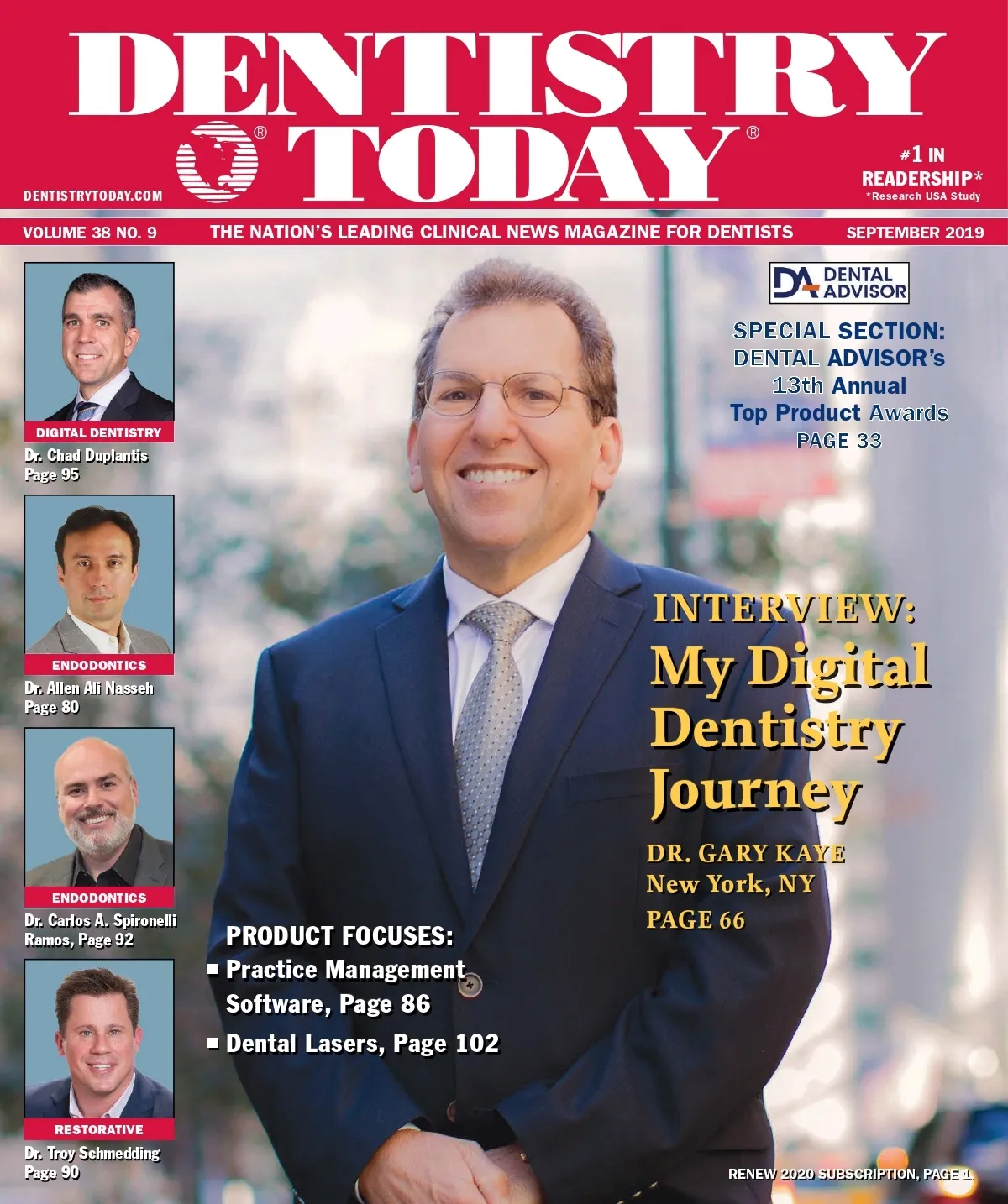
August 2019 · 112 pages
Dentistry Today — September 2019
Clinical articles, techniques, product news and continuing education for dentists. Read the full issue free in the digital edition.
Inside this issue
Excerpts from the issue. Open the digital edition to read any page in full.
- Page 8
Digital Dentistry in the Spotlight In this issue of Dentistry Today, we are featuring an interview with Dr. Gary Kaye, who, as a GP, has successfully implemented digital dentistry into his private practice in Manhattan. I first met Gary when we were both attending and lecturing at the Greater New York Dental Meeting a few years ago. I was immediately impressed by his passion and love for digital dentistry! We talked extensively about the new digital workflows revolutionizing how dentistry is practiced, and I invited him to share his experiences and expertise with our readers. He broke into an infectious…
- Page 10
Refine Wisely Avoiding Hidden Fees and Choosing the Right Refiner Can Help One Make an Extra 35% to 45% on Scrap Metal By eliminating hidden fees and charges, Scientific Metals can help dentists make up to an additional 35% return on their dental scrap. These 2 case studies explain how Dr. William Wong of West Allis, Wis, and Dr. Kelly Waggener of Santa Rosa, Calif, discovered the difference between companies. Refining Case 1: Dr. Wong Dr. Wong sent about 713 grams of dental scrap to a refining company that had exhibited at a recent trade show. After about a week,…
- Page 12
Fixing the Broken Dental Medicaid Program The dental Medicaid program is beyond requiring a tune-up. The dental Medicaid program is wallowing in full-blown failure mode. Dismal fee schedule rates have squeezed out most ethical and skilled clinicians, except those who provide care as a charity or community service. Government price fixing has failed miserably. Many providers on the list of managed care organizations (MCOs) read like a rogues' gallery within the dental profession. Patients and parents are not only frustrated by the troubling level of care they receive, but shortcuts in dental sedation have led to alarming rates of morbidity…
- Page 14
VIEWPOINT continued from page 12 involves generational excessive stainless steel crowns and pulpotomies (baby tooth root canals) on the maximal number of teeth. This may include teeth with minimal-to-no dental caries that readily exfoliate. Furthermore, treatments are frequently below standards of care. To achieve this self-serving objective, clinics demand maximal production from employee doctors through high-pressure production quotas. Children may be needlessly placed in "protective stabilization," achieving maximal dollar production, at the expense of a child's best lacks the intellect or ability to watch over their money is a myth perpetuated by those profiting from the current rampant dental Medicaid…
- Page 16
FOCUS ON CE for the Dental Professional Ronald E. Goldstein, DDS, discusses the different mediums being used for postgraduate education in the profession. Q: Dr. Goldstein, you have been mentoring and educating dentists for more than 60 years. What has been the most dramatic change you've seen? A: Video, video, and more video! In the 50s, if you wanted to learn the intricacies of how to do a cosmetic dental procedure, you would have to either visit a leading clinician's dental office or attend one of the courses he or she was giving. Although those options still exist, "over-the-shoulder" videos,…
- Page 18
Designed for the Way Dentists Work The Invisalign Go System Provides a Simple, Digital Way To Give Patients the Smiles They Desire Figure 1. Use the Invisalign Go digital visualization tools for the flexibility and guidance needed to treat more patients successfully. Figure 2. Many clear aligner systems use off-the-shelf plastics, but only the Invisalign Go system uses SmartTrack material, a proprietary material designed for the sole purpose of moving teeth. Giving patients the opportunity to benefit from Invisalign treatment has never been easier. Thanks to the simplicity of Align Technology's Invisalign Go system, Dr. Betsy Bakeman, DDS, is treating…
- Page 20
Laser-Assisted Techniques Increase Efficiency and Comfort Jeffrey P. Cranska, DDS INTRODUCTION Patient emergency calls add a lot of stress for the doctor and team in any otherwise well scheduled workday. One day, I had an emergency patient present with a non-restorable fractured upper premolar. The tooth was an abutment for an existing 4 unit solid zirconia resin cemented fixed bridge. The patient asked, "How can I keep this tooth replaced?" I told the patient that there were 3 options using the new materials that have been developed over the past decade: implants, fixed bridges, and removable partial dentures. The best…
- Page 22
TECHNOLOGY FIGURE 2. Teeth after crown removal using the laser. FIGURE 3. Extraction of tooth No. 5 with removal of the bridgework, retained in the prosthesis. FIGURE 4. Bridge prepped for reinsertion. FIGURE 5. Following the extraction and laser-induced hemostasis. Laser-Assisted Techniques... continued from page 20 conia bridge was remade 3 years ago, double abutting the anterior teeth to support tooth No. 5. The remade bridge had been placed using a resin cement. The only treatment option was now extraction, followed by replacing the fixed 4-unit bridge or performing additional sinus lift surgery for single tooth implants at the Nos.…
- Page 24
Your Restoration Workflow, Simplified to One Shade Mark Kleve, DDS Tokuyama Dental America continues to develop innovative products that fulfill the needs of the dental professional. The recently introduced OMNICHROMA composite (Tokuyama Dental America), with its universal, color-matching capability and excellent mechanical properties continues this trajectory. Because composite restorations are the most widely placed restorations in the dental practice today, a product that enhances efficiency and predictability is paramount. OMNICHROMA satisfies 2 elements that establish it as a potential leader in the composite marketplace: ease of use and predictability of placement. Most dental professionals continue to seek products that make…
- Page 26
Spotlight Loupes Provide Crisp, Clear Images Across Entire Viewing Field LOMPOC, Calif.–DenMat's PeriOptix loupes are custom built to exact specifications, eliminating eyestrain and providing ultimate clarity, with a crisp and clear image across the entire viewing field. The loupes are available in 2.5x, 2.7x, 3.1x, and 4.0x magnifications for all optical needs. Frame options feature a 2-position, adjustable nosepiece and 3-position adjustable arms to customize the declination angle, improve ergonomics, maximize comfort, and reduce fatigue. PeriOptix highlights offer powerful, light-weight, cordless options that mount directly to the frame to improve visual acuity while working in the oral cavity. PeriOptix has…
- Page 28
Spotlight New Implant System Makes Treatment Faster Handpiece Offers Smooth, Consistent Cutting Feel for Comfortable Operation YORBA LINDA, Calif.–The goal for Nobel Biocare's N1 implant system is to make treatment faster, as well as more straightforward and predictable. To achieve this required challenging conventional techniques in implantology. Addressing some of the shortcomings of current protocols, N1 was designed from the ground up with biological principles and patient needs in mind. In collaboration with a group of international researchers and clinicians, Nobel Biocare is now bringing this long-anticipated new system to the market. It was created from more than 5 years…
- Page 30
Spotlight Service Program Designed To Make Handpiece Repairs Faster and Easier CHARLOTTE, NC-KaVo Kerr launched KaVo Care, which is a unique service program designed to make handpiece repairs faster and easier. It offers an online portal where customers will find flat fee pricing based on the device they wish to service. From there, they can submit and track the status of their repair orders. To expedite the process, KaVo has made investments to expand its repair facility in Charlotte, NC, so that most repairs will now be completed within 24 hours upon arrival. KaVo Care comprises certified KaVo specialists that…
- Page 32
Spotlight Versatile Composite Warming Device Maintains Traditional Feel of Delivery Gun RACINE, Wis—Vista Dental Products' Phasor is the first of its kind, using near-infrared technology to rapidly warm composite compules. With the touch of a button, Phasor is able to heat composite material to 150°F in less than one minute and sustain a constant temperature throughout the entire dental procedure. Materials remain highly sculptable, nonsticky, and easily shaped during manipulation. Unlike other devices, Phasor is not limited to a single brand of composite. This makes the device extremely versatile, not only in quick composite bulk fills but in aesthetic regions…
- Page 52
Achieving Dentin Conservation Through Modern Techniques and Instruments Figure (1a.) The HyFlex EDM 25/12 office opener, 10/.05 glidepath file, 20/.05 preparation file, and 25/.05 shaping file. The EDM 20./05 preparation file highlights the controlled memory property. Figure 2. Tooth No. 19 Dx: SIP/SAP Figure (3a.) Tooth No.19 "Dual-access" or "Truss" minimally invasive endo access design. (3b.) COLTENE Alpen Speedster Metal Cutter US No. 155SG and COLTENE Alpen diamond bur shape 856 for access prep. Marcus Johnson, DDS As endodontic techniques and practices continue to evolve and spawn new paradigms tending to clinical demands of creative dentin-conservation designs, we also see…
- Page 54
Spotlight 3-D System Offers Sleekness and Light Weight MIDDLEBURY, Conn.–Owandy Radiology's 3-D, wall-mounted panoramic digital radiography unit provides a perfect balance of price and performance. One of the unit's innovative features includes being sleek and lightweight at only 135 lbs. It can also be easily wall-mounted by one technician. I-Max 3D comes equipped with a cone beam flat panel, which delivers HD image quality. What's more, a built-in automatic Layers Integration technology ensures exceptional image quality and automatically selects the best images. For more information, call Owandy Radiology at (203) 745-9575, visit owandyus.com, or email sales@owandyus.com. FREEinfo, Full-Arch Guided Surgical…
- Page 56
Spotlight New Sleep Appliance Prevents Airway from Collapsing NEWPORT BEACH, Calif—Glidewell Laboratories' Oasys Hinge Appliance is Medicareand PDAC-cleared (Pricing, Data Analysis and Coding) under code E0486 to treat patients with mild to moderate obstructive sleep apnea. The appliance is the latest addition to the company's family of sleep therapy appliances, including Silent Nite, EMA, and TAP. The Oasys Hinge Appliance is designed to gently shift the lower jaw forward during sleep, which activates airway muscles and ligaments to prevent the airway from collapsing. The device is custom made for each patient for maximal comfort throughout the night. It's microadjustable (0.25-mm…
- Page 57
INNOVATIONS 57 Global Dental Manufacturing Company Comes to the United States CARLSBAD, Calif—FGM is coming to the US dental arena after it has successfully dominated global markets, with its presence in more than 100 countries. Now, the last frontier for FGM—a 25-year-old manufacturer that specializes in whitening, composites, bonding, cements, posts, and implants—is to tackle the largest dental market in the world. As a cosmetically oriented manufacturer, FGM has benefitted from providing the dental professional with the necessary tools to increase traffic flow by obtaining excellent results for his or her patients. This all comes from one of the most…
- Page 58
Spotlight Cleaning Solution Effectively Removes Organic Debris HEATH, Ohio—Enzyme Industries' Sani-Soak Ultra is a dual-purpose, anticorrosive enzymatic cleaner that can be used in an ultrasonic and as a wet evacuation cleaner. Offered in 2 scents, Lemongrass Lavender and Mint, it is highly concentrated, nontoxic, biodegradable, safe for the environment, and effective in removing organic debris while improving the life of instruments and burs. Multiple dispensing options are offered for ease of use and added convenience. For more information, call Enzyme Industries at (888) 236 9983 or visit enzyindustries.com. FREEinfo, sani-treet plus Enzymatic Cleaner ✓ Evacuation Cleaner ✓ Instrument Pre-Soak ✓…
- Page 60
Industry News Tokuyama Partners With Homeless Not Toothless to Provide Care Tokuyama Empowers, Tokuyama Dental America's corporate social responsibility program, is partnering with Homeless Not Toothless to make dental care more accessible to underserved children. The nonprofit is dedicated to providing free, quality dental care to veterans, homeless people, foster youth, low-income children, and underserved populations in Los Angeles. Since its inception 27 years ago, Homeless Not Toothless has treated more than 60,000 patients and provided more than $5 million in free care to those in need. It works with the Partnership for Los Angeles Schools, which is currently in…
- Page 62
Industry News Bone Loss... continued from page 60 continued from page 60 based on Align's volume-weighted average stock price during the term of the ASR transaction, less an agreed upon amount. The ASR transaction is expected to be completed approximately 3 months from July 30, 2019, and will be funded with Align's cash on hand. As of June 30, 2019, Align had about 79.3 million shares outstanding and $765.9 million in cash, cash equivalents, and short-term and long-term investments. Preat Opens New Headquarters Preat Corporation has opened a new headquarters in Santa Maria, Calif. Totaling 20,000 square feet, the new…
- Page 66
My Digital Dentistry Journey Damon Adams, DDS, editor-in-chief of Dentistry Today, speaks with Gary Kaye, DDS, MS, about how he got started in digital dentistry and briefly discusses, from Dr. Kaye's own experience, some key points related to building a successful digitally based practice. When did you start your involvement with digital dentistry? Dr. Kaye: I first started on my journey in digital dentistry in 2001, when I acquired a CEREC 3D chairside CAD/CAM system (DentsplySirona) for my office. What originally sparked your interest in technology and, specifically, digital dentistry? Dr. Kaye: Prior to attending dental school, I had spent…
- Page 68
My Digital Dentistry Journey continued from page 66 has advanced to the point that a full arch can now be scanned in about 1 to 2 minutes. In addition, the capture of the patient's occlusion—the bite record—can be done very efficiently and with great precision. Next, there have been exciting advances in dental materials. The earlier all-ceramics, while useful in the development of CAD/CAM, lacked the appropriate properties for widespread use. It took some time, but now there are many options to choose from, including the highly touted lithium disilicate and zirconia materials. As the years have passed, and these…
- Page 69
INTERVIEW 69 to be included in the development and growth of the practice. Were there any specific challenges that you found yourself confronting when adopting new technologies? If so, how did you get through them? Dr. Kaye: When I started, my goal was to do certain restorations in a single visit. I had to adapt the workflow to match that strategy. Appointments took longer, but there were fewer of them. Initially, I was the only one who could operate and maintain the equipment in my office. The efficiency that I gained from the technology was lost because I was doing…
- Page 74
Figure 4. (a) Implant receptor sites were identified, and virtual implants were positioned in the cross-sectional slices. (b) The diagnostic process visualized the buccal and palatal cortical plates and the quality of the intermediary bone. (c) An appropriate length and diameter implant was positioned within the remaining alveolus based upon the "Triangle of Bone" protocol. Figure 5. Anchor pins were carefully positioned to avoid adjacent vital structures and engage dense cortical bone, helping to gain bicortical stabilization when possible. They will often penetrate both buccal and lingual plates and avoid close proximity to implant receptor sites. Figure 6. (a) The…
- Page 76
Figure 12. (a) Rotary instrumentation (round and serrated tapered burs from Meisinger USA) was used to manage bone reduction and was required to provide (b) adequate restorative space as determined after careful evaluation of potential implant sites in relation to the desired prosthetic outcome. (c) The "carrier guide" (CG) fit passively into the Swiss locks to verify that the bone had been properly leveled. Figure 13. The R2Gate Guided Surgery Kit consists of a sequential series of drills to achieve full-template guidance in a keyless system. Figure 14. (a) The osteotomy drill guide was seated onto the FB secured by…
- Page 78
Full-Arch Implant Surgical and... continued from page 76 pressed area of bone can often be visualized through the residual ridge (Figure 12a). Full template guidance allows for the precise drilling of the implant osteotomies with or without the use of sleeves embedded within the surgical template or separate key inserts that match the drill diameters of the guided surgical kit that must be utilized. Innovative designs have allowed for the elimination of these separate components, simplifying the drilling protocol. The R2Gate Guided Surgery Kit consists of a sequential series of drills that match the diameter of either a resin surgical…
- Page 80
Preventative Endodontics The Art of Avoiding a Root Canal Allen Ali Nasseh, DDS, MMSc Anne Lauren Koch, DMD INTRODUCTION For years, Real World Endo has shared with the readers of Dentistry Today clinical techniques and protocols that we have developed and taught to deliver predictable root canal therapy. Our goal has always been to make an otherwise complex and complicated technique simple. In fact, in regard to techniques, our motto has been, "So sophisticated, it's simple." However, we realize that we need to teach our philosophy in concert with improved endodontic techniques. Included among these improved techniques are minimally invasive…
- Page 82
Preventative Endodontics continued from page 80 attempt at vital pulp therapy, we have to establish an accurate pulpal and apical diagnosis that is based on our clinical history and patient evaluation combined with pulp vitality tests and radiographic analysis. When the pulp of a tooth is diagnosed with reversible pulpitis, and it is not of specific strategic importance (eg, the abutment tooth for a long span bridge where long-term failure may have dire consequences), vital pulp therapy is a good choice instead of root canal therapy. If the pulp testing and history reveals a pulpal diagnosis of irreversible pulpitis, of…
- Page 84
Figure 6. A symptomatic, previously caries-controlled tooth was referred for root canal therapy with remaining decay. Upon clinical examination and radiographic assessment, there was a pulpal diagnosis of reversible pulpitis and an apical diagnosis of normal. Figure 7. The tooth was adequately isolated with a rubber dam, and the restorative material was removed. Figure 8. The remaining decay was removed completely using a sharp round bur at 40,000 rpm with adequate coolant spray and a light touch. Figure 9. All decay was removed without exposure. Figure 10. A thin layer of dentin separated the pulp from the cavity preparation, and…
- Page 85
ENDODONTICS diately. However, since the patient was to see her restorative dentist for a final restoration, the BC Liner was then used to fill the entire cavity in bulk (Figures 13 and 14), and, after allowing a few seconds for the self-etching material to work, the surface was light cured for a few short seconds with a low-power light source (Figure 15). The rest of the material was allowed to self set within the next 3 minutes. The rubber dam was removed, and the occlusion was adjusted (Figure 16). The final radiograph shows the more radiopaque pure bioceramicunder the bulk-filled…
- Page 86
Practice Management Software MacPractice Celebrating 15 years, MacPractice DDS Gen 11 can be considered best-in-class practice management and clinical macOS-native software for dentists who want the freedom to use Macs, iPads, and iPhones. MacPractice's all-in-one design enhances workflow, simplifies tasks, and protects patient information from ransomware and other PC malware on desktops and the cloud (and eliminates most IT costs at the same time). MacPractice software received a highest user satisfaction rating of 92% for return on investment and clinical, business, and overall satisfaction. For more information, call (877) 250-8418 or visit macpractice.com/dds. FREEinfo, ACE Dental Software ACE Dental software…
- Page 88
PRACTICE MANAGEMENT SOFTWARE continued from page 86 tooth charting of existing conditions with 3-D, movable teeth; (2) automatic text messaging and emailing; (3) mobile apps; (4) kiosk patient entry for paperless processing; (5) multi-page scanning; (6) eClaims with digital attachments; (7) scheduling; (8) treatment planning with color charting; (10) billing; (11) patient statements; (12) recall; and (13) accounts receivable. For more information, call (800) 223-5433 or visit ezdoodental.com. FREEinfo, Curve Dental Founded in 2004, Curve Dental delivered the first cloud-based, enterprise-level practice management platform to the dental industry and continues to drive innovation in the dental software space today. More…
- Page 90
The Direct Bulk-Fill Restorative Option Trey Schmeding, DDS INTRODUCTION For a long period of time, direct posterior composite restorations have enabled clinicians to provide patients with minimally invasive and aesthetic restorations as an alternative to amalgam fillings. However, since the introduction of direct composites, clinicians have faced a variety of challenges associated with the placement of these materials in handling, wear, longevity, and aesthetics.¹ Direct posterior composite placement has typically required strict attention to one's individual operative techniques to ensure complete polymerization, great marginal seal, and no postoperative sensitivity. Due to their polymerization properties and limited depth of cure, light…
- Page 91
to achieve our optimal working environment. The preparation was completed using high-speed (4330 bur) and low-speed (#4 round bur) handpieces, making sure that any residual amalgam stains were removed. The prepared cavities were then demarcated using asectional matrix system (Mega V Ring System [Zest Dental Solutions]). Once the matrix system was in place, a ball burnisher was used in a buccal-lingual motion to ensure adequate contact would be obtained. A universal adhesive (Prelude One [Zest Dental Solutions]) was used for the bonding procedure. In conjunction with the bonding agent, it was decided to incorporate a selective etching technique (Figure 2).…
- Page 92
Mastering Irrigation in Endodontics Cleaning and Shaping, or Shaping to Clean? Carlos A. Spirandelli Ramos, DDS, MS, PhD INTRODUCTION Endodontic treatment is aimed at chemo-mechanically minimizing microorganisms, inactivating their by-products, and optimally sealing the canal space to prevent future recontamination. If root canals could be thoroughly cleaned using irrigation alone, and then effectively obturated, there would be no need for mechanical instrumentation.1 The initial cleaning of root canals is commonly performed by mechanical instrumentation, which removes the large bulk of the pulp tissue, the necrotic debris, and bacterial biofilms or a previous root filling. Unless the material is first removed,…
- Page 94
Mastering Irrigation in Endodontics continued from page 92 NaOCl With Surfactant NaOCl surface tension could affect the ability to penetrate the dentin and, thus, reduce antibacterial effectiveness within dentinal tubules. Surface active and wetting agents can be added to NaOCl to increase its penetration into dentin and inaccessible areas of root canals, improving its overall effect. Additionally, replacement and penetration in the main canal and isthuses is enhanced in mixtures with lowered surface tension agents. Moreover, as the surfactant is a detergent, it possesses emulsifying properties. These properties facilitate the removal of debris from the dentin surface by maintaining them…
- Page 95
Successful One-Appointment Monolithic Restoration Chad Daplantis, DDS Digital dentistry encompasses a wide world of conventional and new treatment options for clinicians and patients alike. With new tools—such as in-office milling systems and intraoral scanners—at our disposal, we have the ability to offer patients high-quality treatments in a fraction of the time compared to traditional methods. In many cases, this can be the key to a successful outcome for the patient. As digital techniques have become more widespread in the industry, clinicians are continually finding new cases that are ideally treated with the use of these advanced tools. The fact that…
- Page 96
Figure 3. The prep design includes drafted sides, smooth surfaces, a chamber margin placement for margin, and axial and occlusal reductions of 1.5 mm. Figure 4. Once the intraoral scan is completed, the iTero Element 2 Scanner (Align Technology) automatically transfers the data to the fastdesign.io Software (Glidewell Laboratories), which presents the clinician with an automated crown proposal based on the patient's anatomy. With Glidewell Laboratories, created with artificial intelligence algorithms, these automated proposals typically require little adjustment, but the clinician is free to revise the proposal as he or she sees fit. In this case, minor adjustments were made…
- Page 97
DIGITAL DENTISTRY a resin modified glass ionomer cement may be used. If the prep is not demed retentive, the use of a resin cement is advised to aid in a higher bond strength. Regardless, all chairside fabricated (intraoffice) zirconia restorations should be air abraded on their intaglio surfaces (25 to 50 μm aluminum oxide at 1.5 to 2 bar). (Note: For lab-fabricated restorations, this step is done in the dental lab prior to delivery to the dental office and need not be repeated at the chair.) The use of a universal primer such as Monobond Plus [Ivoclar Vivadent] or zirconia…
- Page 98
No-Preparation Porcelain Veneers Ross W. Nash, DDS Brent West CASE REPORT Diagnosis and Treatment Planning A young woman presented with the desire to improve her smile. Figure 1 shows her smile from the frontal view, and, in Figure 2, her smile can be seen from the right lateral view. The retracted facial view with the patient in centric occlusion is shown in Figure 3. The occlusal view of the maxillary arch is illustrated in Figure 4, and the mandibular occlusal view can be seen in Figure 5. Her dental health was excellent, with no dental caries or periodontal disease. Except…
And 5 more pages — read the whole issue.