
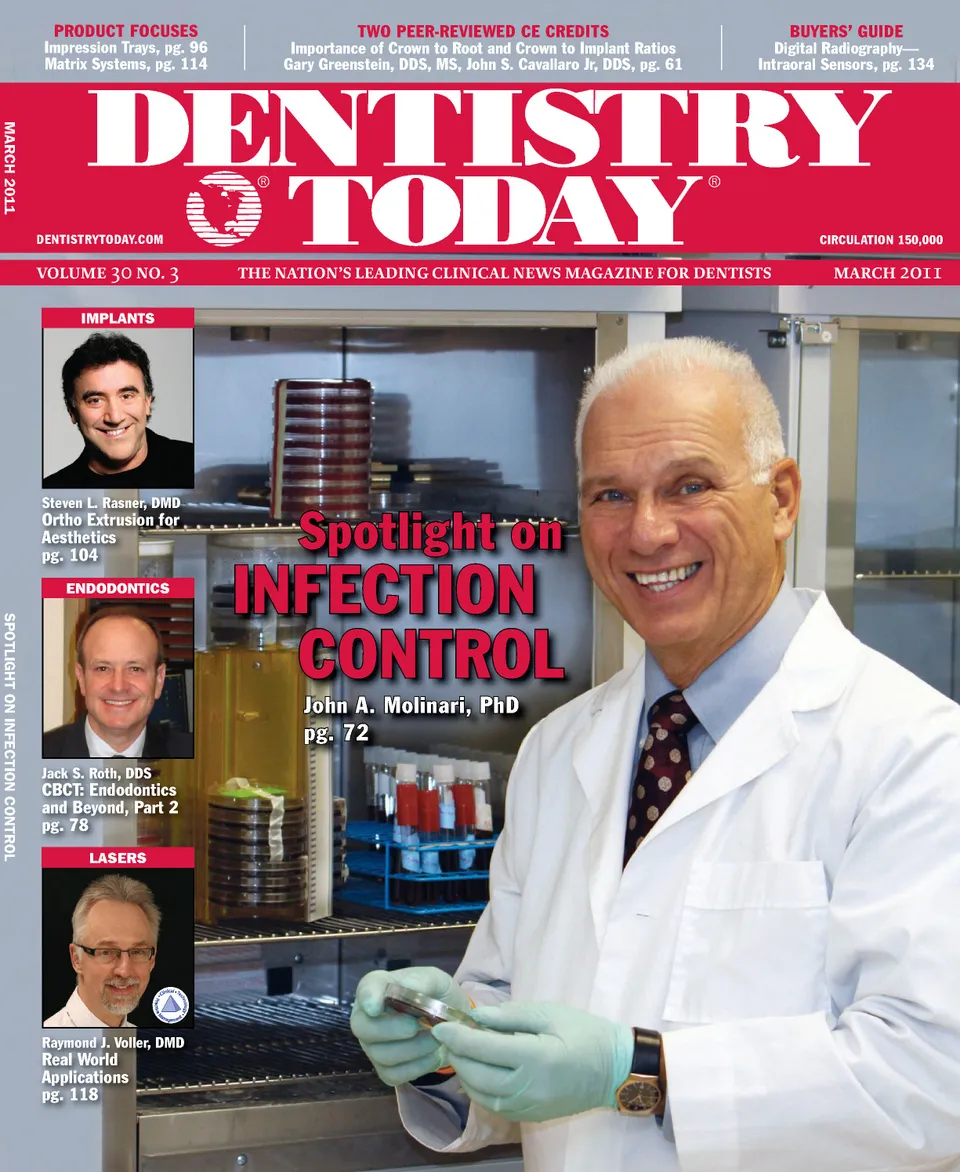
March 2011 · 156 pages
Dentistry Today — March 2011
Clinical articles, techniques, product news and continuing education for dentists. Read the full issue free in the digital edition.
Inside this issue
Excerpts from the issue. Open the digital edition to read any page in full.
- Page 12
Turning the Corner It has been one heck of winter, and anyone who has had to travel extensively due to work requirements (just think of our lecturers and dental meeting exhibitors, for example) knows exactly how challenging it has been! The eager anticipation for spring with warmer weather has been palpable on the minds of many of us, especially where winter has left its bitter cold sting. One is left to wonder, "When we will turn the corner?" In recent years, the profession has seen new and exciting developments in dental materials that have helped many clinicians "turn the corner"…
- Page 14
VIEWPOINT ALARA and Radiation in the Dental Office: Current State of Affairs On November 23, 2010, a story on the front page of the New York Times—"Radiation Worries for Children in the Dentists' Chairs"—created a potential public relations nightmare for the dental community. More importantly, it should serve as a reality check and a wakeup call for the dental profession to examine the use of the different radiation modalities for diagnosis in dentistry. This rightfully deserves a national response from the dental profession. Such an analysis, review, and response should focus not only on the use of cone beam computed…
- Page 16
continued from page 14 Association of Endodontists and the American Academy of Oral and Maxillofacial Radiology. Oral Surg Oral Med Oral Pathol Oral Radiol Endod. 2011 Feb 11(2):234-237. The AOMR is currently working with the American Association of Orthodontists to develop similar use guidelines on imaging for orthodontists. CBCT scans, like all of our radiographic options, are very useful for diagnostic and treatment planning purposes and certainly lead to improved patient treatment outcomes—there is no disputing this fact. The challenge is using CBCT and all radiographic acquisition only in the correct situations and judiciously with appropriate selection criteria and patient…
- Page 18
continued from page 16 A second way to significantly reduce radiation to all of our patients is by utilizing a digital panoramic generator. The benefits of going digital have the same dosage reduction effects for the panoramic radiographs taken in dental offices (Table 1). Digital panoramic images can expose the dental patient to as little as one third of the dose of a film-based image, as long as the practitioner uses appropriate settings. The greater question to consider is: if a panoramic image and bite-wings, and even a few periapicals (I teach this as the Pan Plus Series) would provide…
- Page 20
Dentistry Today.com Providing you with news and information from the industry leader in clinical content. New Site Features & Content! NEW WEB SITE FEATURES www. Dentistry Today Conducts a Blog From the Chicago Midwinter Meeting Chicago Dental Society 146th Midwinter Meeting Dentistry Today's blog conducted at the Chicago Midwinter Meeting highlighted many new products, including those by DENTSPLY Caulk, which sponsored the blog. The blog comprised text, images, and in most cases, a video demonstrating each product's capabilities. The goal of the blog was to offer dentists who could not attend the meeting an opportunity to watch highlights from Chicago.…
- Page 22
From the December 2010 Issue AT-HOME WHITENING SYSTEM Ultradent Products Opalescence features a carbamide peroxide formula for superior tooth whitening. The sticky and viscous consistency prevents the gel from leaking when placed. Opalescence is combined with potassium nitrate and fluoride for patients with sensitivity. The PF formula also benefits patients in improving enamel microhardness and improving overall enamel health. It meets all whitening needs. For more information, call (800) 552-5212. FREEinfo, SELF-ETCH ADHESIVE VOCO America The Futurabond M all-in-one self-etch adhesive ensures high bond strengths on dentin and enamel and, thanks to its nanotechnology, it achieves the highest level of…
- Page 24
NEW PRODUCTS BITE REGISTRATION MATERIAL Danville Materials Affordably priced, AlphaBite is a bite registration material made with the highest quality fillers and silicones. Nonsticky, stable, light, and accurate, it has a working time 30 seconds and a total set time 90 seconds. It is offered in a shy blue color in 50-mL cartridges in 2-pack and 4-pack configurations. For more information, call (800) 827-7940. FREEinfo, FLOWABLE COMPOSITE GC America G-genial Universal Flo is a nanohybrid, light-cured flowable (low-flow) that performs like a conventional composite. Tests have shown it has better strength, wear resistance, and gloss retention than leading flowable and…
- Page 26
To assist practitioners in their selection of essential dental products, Dentistry Today presents items reviewed by THE DENTAL ADVISOR'S staff of editors and consultants. Established in 1984, THE DENTAL ADVISOR, based in Ann Arbor, Mich, has provided dental professionals worldwide with objective, accurate information using in vivo and in vitro results on the performance of materials and equipment based on clinical and laboratory research. For more information, visit dentaladvisor.com or call (800) 347-1330. Accolade SRO ++++1/2 Danyville Materials | (800) 827-7940 | danvillematerials.com Consultants' Comments • "High radiopacity of a flowable is a very helpful characteristic." • "Adapts well to…
- Page 28
Mojo Veneer Cement +++++ Pentron Clinical Technologies | (800) 551-0283 | pentron.com Consultants' Comments • "The try in gels were excellent. The offset an accurate preview of the final color and also cleaned up very easily." • "I loved the viscosity—it was thick enough to prevent floating of the veneer but thin enough to not affect the seating in a negative way." • "I would definitely like more shades than try to mix them together." • "The labels on the try in pastes and the cements should have a more distinct differentiation. Labeling of shades is hard to read." Description…
- Page 29
Mojo™ Cement shifts confidence, NOT SHADE! Introducing Mojo™ Veneer Cement – the cement that leaves shade shift behind and helps you create a seamless, natural looking smile. Give your patients back the self-confidence they deserve! Mojo is the ideal cement because of two important features 1) try-in gels that match the polymerized cement and 2) no detectable shade shift. Average ΔE Between Try-in Gel and Cured Cement Duration = 7 days [CHART showing comparison data across different cement types: Mojo™, RelyX™ Veneer, Variolink™ Veneer, Choice™ 2, Calibra™, da Vinci™ - with Mojo showing approximately 4 on the scale, and Choice™…
- Page 30
Spotlight Endodontic Irrigation System's Safety, Improved Functionality, and Reduced Price Cited CULVER CITY, Calif Peer reviewed research continues to show that Discus Dental's EndoVac is 100% safe, provides 100% bacterial kill, and leads to less postoperative pain when compared to other endodontic irrigation systems (data on file). Rather than using traditional methods, EndoVac uses a pair of patented cannulas to draw irrigant all the way to the working length and then evacuate it into the Hi Vac suction unit. With zero chance of apical extrusion coupled with 100% antimicrobial efficacy, EndoVac can provide quicker relief and faster healing for your…
- Page 33
Imaging Software's New Features Reflect Input From Users ELMSFORD, NY- Many of the features of ImageWorks' newly released EVAsoft 3.0, which functions as the driving software behind the popular EVA Digital X Ray Sensor, come directly from user input. For example, the EVAsoft filmstrip can be now be opened in a separate window that remains on top of all other windows, allowing users to view an entire series of x rays simultaneously while making notes in a chart in any practice software or while writing emails, offering them the opportunity for greater accuracy and better diagnostics. With a few camera…
- Page 34
Spotlight Clinically Proven Composite Now Offers Natural Shade Blend and Extended Working Time AMHERST, NY - Ivoclar Vivadent's new and improved Tetric EvoCeram, a clinically proven nano-optimized composite, features improvements such as extended working time under ambient light combined with faster curing times, new shades with enhanced shade matching qualities, and improved handling properties. As a result, Tetric EvoCeram re duces the application time necessary for completing direct composite restorations. Tetric EvoCeram resolves many issues dentists typically encounter with conventional composite materials, including their tendency to polymerize before restorations are fully contoured. A special additive incorporated into the photo-initiator system…
- Page 36
Ultra-Flowable Restorative's Versatility and Aesthetics Cited ST. PAUL, Minn—3M ESPE continues to expand its Filtek Supreme line of restorative options with the introduction of Filtek Supreme Ultra Flowable Restorative, a flowable companion to the recently introduced Filtek Supreme Ultra Universal Restorative. Indicated for 6 uses, Filtek Supreme Ultra Flowable is a versatile and efficient solution for the multiple restorative situations dentists encounter every day. Whether dentists use it flowable by itself or with a composite material, it brings simplicity and great performance to any of its multiple indications. A user-friendly feature of Filtek Supreme Ultra Flowable is its flow-on-demand handling—becoming…
- Page 40
Three-Dimensionally Shaped Dental Wedge Follows Contour of the Tooth BRIARCLIFF MANOR, NY— Offered by VOCO America, the Contour Dental Wedge is 3-dimensionally shaped to follow the contour of the tooth. Other wedges bend only 4-dimensionally. Easy to insert and remove with cotton pliers, it creates significantly less tissue irritation and postoperative discomfort, and it helps to adapt the matrix band more precisely for faster finishing of the restoration by achieving more accurate interproximal contacts and less chance for overhangs. The wedge comes in 3 sizes (small, medium, and large) in clockwise and counter clockwise designs. For critical marginal adaptation, a…
- Page 42
New Feature-Laden Glass Ionomer Temporary Cement Introduced ALSIP, Ill- GC America introduces GC Fuji TEMP LT, a first-of-its-kind conventional glass ionomer temporary cement indicated for the provisional cementation of all ceramic and resin and metal based crowns and bridges as well as implant abutments. GC Fuji TEMP LT offers the following features and benefits: excellent handling without runny consistency; easy removal of excess cement; low film thickness for an accurate fit; excellent minimal occasion (to help prevent vent sensitivity); excellent biocompatibility; fluoride release and recharge; high bond strength and appropriate physical properties for cases where high retention is needed (both…
- Page 43
Condensers Facilitate Dense Gutta-Percha Fill, Even in Complex Anatomy BALA CYNWYD, Pa Vertical compaction of warm gutta percha as described in warm vertical obturation techniques and the Buchanan Continuous Wave technique relies on pre cision instruments to achieve the desired 3 dimensional fill, and the new BL Condensers have been designed with these techniques in mind—to effect a dense fill, even in complex anatomy. The double ended pluggers feature a 0.04 taper Ni Ti end for condensation in the apical third, with the opposite end being a stainless steel rigid plugger, double the size of the Ni Ti end for…
- Page 44
Minimally Invasive Sinus Lift Instrumentation Kits Offered CARLSBAD, Calif. Zimmer Dental announces the availability of the Sinus Crestal Approach Kit and Sinus Lateral Approach Kit for minimally invasive and streamlined sinus lift procedures. The Sinus Lateral Approach Kit offers a complete solution for accessing the sinus via opening the lateral wall, which results in minimal flap size and a smaller window than conventional techniques. The kit's reamers can be used with a standard surgical motor handpiece (2,000 rpm) for an expedient osteotomy. The tapered trunk on the kit's LS reamer is designed to control drilling depth up to 3.5 mm…
- Page 46
NEWS/TRENDS Industry News 3M ESPE Named Most Innovative Company in Dentistry For the sixth year in a row, 3M ESPE ranks as the most innovative company in the worldwide dental industry, according to the 2010 Dental Industry Review conducted by The Anaheim Group, distributors of Dental Evo Weekly. Commenting on the announcement, Larry Lair, division vice president and general manager, 3M ESPE, said, "There are many stories in this company of technology cross-pollination that has led to breakthrough innovations that really make a difference for our customers. Every day we are working to leverage the resources of the total company…
- Page 48
NEWS/TRENDS NYUCD Smigel Prize Winner Announced Dr. Seok Kyun Kim, founder and president of the Korean Academy of Aesthetic Dentistry, has received the 2010 New York University College of Dentistry (NYUCD) Irwin Smigel Prize in Aesthetic Dentistry. Internationally renowned as one of the all time great teachers and researchers in aesthetic dentistry, Dr. Kim has established more than 50 aesthetic dentistry centers in South Korea and has advanced the status of aesthetic dentistry among Korean dentists and through the Korean public through thousands of hours of continuing education courses and media presentations. The prize was presented to Dr. Kim at…
- Page 50
Effects of Xylitol on Mutans Streptococci A study investigated the effects of xylitol on mutans streptococci in an in vitro 6 species oral biofilm model. Each biofilm contained one of the following: a laboratory reference strain, a fresh isolate, a xylitol-sensitive, a xylitol resistant strain of mutans streptococci or Streptococcus sobrinus. The biofilms were grown on hydroxyapatite discs which were pellicle-coated, and were fed with a medium supplemented with glucose/sucrose medium 5 times per day for 23 minutes; between feedings, the biofilms were incubated in saliva. Before after feeding, biofilms were exposed to either 7.5% xylitol, 7.5% sorbitol or the…
- Page 52
Asthmatic Youth Have a Greater Caries Risk Children and adolescents with asthma tend to suffer more often from caries and gingivitis than people of similar age without asthma, concluded Ms. Melin Stensson in her thesis presented at the Sahlgrenska Academy. The study had examined people in the age groups of 3, 5 to 10, 16, and 18 to 24 years, with and without asthma. "Children with asthma had a greater tendency to breathe through the mouth, resulting in dry mouth, and were often given sugary beverages. This may have contributed to their developing higher caries prevalence," explained Ms. Stensson, a…
- Page 53
Blood Vessels For Lab-Grown Tissues Researchers from Rice University and Baylor College of Medicine (BCM) have broken one of the major roadblocks on the path to growing transplantable tissue in the lab: they have found a way to grow the blood vessels and capillaries needed to keep tissues alive. The new research is available online and in the January 2011 issue of the journal Acta Biomaterialia, and was supported by the National Science Foundation and the NIH. "The inability to grow blood-vessel networks — or vasculature — in lab-grown tissues is the leading problem in regenerative medicine today," said lead…
- Page 54
In First Impressions, George Freedman, DDS, gives readers a brief summary of products that have recently been introduced to dentistry, based on his clinical experience. Luxatemp Ultra DMG America Indirect dental procedures imply that a laboratory fabrication interval is part of the treatment process. Patients, particularly those who are undergoing aesthetic procedures, will not accept a compromised smile or functionality this during this over 1 to 2 week interval. Fortunately, the profession has had chairside fabricated provisional restorative materials for the better part of a century. Luxatemp Ultra has been the benchmark for aesthetic provisional materials for many years. Now…
- Page 56
DirectDia Paste Shofu Dental Enamel presents a naturally polished surface in the mouth. This smooth and lustrous external facade of the teeth makes it difficult for plaque and bacteria to adhere, promoting long-term dental health. Damaged and decayed teeth must be returned to the same exterior condition as must indirect restorations. Shofu Dental has recently introduced DirectDia Paste, a diamond impregnated polishing paste that can be used both intra and extraorally to achieve a high-luster polish on direct restorations and natural tooth surfaces. DirectDia Paste is a 20% diamond polishing paste that uses synthetic diamond powder as an abrasive grain.…
- Page 58
Transforming a Patient's Life in Two Appointments With Snap-On Smile Barry Freyglberg, DDS As a dentist, there is nothing sadder than a patient who is too ashamed to smile because of his or her teeth. We all see it, and I know that in many cases patients are not prepared to take the steps necessary to change the situation. From financial considerations to disinterest in the time it can take to complete a full mouth restoration, just living with this situation is the path often chosen. I've found myself frustrated at not being able to help in these cases, and…
- Page 61
dentalCEToday.com RESTORATIVE 61 Test 135 Importance of Crown to Root and Crown to Implant Ratios Historically, crown to root ratios (CRRs) of teeth were used as a parameter to help decide if teeth should be restored with or without splitting to adjacent teeth or employed as abutments in dental prostheses. However, guidelines were based upon empiricism rather than scientific data. This resulted in teeth being extracted that could have been retained. With respect to dental implants, the desire to reduce crown to root ratios (CIRs) could result in an area being unnecessarily bone augmented to provide additional support for a…
- Page 62
RESTORATIVE ening or ridge reduction to make room for an implant abutment increase the CRR.6 After assessing the literature, Grossmann and Sadan6 concluded that no definitive recommendations could be established for an optimal CRR concerning teeth. To compensate for increased forces on prostheses due to increased CRRs, clinicians have splinted teeth together.10 This may shift the center of rotation and transmit less horizontal forces to individual abutments or alter the response to the applied forces.11,12 However, no objective criteria exist to determine the need or extent of splinting to assage the effect of an increased CRR.13 Dental Implants A consensus…
- Page 64
Importance of Crown to Root... continued from page 62 In addition, they reported that the survival rate of prostheses with a CIR of more than 2 was 94.1%.³ Three other studies contained data with respect to CIRs when implants were used to support short scant cantilevered bridges.²⁴-²⁶ The reported CIRs, the percentage of implant survival after 5 years, the number of assessed implants for each study, and the mean or range of implant sizes are listed in Table 1. Elevated CIRs on abutments for cantilevered bridges associated with successful prostheses further support the concept that implant restorations can successfully tolerate…
- Page 68
Table 3. Studies Dedicated to Assessing Survival Rates of Short Dental Implants^a Study | n | No. of implants | Length | Type | Surface | Survival Rate | Time ---|---|---|---|---|---|---|--- Argon, et al^56 | 293 | 532 | 7 to 9.5 mm | BTI | rough | 99.2% | 3-1 months Arlin, et al^56 | not reported not reported | 35 141 | 6 mm 8 mm | ITI | rough | 94.3% 99.3% | 2 years Fugazzotto^33 | 1,774 | 2,073 | 6 to 9 mm | ITI | rough | 98.4% | 36.2 months Gapski, et al^52…
- Page 71
Test 135 Expiration date of this CE article is March 1, 2015 To submit Continuing Education answers, use the answer sheet on page 60. Circle the letter corresponding to the answer you believe is correct, detach the answer sheet from the magazine, and mail to Dentistry Today Department of Continuing Education or use our online option at dentalcetody.com. This article is available for 2 hours of CE credit. The following 16 questions were derived from the article "Importance of Crown to Root and Crown to Implant Ratios by Gary Glassman, DDS, MS, and John S. Cavallaro Jr, DDS on pages…
- Page 72
Spotlight on Infection Control— That Thing You Do! Dental healthcare professionals historically have been able to meet numerous infection control challenges, ranging from the threats of bloodborne infections like hepatitis B and AIDS to the re-emergence of tuberculosis. Numerous effective options are available in the marketplace to address and accomplish infection control goals. It is not unusual for dentists, hygienists, assistants, and laboratory technicians to occasionally feel overwhelmed and possibly a bit confused when reading published guidelines and regulations, especially when we all want to be assured that what is being done is efficient and in compliance with professional standards.…
- Page 74
Spotlight on Infection Control... continued from page 72 Development of a new generation of autoclaves within the last 2 decades has added a new dimension to this heat sterilization modality. These autoclaves are classified as "Class B" sterilizers or "preand post-vacuum" steam sterilizers. The equipment is fitted with a pump that creates an initial vacuum in the chamber to ensure air is removed from the sterilizing chamber before steam enters. In contrast to a gravity displacement autoclave, this procedure allows faster and more thorough steam penetration throughout the entire load. The poststerilization vacuum cycle also is highly efficient because it…
- Page 76
Spotlight on Infection Control... continued from page 74 breaches in infection control. In just reviewing the past few years of possible incidents, multiple facilities have been investigated for failures associated with accepted infection control standards and instrument reprocessing protocols. Investigations also include a Veteran Affairs hospital dental clinics where the possible failure of clinic staff to comply with mandated infection control standards and protocols is under scrutiny. Allegations include improper use of gloves, burrs, and inro cedures involved in instrument clean ing and sterilization of instruments. From where do these and many of her possible patient exposures result? Accumulated evidence…
- Page 78
Technology: Endodontics and Beyond, Part 2 Jack S. Roth, DDS Figure 1a. No. 14 root canal therapy (RCT) completion 1. Figure 1b. Periapical pathology now evident. Figure 1c. Apicoectomy No. 14 MTA Retrofill. This is part 2 of a 2-part article series. Part 1 of Dr. Roth's article was published in the February 2011 issue of Dentistry Today and can be found in our archived articles at the Web site . Figure 1d. Recall radiograph. Figure 1e. Follow-up radiograph continuing to show evidence of healing. The entire spectrum of 3-dimensional (3-D) imaging has advanced dramatically in the past decade. More…
- Page 80
Technology... continued from page 78 nostic aides for more than a century. However, when critically analyzing its benefits, there are some glaring shortfalls. Many dentists believe that a radiograph is completely evidence based. Unfortunately, a radiograph is a 2-dimensional (2 D) image not dissimilar to a photograph. In a 2-D analysis, all images are open to interpretation and are subjective in nature. One can also question the accuracy and quality of the information that is being seen. More importantly, an image such as a dental radiograph may have incomplete information since it lacks the third dimension. The limitations of dental…
- Page 81
ENDODONTICS become crystal clear; 3-D imaging will: 1. Become a case specific resource of quality information not available by any other modality 2. Standardize decision making by verifying an evidence-based diagnostic protocol 3. Help eliminate operator subjectivity and restore balance and objectivity to dental care delivery 4. Bridge the gap in deciding between endodontics and implantology 5. Recreate an interdisciplinary dialogue amongst all dental professionals. As with all anecdotal information, the longer and more often it is repeated, the more firmly we hold onto it as fact. As an example, during the past 2 decades there has been a concerted…
- Page 82
ENDODONTICS mation. Three dimensional imaging can help in: • Differentiating odontogenic from nonodontogenic pathology • Determining accurate dental anatomy, verifying number of roots or anomalies • Differentiating resorptive defects and locating them anatomically to determine a prognosis • Visualizing iatrogenic defects • Diagnosing periapical pathology encased in cancellous bone that a 2D radiography cannot see. CASE EXAMPLES The following cases represent clear examples of information that can only be available by using 3 D CBCT imaging. Case 1 In Case No. 1, a patient presented with With present day CBCT imaging, cracks of clinical significance can be visualized.... an acute…
- Page 84
Fabricating Fiber-Reinforced Composite Posts The prosthetic treatment of seriously damaged, endodontically treated teeth often requires an endodontic post as an additional retention element for buildup with crown restoration. In addition to metal based posts and zirconia based ceramic posts, fiber reinforced composite posts have recently become the center of interest for dentists and science. In the past, it was commonly accepted, to some extent, that teeth would become brittle after root canal treatment with an increased risk of fracture. Historically, it was alleged that the strengthening effect of endodontic posts would compensate for any weaknesses caused by the endodontic treatment…
- Page 86
Fabricating Fiber-Reinforced... continued from page 84 Requirements of Endodontic Posts The fundamental requirements of endodontic posts include, among other things: high tensile strength, high fatigue resistance to occlusal and shear loading, and stress-free distribution of the forces affecting the tooth root, excellent accuracy of fit, biocompatibility, and electrochemical innocence. Also essential: Unnecessarily weakening the tooth root should be avoided by selecting a suitable post form (enhance? substantive loss should be avoided by selecting a suitable post form enhance?). For therapy of aesthetically challenging situations these days, all ceramic crowns and bridges fabricated from translucent ceramic are a wide ly used,…
And 34 more pages — read the whole issue.