
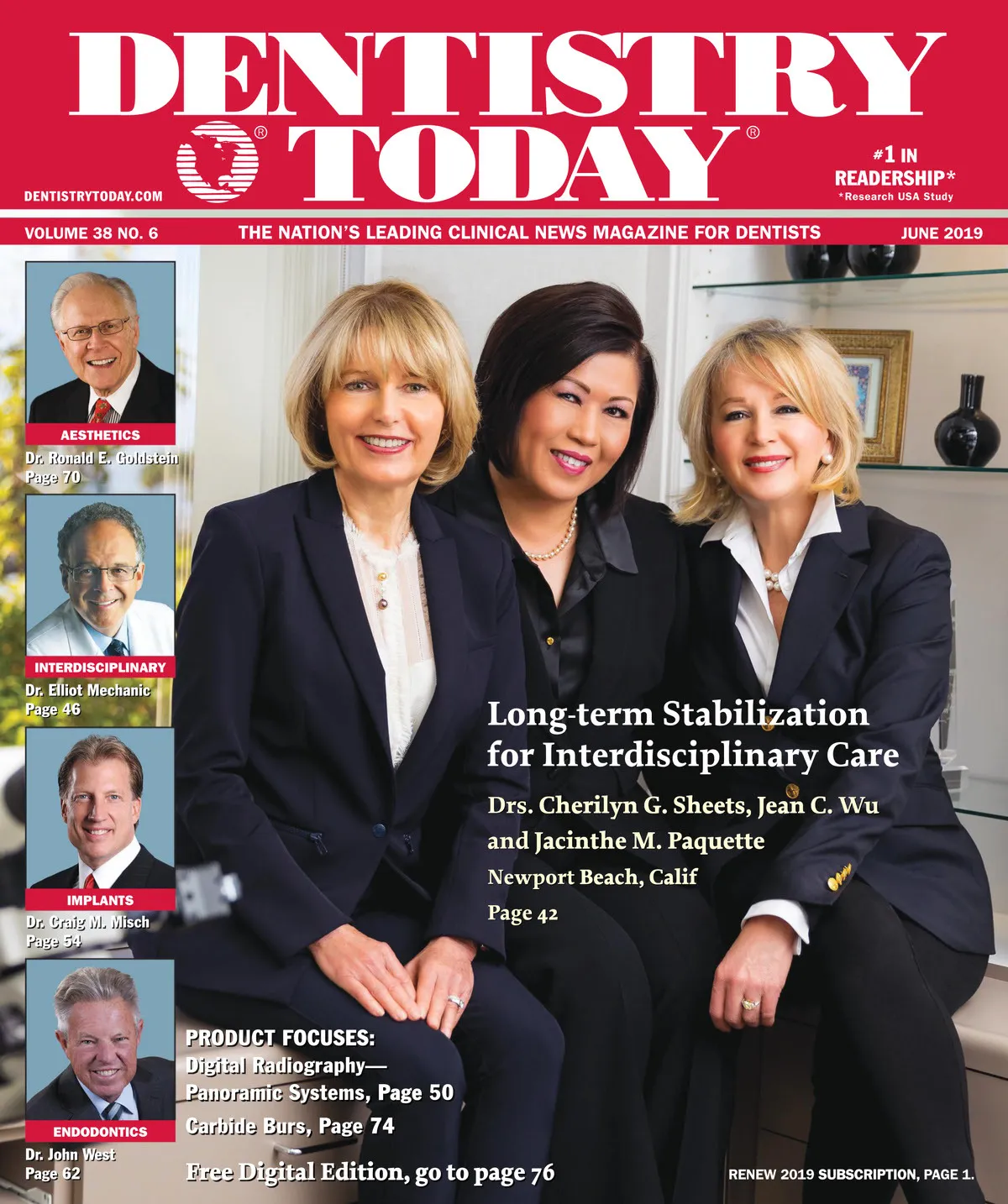
May 2019 · 88 pages
Dentistry Today — June 2019
Clinical articles, techniques, product news and continuing education for dentists. Read the full issue free in the digital edition.
Inside this issue
Excerpts from the issue. Open the digital edition to read any page in full.
- Page 5
The Best Time to Go Digital Is Right Now. Embrace digital dentistry with confidence. The iTero Element® scanner and Glidewell Laboratories are behind you. Why iTero®? iTero® scans have been used in more than 2.6 million restorative crown, bridge, and custom implant cases.* Winner of multiple awards for design, accuracy and performance. The iTero® modeling process ensures efficient lab submissions, minimizes scan retakes and enables consistent restorative outcomes. Why Glidewell? Glidewell Laboratories is No. 1 in producing restorations from digital impressions, processing more than any other U.S. lab. Full integration with the iTero Element® for a seamless digital workflow. Save…
- Page 8
Potpourri of Clinical Topics This month in Dentistry Today, we have put together a number of different clinically relevant topics for you to review and think about. Our featured cover article, written by Drs. Cherilyn Sheets, Jacinthe Paquette, and Jean Wu, is a case report that describes the treatment planning and treatment of a patient who presented with hypohidrotic ectodermal dysplasia (HED). The article showcases the use of a recently introduced and innovative composite dental material that was utilized for the long-term stabilization needed as a part of the clinical protocol involved in this complex interdisciplinary case. Also this month,…
- Page 10
Keeping Overhead in Check With Lean Dentistry You have likely often heard it said by fictional CEOs sitting in fictional boardrooms within glitzy, big budget movies: "In order to make money, you have to spend money." And, although they live in a world of make-believe, they are right. You must spend money in order to effectively operate your practice and in turn, make money. However, if you are not careful, high overhead can and will destroy your practice. Unfortunately, since 2008, there has been a disturbing trend of clinicians who have experienced this with their practices. Many of these practices…
- Page 14
FOCUS ON: Endodontic Education Clifford J. Ruddle, DDS, discusses the evolution of education. Q: How have endodontic education and the way we learn evolved? A: Over the past 3 decades, there have been remarkable advances in endodontic technologies, which affect the way we think, learn, and, ultimately, perform. The good news is technology has created a sea change in clinical possibilities. The bad news is all this change has widened the critical gap between current performance vs achieving one's full potential. To close this gap, clinical endodontic education is evolving at vastly different levels of focus, quality, and transferability to…
- Page 16
Direct Anterior Composites: Practical and Predictable Aesthetics Kevin Brown, DDS For patients just finishing expensive orthodontic treatment, cost is almost always a significant factor in restorative treatment decisions. Direct composite bonding is more conservative because it requires no tooth reduction and it is significantly less expensive compared to porcelain. When it's done properly, it can look as good or better than porcelain. Herein lies the dilemma for most general dentists with direct composite bonding: How does one properly layer multiple shades of composite, and which composites are best in aesthetic applications? In this case example, the plan was to use…
- Page 17
Figure 7. A one-week follow-up image. it works, and only practice can allow one to become familiar with each material (Figure 3). Third Layer A clear or highly translucent composite (TRANS) to accentuate incisai translucency and highlight the dentin mamelons just created in the second layer. This layer is not always needed if the natural teeth you are trying to match do not have any incisial translucency. Also, care must be taken here to not overdo it. Only just enough to fill the small space from the incisal edge to the mamelons is usually sufficient (Figure 4). Fourth Layer Enamel…
- Page 18
Show Me the Way Paul Feuerstein, DMD Digital impressions took an interesting step. In addition to improving current products, companies are looking to expand the use of these devices beyond restorative processes. The largest dental show in the world is the International Dental Show (IDS), held every other year in Cologne, Germany. It is a unique experience where you can see new and upcoming products from around the world well before they arrive in the United States. The design and size of manufacturers' booths can only be described as amazing. In addition to the array of products, many of the…
- Page 20
Spotlight Chair and Delivery System Allows Clinicians to Perform Procedures Without Looking Away WOODINVILLE, Wash.—The new A-dec 500 chair and delivery system is based on the legendary reliability and longevity one expects, with built-in details and holistic control to seamlessly activate, deactivate, position, and place instruments without looking away from the procedure. A-dec has worked hard to keep the equipment and technology simple to maintain confidence in front of patients. LED coolant indicators, for example, light up when a handpiece is lifted out of the holder for adjustments without second guessing. The delivery moves smoothly and stays put. An option…
- Page 22
Spotlight Versatile Electric Handpiece System Can Perform Many Dental Procedures IRVINE, Calif.—Bien-Air's iOptima INT is an incredibly versatile electric handpiece system, enabling one to perform many dental operations—restoration, endodontics (including WaveOne from Dentsply Sirona), oral surgery, implantology, and scaling. Fully integrated into the dental unit, the iOptima INT system guarantees optimal space saving and ensures that the working area is fully operational. It's an all-in-one space-saving and money-saving solution. Coupled with the iOptima INT and iNx motor, the new Bien-Air Contra-Angle ENDO handpiece has been specially designed for root canal treatment, including in WaveOne mode. Therefore, it is perfectly compatible…
- Page 24
Spotlight Laser's Enhanced Software Offers User-Customizable Options NEEDHAM, Mass.–The advancements from Convergent Dental's latest version of Solea provide unprecedented performance, significant software upgrades, improved ergonomics, increased accessibility, and a smaller footprint. Solea earned its reputation for enabling dramatic practice growth and reduced stress for dentists and patients by taking anesthesia, bleeding, sutures, and discomfort out of the dental experience. Before the launch of this new platform, Solea dentists reported doing a to 6 more procedures per day while feeling like they were doing less work. With this new generation, Solea dentists will benefit from even more growth while enjoying an…
- Page 25
REQUEST YOUR COMPLIMENTARY COPY TODAY: How I Raised Myself From Failure to Success in Dental Sleep Medicine Two days into my dental career, I treated my first sleep apnea patient. Her name was Peggy. I met with her, made her an oral appliance, and told her to come back in a few weeks to assess progress. Two weeks later, she greeted me with the world's biggest hug as she explained how I had "completely changed her life." "I can sleep again," she said. "I don't know how I could ever repay you." I invested about $300 to treat Peggy and…
- Page 26
Spotlight Handpieces Feature Solid Titanium Bodies HOFFMAN ESTATES, Ill–NSK Dental features an ultra-premium line of air turbines, the Ti-Max Z handpiece line. The handpieces are engineered for maximal durability, consistent performance, smooth cutting, and optimal access to all areas of the mouth. The standard head Ti-Max Z90oL delivers a professional leading 30 W power and operates between 330,000 and 400,000 rpm. A proprietary, specially shaped turbine makes these power outputs possible and enables fast cutting for reduced treatment time. There's also a smooth, consistent cutting feel for comfortable operation. The handpieces feature solid titanium bodies. The ergonomic shape and DuraBuild…
- Page 28
Spotlight Angulated Screw Channel Service Available for Major Implant Systems IRVINE, Calif–TruAbutment expands its innovative solutions with the addition of the Angulated Screw Channel (ASC) to its custom abutment services. Even though screw-retained solutions have become the standard with the advent of CAD/CAM technology, it has been largely limited to posterior restorations due to design challenges in the anterior region. The conventional ASC Ti bases have allowed users to deal with these challenges by providing a functional restoration. But the pioneering concept of TruAbutment, ASC will further advance the concept by integrating the ASC into the widely used custom abutment…
- Page 30
Spotlight Company Releases New Set of Crowns and Composites VANCOUVER, Wash.–ContactEZ's Rainbow Set for IPR and Signature Set for crowns and composites include sets of 24 strips comprising a carefully selected assortment of existing ContactEZ products. They are housed in an attractive storage case, giving clinicians the perfect way to add these innovative products to their offices. The Rainbow Set includes each strip in the IPR Strip System and IPR Plus, equipping doctors with everything they need to perform safe, effective chairside stripping for any patient. The number of strips included in each case has been adjusted to reflect what…
- Page 32
Implant's Traits Prove Ideal in Maxillary Region AMHERST, NY–Shatkin F.I.R.S.T.'s 15° mini dental implant is one of the strongest on the market. It has a special Ossean surface, which makes the calcium phosphate exceptionally stable. It also preserves its bioactive properties. This is made possible because of its molecular impregnation. In summary, the Ossean surface helps to accelerate the integration to the bone. The Shatkin angled implant lengthened with a 15° prosthetic compensation. This facilitates the necessary angle adjustment while preserving the integrity of the O-ball, square, and collar. This is ideal for implants in the maxillary anterior region. This…
- Page 33
Material Provides Lifelike Aesthetics, Reliable Color CHARLOTTE, NC—Dentsply Sirona's brand new Cercon xt Multilayer(Cercon xt ML for short) provides lifelike aesthetics, reliable color accuracy, and faster production processing, even in monolithic restorations. This is due to the material's unique multilayer zirconia composition, which includes 2 transition layers between an incisal layer and a dentin layer. The layers create an ideal shade gradient for the restoration, resulting in a perfect, natural look after sintering, with no veneering or any additional characterization required. In addition to the material's lifelike shade gradient that mimics the dynamic luminosity of natural teeth, Cercon xt ML…
- Page 34
Industry News Ken Austin, A-dec Cofounder, Dies at 87 Ken Austin, cofounder of A-dec, died on May 1, 2019, at 87. He and his wife Joan launched the company in 1964 and grew it from their kitchen table into one of the world's largest manufacturers of dental equipment. Joan managed the young company's day-to-day business, and Ken designed and built its products. Asked once about his engineering skills, Ken said that he preferred to think of himself as an "imagineer" or even as a simple blacksmith, someone who could shape what he had into whatever the job required. A-dec now…
- Page 36
Some Thoughts on Leadership Robert Ganley I have had the opportunity to work in the dental industry for most of my life. On July 1, I will retire from my position as CEO of Ivoclar Vivadent. Dentistry Today has kindly invited me to share some "first thoughts" after leading Ivoclar Vivadent for so many years. I accepted with the qualification that the thoughts that I share would be comprehensive and clear, but certainly not final. With that said, it is my pleasure to write this short letter to the profession and share some thoughts on leadership. Dentistry is dedicated to…
- Page 41
In First Impressions, George Freedman, DDS, gives readers a brief summary of products that have recently been introduced to dentistry, based on his clinical experience. He can be reached at (416) 473-0045 or via email at freedman@epdol.com. Polus Advanced Whitening Accelerator Beyond International Patients have many options for tooth whitening, and it is incumbent upon each dentist to provide effective, predictable, and comfortable procedures in-office, as most patients prefer relatively immediate chairside results. Beyond International has introduced the Polus Advanced Whitening Accelerator, which combines halogen and LED lights with ultrasonic technologies and a proprietary destaining chemistry to offer maximized whitening…
- Page 42
Long-term Stabilization for Interdisciplinary Care Cherrilyn G. Sheets, DDS Jacinthe M. Piquette, DDS Joan C. Wu, DDS INTRODUCTION Young patients with complex developmental problems that impact the skeletal and dental systems require well-coordinated interdisciplinary management to restore functional, aesthetic, and psychological deficits. The following case report describes the management of a young female with hypohi-drotic ectodermal dysplasia (HED) (also known as "anhidrotic ectodermal dysplasia" and "Christ Siemens Touraine syndrome") by an interdisciplinary team comprising prosthodontists, an orthodontist, oral maxillofacial surgeons, and a team of dental technologists. In addition, this patient's unique dental needs were well suited for use of a…
- Page 44
Figure 2. Teeth marked with an X depict deciduous teeth to be extracted in the maxillary arch. Deciduous teeth C, D, G, and H were to be prepared for provisional crowns to establish appropriate tooth dimensions. Figure 3. Teeth marked with an X denote deciduous teeth to be extracted in the mandibular arch. Figure 4. Pre (a) and post diagnostic (b) wax up study models. The establishment of appropriate tooth dimensions serves to guide orthodontic treatment objectives. Long-term Stabilization for... continued from page 42 extracted prior to the commencement of orthodontic alignment to allow consolidation of the spacing for future…
- Page 46
Seeing With Aesthetic Vision Tooth Size Discrepancies Elliot Mechanic, DDS INTRODUCTION Either you see it, or you don't? Some people never see it, while others see it immediately. It will drive you absolutely crazy if what you see does not match your aesthetic vision. Over the past several decades, we have witnessed a revolution in the fields of facial and dental aesthetics. A dentist's key to success is to have a totally clear vision of the desired final result. A sequential treatment plan can then be made to predictably satisfy the patient. If you watch television, you have undoubtedly seen…
- Page 47
In order to establish a comprehensive treatment plan, it is essential for the dental team to be able to visualize the final result before commencing any treatment. Meticulous planning is essential. It is paramount for the dental health professional to not limit his or her vision to his or her own specialty. With a coordinated treatment plan and a multidisciplinary team approach, we can achieve predictable and pleasing results that will satisfy our patients for a lifetime. The face should dictate the treatment. Every case begins with an aesthetic analysis of the facial shape and soft tissue. We must then…
- Page 48
Figure 5. Retraction paste (Expasyl [Kerr]) shown in place. Figure 6. Interproximal emergence profile. Figure 7. An intraoral scan (TRIOS [3Shape]) was taken. Figure 8. Final VPS impression (Honigum Pro-Putty and light-body Honigum wash impression materials [DMG]). Figure 9. An accurate acrylic bite registration (LuxaBite [DMG]) was taken. Figure 10. Mounted stone models. Figure 11. Wax-up of the restorations. Figure 12. Individually boxed composite micro-veneer additions. Figure 13. Etching (Uni-Etch [BISCO Dental Products]) and bonding (All-Bond Universal [BISCO Dental Products]) were done per the manufacturer's directions. Figure 14. Individual placement of the micro-veneers. Figure 15. Creation of a new tooth…
- Page 49
rations from adhering to the model. A diagnostic wax-up from canine to canine was created on a duplicate model, providing a guide for the proportions of the composite restorations (Figure 11). GRADIA composite (GC America) micro-veneer additions were created by applying incremental layers (shade B1), each light cured for 10 seconds (Steplight SL1 [GC America]). Gradia Air Barrier (GC America) was then applied, and final curing was done with a Labiolight LV4 (GC America). Diamonds, carbides, rubber wheels, and points were used to adjust the contours. A diamond polishing paste (Legabril, Diamond Polish [G crides Metamacil]) then imparted a final…
- Page 50
Digital Radiography—Panoramic Systems Owandy Radiology The i-Max 3D is one of the most comprehensive, compact, and light-weight 3-D units on the market. Weighing only 66 kg (145.5 lbs), this 3-D unit is equipped with a 120-mm beam sensor (with multiple fields of view, including 1.2 x 10 cm to 5 x 5 cm). It will enable one to carry out HD (87 µm) examinations. The i-Max 3D also comprises a range of 3-D programs for more in-depth examinations. Its ultra-sensitive sensor helps to considerably reduce x-ray dose emissions. For more information, call (203) 745-0575, visit ouandy.com, or email sales@ouandyux.com. FREEinfo,…
- Page 52
Implant Placement Strategies This month's Implants Today column focuses on implant placement strategies. In light of that topic, we have an excellent article by one of our Implants Today advisory board members, Dr. Craig Misch. Craig offers the unique perspective of having dual specialties in oral surgery and prosthodontics. In his article, entitled "A 'Graft Less' Approach to Posterior Implant Sites," he discusses how older paradigms of relying on bone grafts to place dental implants can now be avoided in many circumstances by utilizing shorter implants. This is a strategy that was not available just a few years ago, and…
- Page 54
IMPLANTS A 'Graft Less' Approach to Posterior Implant Sites Craig M. Misch, DDS, MDS INTRODUCTION In the past, a common guideline for selection of an implant size was to choose the maximum length without impinging on anatomic boundaries. When treating the atrophic ridge, surgeons would often favor the option of vertical bone augmentation to allow the placement of longer implants. Several advancements have led to the greater use of, and better outcomes with, shorter implants. Microtextured implant surfaces enhance earlier bone formation and a higher percentage of bone-implant contact.¹ Design improvements in the connection between the implant and abutment have…
- Page 56
A 'Graft Less' Approach to... continued from page 54 bone grafting has a higher incidence of complications and a greater cost and requires additional surgical and healing time. The clinical trend is to favor shorter implant lengths in the posterior maxilla. The use of shorter implants may avoid the need for grafting or reduce the volume of bone graft material that is needed for sinus floor augmentation. It may also allow the surgeon to consider an internal sinus floor lift for shorter implant placement rather than using a lateral window technique. For example, a vertical bone height of 6.0 mm…
- Page 57
IMPLANTS load provisional prosthesis can be placed on the implants as well. This alternative may be preferred if the prognosis of the remaining teeth is guarded or the caries risk is high. Overall, this option may be more costly, but the patient benefits from immediate implant teeth and a shorter treatment length compared to bone augmentation. When placing short dental implants in the posterior mandible, it is critical to maintain a safe distance a few millimeters from the mandibular canal. This allows for potential inaccuracies in radiographic measurements, drilling depth, and implant insertion. For example, if an 8.0-mm implant was…
- Page 58
Full-Mouth Rejuvenation Ross W. Nash, DDS Even a dentist's teeth are not immune to wear and breakdown. I was honored to receive a request from one of my colleagues, Dr. Hugh Dowdy of Eden, NC, to perform rejuvenation of his worn teeth. CASE REPORT Diagnosis and Treatment Planning The patient's pretreatment smile can be seen in Figure 1. His oral health was very good, with no active caries or periodontal disease. The retracted facial view (Figure 2) shows uniform anterior incisal wear on all the teeth. The maxillary occlusal view (Figure 3) shows that he had an occlusal-lingual composite in…
- Page 59
Figure 2. Retracted facial view before treatment. Figure 3. Maxillary occlusal view before treatment. Figure 4. Mandibular occlusal view before treatment. Figure 5. Centric occlusion before treatment. Figure 6. Protrusive guidance before treatment. Figure 7. Right lateral guidance before treatment. immediate stent was made with a VPS putty (Lab Putty) using a dual arch tray. This would be used to make cemented temporaries. The mandibular anterior teeth were prepared for final restorations, and an anterior bite registration was taken prior to the preparation of the maxillary anterior teeth. This allowed the lab team to "jump" the mandibular prepared model to…
- Page 60
Figure 8. Left lateral guidance before treatment. Figure 9. Crossover anterior contact before treatment. Figure 10. Retracted facial view of fixed prototypes in place. Figure 11. Centric occlusion with fixed prototype in place. Figure 12. Hugh's smile with the fixed prototype. Figure 13. Maxillary and mandibular anterior prepared teeth. Figure 14. Right posterior preparations. Figure 15. Right posterior restorations in place. Figure 16. Retracted facial view of the final result. Figure 17. Maxillary occlusal view (a) and mandibular occlusal view (b) of the final result. Figure 18. The patient's new centric occlusion. The all-ceramic restorations were tried in and evaluated…
- Page 62
The Evolving Look of 'The Look' John West, DDS, MSD INTRODUCTION "The pulp is a big issue about a little tissue." This quote is credited to early endodontic educator Dr. Sam Seltzer of Philadelphia. Nothing has changed. Restorative dentists have discovered that endodontics is one of the fastest ways to grow their practices, and, therefore, most dentists want to add more endodontic procedures to their schedules. However, as dentists, we are almost all built alike. We also want to do a better job. Our No. 1 desired outcome in clinical dentistry is predictability. I know this because, after more than…
- Page 64
The Evolving Look... continued from page 62 endodontists. Dentists always ask me, "How am I doing?" Now they can at least answer their own questions by comparing their endodontic finish radiographs with the current "Look" of the endodontists. You can grade yourself using the following simple 30-point scale. Critical elements to consider when comparing your radiographs with these should be (1) smooth and appropriately sized preparations, based on the pretreatment and post-treatment images (10 points); (2) the prepared radicular outline from preparation shapes should follow the shape/flow of the original canal itself (10 points); and (3) the obturation should be…
- Page 65
ENDODONTICS 65 with a sealing material. The only real difference between now vs the past is newer technologies, such as the microscope, for better vision; digital radiography, for enduring images for better detail; 3D CBCT to evaluate the root canal system in 3 dimensions vs 2 dimensions; NITI files, for increased shaping control, confidence, and consistency; new hopeful Restorative dentists... discovered that endodontics is one of the fastest ways to grow their practices.... technologies to enhance root canal system cleaning; and, finally, improved obturation techniques that better enable filling material to flow into all foramina as well as complex internal…
- Page 66
ENDODONTICS ent, such as, for example, a size No. 60 or greater! This is the reason for fully understanding mechanical objective No. 5, which suggests that the funnel shape is, more often than not, an oval or asymmetric apical shape. This knowledge facilitates obturation since the clinician is asking for a round cone of gutta percha to fit into a nonround foramen, and it therefore must be distorted to minimize the gutta-percha/dentin interfaces. Newer obturation materials are offering the promise that the gutta percha cone serves only as a plunger to press nonresorbable material into the body of the root…
- Page 67
Transforming Aesthetics Using CAD/CAM Dentistry Perry E. Jones, DDS INTRODUCTION When a patient presents with a dental injury, or a request for improved aesthetics in the anterior, there are well-established treatment planning guidelines, restorative techniques, and biologic principles we can follow to ensure an optimal outcome. One of the great advantages of modern dentistry is the availability of digital tools and versatile restorative materials that clinicians can use to fine tune and confirm prosthetic design in advance of the final restoration. We can test out a proposed design with custom, prefabricated provisionals; make chairside adjustments; and communicate those changes to…
- Page 68
Impressions were taken at the initial appointment serve as the basis for the BioTemps provisional restorations. Clinical and Laboratory Protocols: The Provisionals One week later, the patient returned for delivery of the temporary restorations. Modern provisionals that are made prior to preparation of any teeth afford many advantages. In addition to offering durability and favorable aesthetics, temporary materials like PMMA can be adjusted with ease to create a precise fit and ideal occlusion, contours, and aesthetics. The BioTemps Provisionals used in this case were fabricated by the dental laboratory team (Glidewell Laboratories) based upon the initial impressions and instructions for…
- Page 69
AESTHETICS definitive 3-unit bridges. Then the high-strength monolithic zirconia (BruxZir Full-Strength Solid Zirconia [Glidewell Laboratories) restorations (including 3-unit bridges for teeth Nos. 6 to 8 and Nos. 9 to 11) were milled. This material was selected because the patient had fractured her teeth on several occasions, calling for a maximum-strength solution. Dr. Jones received his DDS degree from the Virginia Commonwealth University School of Dentistry, where he has held adjunct faculty positions since 1976. He maintains a general practice in Richmond, Va. He has been a member of Align Technology's speaker team since 2002, published numerous articles on digital dentistry,…
And 9 more pages — read the whole issue.