
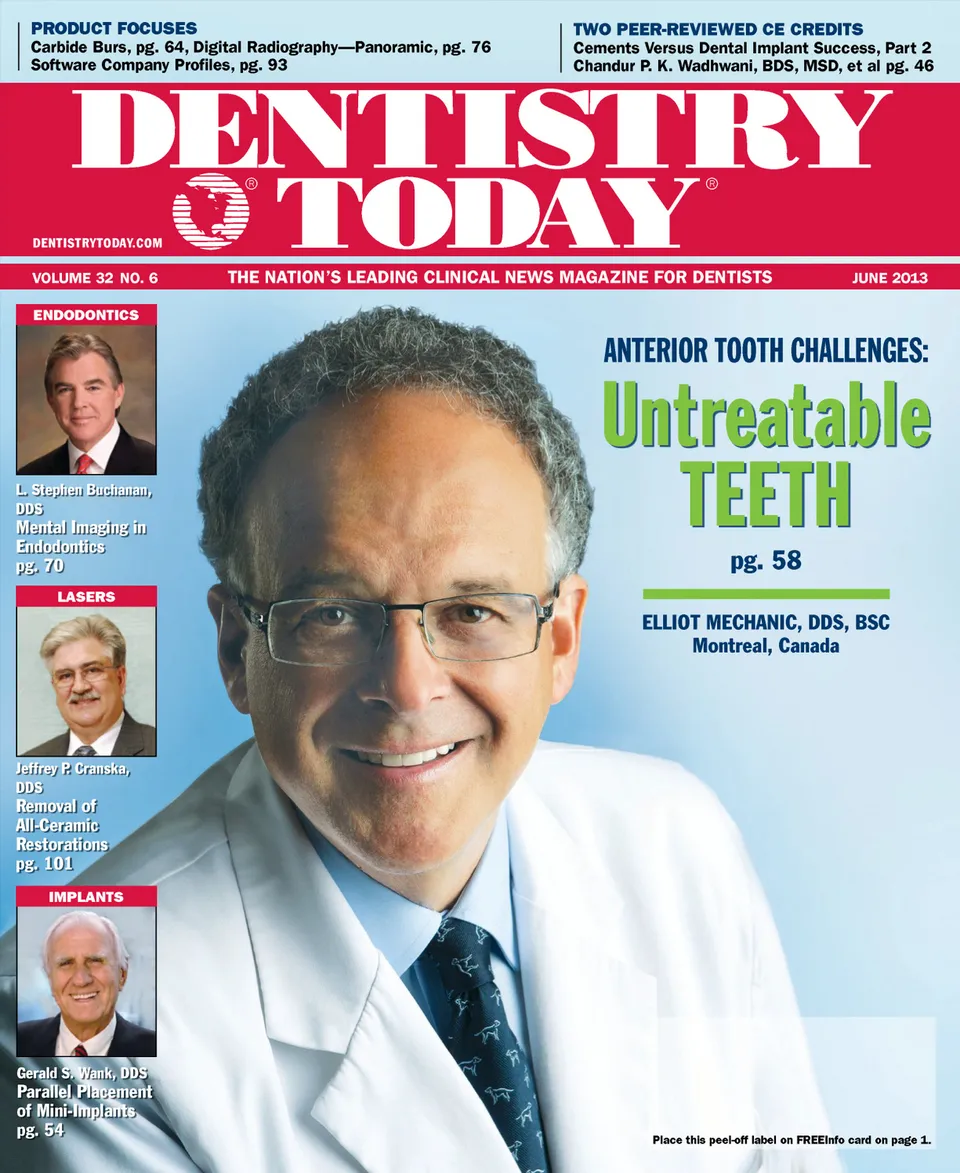
May 2013 · 112 pages
Dentistry Today — June 2013
Clinical articles, techniques, product news and continuing education for dentists. Read the full issue free in the digital edition.
Inside this issue
Excerpts from the issue. Open the digital edition to read any page in full.
- Page 8
Solving a Case: Like Playing a Puzzle? Sometimes the obvious is not the only, or even the best, solution. As the saying goes, "Not all appears as a nail...unless you are a hammer." Taking the time and discipline required to gather and assemble all the findings (the pieces of the puzzle) needed to arrive at a proper diagnosis, and then devoting the time to think through all the possibilities before initiating treatment of an anterior aesthetic case, can be a real game changer. This process of time and cerebration can result in treatment outcomes that can move from simply mediocre…
- Page 10
Stretching Educational Boundaries THE NEED Technology is progressing so fast that it is difficult to keep track of all the developments. Dental technology has grown exponentially and so has the demand for faster services along with natural aesthetics and excellent function. To this end, it becomes imperative that the dental team optimize a team approach when treating the patient. Furthermore, it is even more important to understand what each team member can contribute and in what way(s) they may be limited. During the past 10 years, a good number of formal dental technology training programs have been shut down. On…
- Page 12
VIEWPOINT continued from page 10 fessional relationships. In Clinic I, they learn together that communication between the dentist and the dental technician is always critical and, though it is made easier through the use of digital photography and the Internet, it is still important to establish meaningful face-to-face team relationships. In this program, the dental students are able to see the dental technology student as a "real person," and together, they can communicate their concerns about a case or discuss treatment options from both clinical and technical perspectives. In the end, they learn that everyone benefits from this team relationship.…
- Page 14
Providing you with news and information from the industry leader in clinical content. Visit Our Site Today! The CROWNING Technique of the Week Minimal Prep With Laser Dr. George Kirtley, of Indianapolis, Ind. performs a minimal prep case of 6 upper teeth. His preferred approach is to initially angle the bur at 45° for "drawing" a line and margin along the gumline. A reduction guide is necessary after preparation for the placement. A laser is used in this procedure, as the onlay veneers are prepped and placed with this minimally invasive technique. To view this procedure, visit our home page,…
- Page 16
FOCUS ON: Digital Impressions Alex Touchstone, DDS, discusses how to use digital impressions in your dental practice. Q: What types of procedures are possible with digital impressions? A: Basically, if a physical impression is traditionally required for a procedure, a digital impression may be used. This includes fixed prosthotics, removable prosthetics, orthodontic appliances, snoring appliances, implant surgical guides, diagnostic models...you name it. Less obvious but highly useful, digital impressions also serve as powerful teaching tools during case presentations. Q: What changes to the normal clinical workflow (if any) are there when making digital impressions versus traditional methods? A: There are…
- Page 18
From the March 2013 Issue DENTAL APP DENTSIO DENTSIO is the first iPad app for dental practices that allows dentists to keep patient records for most dental specialties. Starting from a basic medical exam, they can then work on dental and periodontal charts, orthodontics, and TMJ, followed by diagnosis and the development of a treatment plan. After installation, dentists can access all records. For more information, call (786) 279-0606 or visit dentsio.com. FREEinfo, HYBRID CERAMIC Vident VITA Enamic is the world's first hybrid dental ceramic with a dual-network structure that combines the best properties of ceramic and composite materials. Its…
- Page 19
Golden Dental Solutions For years, dentists have enjoyed the effectiveness of Physics Forceps for tooth extraction. Now Golden Dental Solutions introduces the GMX 400 Molar Series, featuring a new design that offering the same optimal performance. The Beak & Bumper technique truly facilitates difficult molar extractions with just 2 instruments that allow for proper placement on the buccal or lingual side. For more information, call (877) 987-2284. FREEinfo, CANAL ACCESS TIP KIT ACTION North America The EndoSuccess Canal Access Prep Ultrasonic Tip Kit includes 3 microblade tips that are ideal for locating and opening hidden or calcified canals as well…
- Page 20
TheraCal LC Six-Month Clinical Performance Report +++++ BISCO Dental Products | (800) 247-3368 | bisco.com Consultants' Comments • "Finally, there is a therapeutic liner that reduces sensitivity and is easy to place." • "None of the teeth treated with TheraCal LC needed root canal treatment." • "In patients who had a history of postoperative sensitivity, TheraCal LC was exceptional in reducing or eliminating the discomfort." Placement Ninety-seven restorations placed in 55 patients were evaluated at placement for (1) type of tooth, (2) level of caries risk, (3) type of pulp cap, (4) bonding agent and restorative material used, and (5)…
- Page 22
Spotlight Next-Generation Digital Shade-Matching System Offers Greater Speed and Reliability BREA, Calif.–Building on the popular VITA Easyshade digital shade matching system, VITA introduces the fourth generation of easyshade technology with the new VITA Easyshade Advance 4.0. Optimal shade determination is now easier than ever, thanks to new functions for automatic measurement. With cutting-edge measurement technology and durable LED components, VITA Easyshade Advance 4.0 offers precision that is twice as effective as that of the human eye. A new "average" mode in the Easyshade Advance 4.0 allows users to measure up to 50 shades on a single tooth and arrive at…
- Page 24
Spotlight Patient-Specific Implant Treatment Kit Offered Scanner Utilized With Digital Impression System Enables Simplified Dental Implant Process ST. PAUL, Minn.—Utilized with BIOMET i's BellaTek Encode Impression System, 3M ESPE's 3rd True Definition Scanner makes it possible for dentists to increase productivity and reduce appointment time for patients receiving dental implants. A simplified, all-digital implant workflow for the scanner and the impression system allows a custom implant abutment and final crown to be designed from just one digital scan, eliminating the traditional impression coping process and maximizing efficiency and accuracy. A departure from the traditional implant restoration process, the scanner and…
- Page 26
Tulsa's ProTaper NEXT A New Standard in Safety and Efficiency Clifford J. Ruddle, DDS CLINICAL PROCEDURE The recently launched ProTaper NEXT (PTN) rotary file system (DENTSPLY Tulsa Dental Specialties) has 3 unique design features that influence performance. The system consists of 5 files of varying D1 diameters and tapers that can be utilized for shaping virtually any canal. Generally, only 3 or 5 files are used to optimally shape most canals. Like ProTaper Universal, PTN utilizes the highly successful variably tapered design feature on a single file. Specifically, a file with a decreasing tapered design strategically improves flexibility, limits shaping…
- Page 28
Spotlight System's Composites Display Superlative Physical Properties, Yield Exceptional Aesthetic Results THE VILLAGES, Fla.—The DMP Dental Complete Composite System comprises 3 types of composites: (1) NanoCeram Universal, a light-cured nanohybrid suitable for all direct anterior and posterior restorations, (2) NanoCeram Flowable, and (3) Bright Posterior. They are offered in 4-g syringes and unit-dose capsules as well as 2-g syringes of flowable. Available in 16 VITA shades as well as opaque, incisal, and bleach shades, the composites consist of a special blend of microfillers (20 to 700 nm), and exceptional aesthetic results and superlative physical properties have been achieved through the…
- Page 30
Bonding System Specifically Designed for Repair of Ceramic, Porcelain, Acrylic, and C&B Materials SAN MARCOS, Calif.-Offered by Shofu Dental, CERARESIN BOND is a bonding system specifically designed for the repair of ceramic, porcelain, acrylic, and C&B materials. With this simple-to-use system, both dentists and laboratory professionals can securely and reliably bond various materials, including light-cured laboratory composites such as CERAMAGE coronal or even light-cured resin composites such as BEAUTIFIL Flow Plus for veneering or repair intraorally. The material is extremely resistant to moisture and thermal strains, and it provides a long-lasting, durable bond. CERARESIN BOND kits have a 3-year shelf…
- Page 31
Pin's Reliability and Ease of Insertion Cited MIAMI, Fla.–Offered by Fairfax Dental, the Stabilok Pin is designed to achieve 2 criteria: (1) self-shearing at maximum reliability and (2) insertion with maximum ease. A wide-pitch thread provides excellent retention for the pins, which are available in either the purest commercially available titanium or stainless steel. The pins and drills are dispensed from the box through apertures, which can be set to either open or closed. For more information, call Fairfax Dental at (800) 233-2305. FREEinfo, Drill Ideal for Canal Preps BURNABY, BC–Made from superior stainless steel with improved cutting capacity, Diadent's…
- Page 32
Spotlight Universal Cement's Outstanding Bond Strength and Easy Cleanup Cited ORANGE, Calif.–Offered by Kerr Dental, Nexus RMGI is a radiopaque resin-modified glass ionomer cement that offers clinicians a wide range of utility for nearly all luting situations, including PFMs, full-metal restorations, resin restorations, full zirconia restorations, lithium disilicate restorations, and zirconia lavered with porcelain restorations. It offers excellent and consistent mixing stability, high fluoride release, and the characteristic gel-type cleanup experienced in a Kerr cement. Only Nexus RMGI combines One Peel cleanup, tack cure capability, and outstanding bond strength for consistent, predictable outcomes. As the first RMGI available with advanced…
- Page 34
Spotlight Cordless Device Facilitates Warm Gutta-Percha Techniques BALA CYNWYD, Pa.-B&L Biotech's cordless beta Obturation device has been designed for warm gutta-percha techniques such as backfilling a canal with warm vertical obturation or with a complete fill technique (injecting from the apex up). Perfectly complementing B&L's alpha heat source, it provides simplicity, operator ease and comfort, and durability. Equipped with a durable, rechargeable battery that mounts easily in a charge cradle, the device offers more than 4 hours of continuous use on a single charge. Among its unique design features is a patented 360° swivel needle that allows users to change…
- Page 35
Combination Matrix/Plastic Wedge Now Offered for Large Class II Fillings STOCKHOLM, Sweden—The FenderMate combination matrix/plastic wedge for Class II restorations, a sectional matrix band system designed for small and medium cavity boxes, had its limitations for larger boxes. Now it has a companion—Directa AB's FENDERMATE FIX, which secures the matrix band in place around the tooth for large boxes for Class II fillings. The concept is simple: once FenderMate is inserted into the interproximal space, the matrix band is separated from the wedge, and FENDERMATE FIX is applied between the band and the wedge. Light-cure for 5 seconds, and there…
- Page 36
SciCan's HYDRIM G4 Instrument Washer SciCan has set the benchmark for sterilization and instrument reprocessing technology. For more than 20 years, it has been developing and manufacturing highly innovative infection control products that address the need for versatility, flexibility, and efficiency in today's environments. Now, it is proud to unveil its newest instrument washer, the HYDRIM C6rw G4. Instrument cleaning has never been faster or smarter. The touchscreen display, ready HYDRIM C6rw G4 uses fresh water and cleaning solution for every cycle, ensuring superior washing results. Plus, its unique combination of safety, efficiency, and instrument protection can simplify reprocessing and…
- Page 38
NEWS/TRENDS Industry News Heraeus Kulzer Acquired by Mitsui Chemicals Japan-based Mitsui Chemicals, Inc (MCI) announced recently that it will purchase the Heraeus Kulzer dental division of Heraeus Holding, a German precious metal and technology company. The transaction is expected to be approved by German trade authorities this month. Heraeus Holding's decision to sell was prompted by its conclusion that the dental business was not an ideal strategic fit with its other business sectors. In contrast, MCI management has strategically targeted the emerging healthcare market and intends to have Heraeus Kulzer serve as the cornerstone of its efforts in the international…
- Page 39
Ana Bedran-Russo Elected President of IADR-DMG Ana Bedran-Russo, DDS, PhD, MS, an associate professor of restorative dentistry at the University of Illinois at Chicago College of Dentistry, has been elected 2013-14 president of the International Association for Dental Research (IADR) Dental Materials Group (DMG). In this role, she will oversee the DMG organization for the IADR and American Association for Dental Research (AADR) meetings, including selection of reviewers for abstract review and sponsoring and co-sponsoring scientific programs. Dr. Bedran-Russo noted that she hopes to continue the intensive work of past DMG presidents in actively participating in the DMG-related scientific and…
- Page 40
NEWS/TRENDS OSAP Bringing Infection Control Resources to Canadian Dental Professionals The Organization for Safety, Asepsis and Prevention (OSAP) announced recently that it's joining forces with the Canadian Dental Association and the Journal of the Canadian Dental Association (JCDA) Oasis Program to bring infection prevention resources to Canadian dental professionals. Dr. John O'Keefe, the Canadian Dental Association's director of knowledge net works and member of the OSAP board of directors, proposed the partnership, suggesting OSAP became a consulting organization for infection control. He is developing a team of experts in all clinical areas for JCDA Oasis and plans to repackage question-and-answer…
- Page 42
New Research: Mouthrinse Reduces Plaque and Gingivitis New research published in General Dentistry indicates that the use of a germ-killing mouthrinse in addition to regular tooth brushing can significantly reduce plaque and gingivitis, more so than brushing alone. Mouthrinses can reach nearly 100% of the mouth, while brushing focuses on the teeth, which make up only 25% of the mouth. Even with regular flossing, bacteria often are left behind, says Christine A. Glanville, RDH, BS, lead study author and director of Scientific and Professional Affairs, Global Consumer Healthcare Research and Development, Johnson & Johnson Consumer and Personal Products Worldwide. This…
- Page 43
Human Microbe Study of Periodontitis Scientists at the Oak Ridge National Laboratory (ORNL) have solved the genetic code of bacteria linked to periodontitis. The finding, published in Proceedings of the National Academy of Sciences, profiles the symbiosis region t bacterium (SR), a group of microbes present in many environments, ranging from the South to deep within the Earth, that have never been cultured in the laboratory. Human oral SR bacteria are elevated in periodontitis. Scientists also found that the SR bacteria employ a unique genetic code in which the codon UGA (also called opal, or number), a sequence of nucleotides…
- Page 44
In First Impressions, George Freedman, DDS, gives readers a brief summary of products that have recently been introduced to dentistry, based on his clinical experience. OraVerse Septodont USA The major drivers that ushered in the golden age of dentistry were the high-speed handpiece and the increasing use of local aesthetic to make the patient more comfortable during a variety of dental procedures. In the 1990s, cosmetic dentistry added to the momentum. Local anesthesia as required to make the patient totally insensitive to the dental procedures, particu larly when combined with a pre-application of topical, has become the clinical standard in…
- Page 45
Radiation Badge Service Instadose Dosimeter ICCare The level of radiation to patients who are undergoing initial or recall appointments is exceedingly small. Digital radiography has further decreased these radiation levels. But for those who work with radiation daily, safety and ongoing monitoring should be paramount. Given today's level of precautions, it is unlikely that members of the dental team involved in radiography are exposed to dangerous levels of ionization. Equipment can break down, however, and safety techniques can lapse. Government-based dosimetry for private dental practices has largely disappeared, yet many high-risk individuals (pregnant, lactating, radiation-treated) may be employed in close…
- Page 46
The Role of Cements in Dental Implant Success, Part 2 This is part 2 of a 2-part article series. Part 1 of this series was published in the April 2013 issue of Dentistry Today and can be found in our archived articles at the Web site dentalCEtoday.com. Chandur P. K. Wadhwani, BDS, MSD Kwok-Hung (Albert) Chung, DDS, MS, PhD Cementation as a means of attaching a restoration such as an inlay, onlay, crown, or bridge to a natural tooth has been used for close to 100 years. The process serves to unite components of the same or different materials together.…
- Page 48
Figures 2a and 2b. (a) This group of dentists overfilled the crowns with cement—some placed more than 50 times the ideal amount required. (b) This group underfilled the crowns with insufficient cement to fill the tiny space. Figures 3a and 3b. (a) This body of water has Newtonian properties. It fills this container and does not flow out when no force is applied to it. (b) This liquid does not follow Newtonian laws. It does not flow into the container and will behave differently than water when force is applied. The Role of Cements in Dental... continued from page 46…
- Page 49
Figures 7a to 7c. Application of the veneer crown near but not on the occlusal surface, permits in cement flow in the same direction as the apical surface. The pressure is then reduced intracoronally to direct the flow of excess cement to the apex application. Figures 8a to 8c. Application of the veneer crown at the outer crown margin results in a flow pattern that forces cement occlusally initially, then in the model crown seals, the cement flows down toward the margin with small amounts of excess cement. occlusal cement layer that traps between the 2 horizontal surfaces. Liquids/cements prior…
- Page 50
IMPLANTS to the gross application technique due to less cement material applied in the first instance. However, the incomplete fill of the cement space makes this process potentially problematic, with potential reduction of retentive force capabilities. When the cement is applied to the internal aspect of the crown near to, but not including the crown margin, then seated onto the abutment, a different effect is seen15 (Figures 8a to 8c). The cement appears to flow against the direction of the seating force. In effect, it flows "up".26 As the crown is seated, the cement contacts the axial walls of the…
- Page 51
IMPLANTS inclusions, and therefore, are not recommended for zirconia or ceramic abutment materials. The number of sites of the wells required is currently being evaluated; presently it is considered adequate to have 3 wells, 120 degrees apart, with one at the mesial aspect of the implant, one at the distal, and 1 mm from the occlusal surface. Further study may be required to optimize their position. The screw head should always be protected by a spacer to prevent cement getting into the screw driver engagement site; currently the recommended material is polytetrafluoroethylene tape.19 This material can be sterilized, is easy…
- Page 52
Test 162 Expiration date of this CE article is June 1, 2016. To submit Continuing Education (CE) answers, use the answer sheet on page 53. Circle the letter of the answer you believe is correct, detach the answer sheet from the magazine, and mail to Dentistry Today Department of CE. Or, use our easy online option at dentaltoday.com. This article is available for 2 hours of CE credit. The following 16 questions were derived from the article "The Role of Cements in Dental Implant Success, Part 2" by Chandur P. K. Wadhwani, BDS, MSD, and Kwok-Hung (Albert) Chung, DDS, MS,…
- Page 54
Simplified Technique for Parallel Placement of Mini-Implants Mini-dental implants (MDIs) (also referred to as small diameter implants) have been used successfully to treat patients previously unable to receive standard diameter implants. Applications/indications include: single tooth replacement, temporary anchorage devices for orthodontic therapy, and maxillofacial prosthetics. Perhaps the most widely used application of MDIs is for the stabilization of loose dentures, which has been shown to have long term clinical success.1-3 There have been several techniques employed for the parallel placement of a MDI in preparation for an implant-retained overdenture. Parallelism is important to allow an even draw of the prosthesis…
- Page 56
IMPLANTS use and care of the denture during the healing period. After a 6-week healing period, the integration of the implants was noted. The female metal housing (3M ESPE) was then placed over each implant (Figures 21 and 22). A shim was used to block out any undercut areas between the metal housing and the tissue. A hard cold-cure acrylic (SECURE [3M ESPE]) was placed into the relieved areas of the denture. Then the denture was seated and the patient was instructed to close and hold in centric occlusion for approximately 5 minutes while the material set. Any excess acrylic…
- Page 58
Aesthetic Zone Challenges: Untreatable Teeth, Part I Using Low Intensity Orthodontic Eruption to Safeguard Gingival and Bone Levels Elliot Mechanic, DDS, BSc INTRODUCTION Today's dental patient has extremely high expectations, often asking us to seemingly perform miracles. Sometimes this is unrealistic and just not possible. In the medical world, patients must accept and live with compromises to their health, but some dental patients always seem to expect perfection. A dentist must be very careful when making the decision to attempt a challenging restoration in the aesthetic zone, especially when the gingival level is directly in the line of vision. The…
- Page 60
Aesthetic Zone Challenges... continued from page 58 Untreatable Teeth We must manage the anterior ridge at the time of extraction to maintain its sue with good approximal and facial tissue height, as we do not want to lose papillae, creating spaces between the adjacent teeth that are often described as "black triangles." This is especially critical in patients who have gingival margins that are visible in the direct line of vision.5 The easiest way to maintain gingival aesthetics is to retain a natural tooth or root, because natural teeth stimulate the body to maintain tissue and bone. Before we extract…
- Page 62
Aesthetic Zone Challenges... continued from page 60 would last for more than a few years and, after assessing the cost of treatment versus the esthetics and the prognosis for each, it was determined that extraction of the root and placement of an implant was the choice. However, the extraction of this decayed and fragile root presented the possibility of creating a large bony defect that would likely be extremely difficult to repair after the extraction. Single-tooth implants placed in esthetic areas require extreme precision. The fact that this patient displayed gingiva in our direct line of vision made this situation…
- Page 64
Carbide Burs George Freedman, DDS Most dentists give very little thought to the tiny tools that are used so often in the clinical practice. Burs may often seem insignificant in size and cost with respect to other commonly used equipment and materials. They do, however, have a major impact on the efficiency of the dental practice and the eventual bottom line. Burs cut through hard dental tissues and harder dental materials. A sharp, new bur makes tooth preparation virtually effortless for both patient and dentist. Dull, worn burs require more application of torque and greater manual effort, cutting more slowly…
- Page 65
SS White Burs Doctors who used to use 2 or 3 carbides to remove crowns reported using one Great White Gold Series carbide bur to remove 2 to 3 crowns. The faster cutting rate is experienced in amalgam, IPM, and all nonprecious metals, and doctors indicate this saves them 12 hours each year. These burs are ideal for quick removal of amalgam and modern-day composite materials. The burs are also the perfect instruments for any procedure requiring a plunge cut. The Great White 2 can help reduce the number of burs inventoried in any office. For more information, call (800)…
- Page 66
Johnson-Promident Johnson-Promident is one of the largest manufacturers of bide burs and offers more than 300 different types of burs. Their burs feature high-quality tungsten carbide tips that are brazed onto the neck of a stainless steel shank. They are manufactured under strict tolerances and are crafted to resist wear, chipping, and break-age. All Johnson-Promident rotary instruments provide unbeatable value. For more information, call (800) 210-8045 or visit the Web site johnsonpromident.com. FREEinfo, Shofu Dental Shofu Robot Carbides are ideal for cosmetic restorations with high-quality tungsten finishing heads on stainless steel shanks. With a multifluited design, these carbides are available…
- Page 68
Coltène Alpen Carbides offer a comprehensive line of one-piece carbides that cut faster, last longer, and eliminate brazed joint breakage and rusting. The majority of carbides sold today are based on 60-year old 2-piece construction. These carbides provide clinicians with a comprehensive line of advanced one-piece carbides. Alpen Carbides are available in a full line of metal cutting, operative, and trimming and finishing burs. In addition to friction grip shanks, many shapes are also available in short shank, right angle latch, handpiece, and surgical lengths. For more information, call (800) 221-3046 or visit alpentotary.com. FREEinfo, Alpen SteriX are presterilized carbide…
And 28 more pages — read the whole issue.