
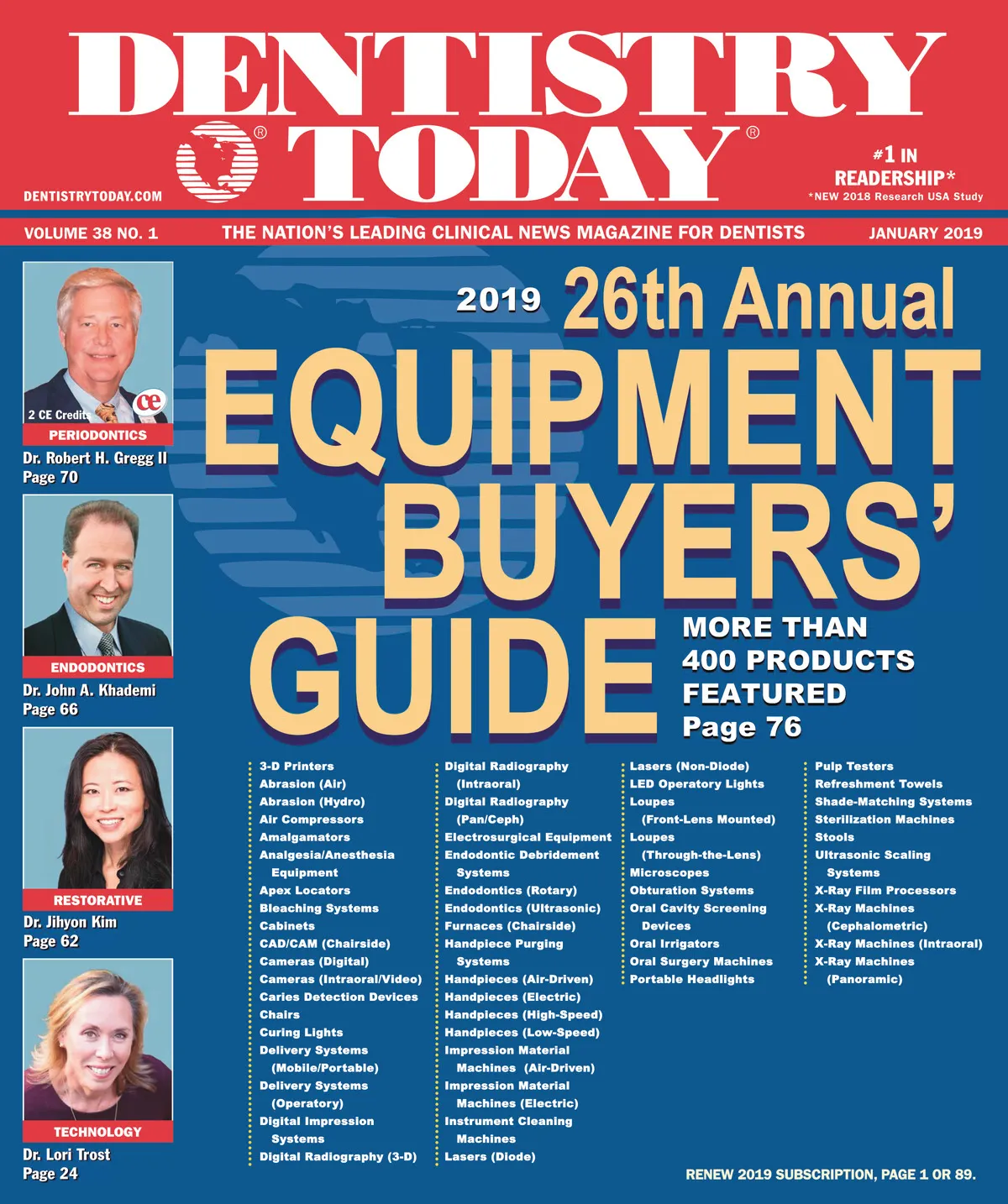
January 2019 · 116 pages
Dentistry Today — January 2019
Clinical articles, techniques, product news and continuing education for dentists. Read the full issue free in the digital edition.
Inside this issue
Excerpts from the issue. Open the digital edition to read any page in full.
- Page 10
Guided by the Light The oral-systemic connection is a new charge for our profession. By offering a paradigm shift in how healthcare professionals look at pathogens and disease processes affecting overall health, the connection between oral health and overall systemic health has opened doors for collaboration between the dental and medical communities. Let me correct myself: The doors are now flung open, and there's no shutting them. As dentists, we are aware of the importance of oral health. After all, we are dedicated professionals whose careers focus on this. We should be proud, but also humble because there is still…
- Page 12
VIEWPOINT continued from page 10 One of the most prominent examples of the ALD mission for improving oral health is the planning for 2019's Academy of Dentistry's 46th annual meeting from April 4 to April 11 in Dallas. The meeting theme is "The Laser Systemic Link: Lighting the Way to a Healthier Mouth and Body." The ALD is setting the tone by having one of the nation's leading physician advocates for dental medication collaboration, Charles Whitney, MD, present the keynote address. Dr. Whitney's medical practice specializes in heart attack, stroke, and dementia prevention and relies on collaboration with dental clinicians…
- Page 13
What's New on Live Blog Coverage From The Greater New York Dental Meeting In November, Dentistry Today attended the Greater New York Dental Meeting at the Jacob K. Javits Convention Center in New York City. We covered all the happenings at the event and interviewed industry executives on their companies' new products and technologies. Watch full videos on the Live Blogs page at . Bien-Air Dental Eastern regional sales manager Andrew Magnani reveals Bien-Air Dental's Tornado X handpiece and the iOptimalNT handpiece setup. Carestream Dental Chief dental officer Ed Shed-lard discusses Carestream Dental's new high-resolution CS 9600 3D CBCT system.…
- Page 14
FOCUS ON: Oral Appliance Hygiene Lorin Berland, DDS, discusses hygiene for removable appliances, such as mouth guards, aligners, retainers, airway devices, and dentures. Unfortunately, most people do not understand the importance of cleaning their removable oral appliance hygiene. Patient compliance, as well as patient satisfaction, may decline. Clinical research consistently finds that the majority of oral appliances and their wearers eventually become infected with pathogens such as Candida Albicans, Streptococcus, Staphylococcus and Actinomyces—the leading causes of oral thrush, denture stomatitis, pneumonia, and more. In addition, these pathogens are also linked to multiple systemic health issues. As a result, millions of…
- Page 16
Spotlight Company Adds Digital Treatment Planning and Surgical Guide Fabrication Offerings NEWPORT BEACH, Calif.–Glidewell Laboratories is now offering digital treatment planning and surgical guide fabrication to implant dentists. Pairing the dental lab's restorative expertise with 3-D treatment planning technology, the new DTP service is devoted to helping clinicians perform implant surgery with maximal safety and predictability while maintaining a prosthotically driven approach throughout treatment. Cases, including a full-arch CBCT scan and a digital or physical impression, can be digitally uploaded via the My Account feature or shipped to the lab. Available for most major guided surgery systems, the DTP service…
- Page 17
We Have the CURE. parkell CURING LIGHT • Low-profile head design for easy access in all areas of the oral cavity. • High quality LEDs provide intense light that will last. • Removable lens for easy replacement. • Tacking Lens and additional standard lens comes with the light. Our curing light is just one more example of the quality design and workmanship that we've been known for in the 70 years Parkell has been in business. This sleek light features a low-profile head, so reaching into the posterior region of the mouth or sliding it into the buccal vestibule is…
- Page 18
Spotlight Composite Warming Device Improves Depth of Cure RACINE, Wis—Vista Dental Products' Phasor is the first of its kind, using near-infrared technology to rapidly warm composite compules. Warming composite significantly lowers the viscosity of the material, resulting in better adaptation, reduced voids and microleakage, and improved depth of cure. With the touch of a button, Phasor is able to heat composite material to 150°F in less than one minute and sustain a constant temperature throughout the entire dental procedure. Materials remain highly sculptable, nonsticky, and easily shaped during manipulation. Unlike other devices, Phasor is not limited to a single brand…
- Page 19
Spotlight System Offers Dentists Practical Way to Buffer Local Anesthetic Cartridge CARSON CITY, Nev.–Chairside buffering using the Onset system is simple to incorporate, easy to use, and will make the local anesthetic less acidic, whether using articaine lido caine, prilocaine, or mepivacaine. Because local anesthetic is a key part of so many procedures in the dental office, a long-standing question among dental practitioners has been how can local anesthetics become better? Chemistry lies at the heart of the answer. Local anesthetics begin as alkaline solutions, but manufacturers add hydrochloric acid to lower the pH to around 3.5 (or the same…
- Page 20
Guided Prosthetics Delivery Reduces Each Patient's Chair Time GOLDEN, Colo—FirstFit is a guided prosthetics delivery system that utilizes the latest digital technology to provide 3-D printed prep guides and the final, ready-to-see restoration at the same time. The use of this guided system enables clinicians to provide predictable and consistently aesthetic restorations while reducing the patient's time in the chair. Using proprietary CAD software, a designer creates a digital prep for the tooth using a series of prep guides while also creating the final restoration to fit this preparation. This revolutionary system provides a precise and unparalleled treatment solution that…
- Page 21
Using a Universal Adhesive for a Large Direct Posterior Composite Restoration: Tokuyama Universal Bond James Chor, DDS Adhesive dentistry has historically presented dentists with challenges associated with the selection, indication, and application of bonding agents used during their adhesive protocol. Difficulties may present due to a particular adhesive bonding agent's compatibility or incompatibility with direct or indirect restorative materials, suitability for use with only specific etching techniques (eg, total-etch, self-etch, or selective enamel-etch), and/or curing requirements. Additionally, such considerations as bond strength, working time, and adhesive bonding agent film thickness can ultimately influence the predictability of adhesively placed restorations. Fortunately,…
- Page 22
Dentapen: The Next Generation CCLAD Robert M. Peskin, DDS Historically, many patients avoid visiting the dentist because of the fear and anxiety often associated with the dental experience. While sources of fear may include noise and vibration from dental handpieces, as well as the smells of drugs and materials utilized during treatment, one of the primary fear-provoking concerns patients have is the administration of the local anesthetic itself, which is often perceived as the primary source of concern more than the procedural discomfort it is intended to eliminate. Dental local anesthetics can cause pain for various reasons, including needle penetration…
- Page 24
Shedding the Right Light on Aesthetics Lori Trost, DMD INTRODUCTION Simply put, contemporary dentistry has become a resin-based world. Every day, clinicians perform a variety of adhesion-based procedures that rely on a curing device to activate a material's chemical. The dental curing light is solely responsible for the conversion of polymerization of resin based materials. As reported by the ADA, at least 50% of a practice's income is tied directly to the successful use of light cured materials, thus necessitating the recognition of how important proper light curing is and its dramatic impact on both the clinical and financial aspects…
- Page 26
TECHNOLOGY CASE 1 Figure 3. Preoperative photo. Figure 4. Using a periodontal probe to discover inter-proximal box depth. Figure 5. Translating interproximal box depth to the bulk-fill by using an endo stopper. Figure 6. Bulk-fill placement that has been allowed to self-level at proper depth and was light cured. Figure 7. The final composite resin restorations (SureFil SDR [Dentsply Sirona Restorative]). CASE 2 Figure 8. Pre-op photo. Figure 9. Tack-cure of the self-adhesive resin cement. Figure 10. Peel-off cement removal of the adhesive resin cement immediately after tack curing. Figure 11. The completed full-coverage restorations (IPS e.max [Ivoclar Vivadent]) on…
- Page 28
Spotlight Disposable Matrix Band Adjusts to Any Preparation SOUTH JORDAN, Utah—Ultradent Products' all-new Omni-Matrix disposable retainer and matrix is a superior circumferential matrix band solution. Designed to perfectly customize to any preparation, the band's circumference can be easily adjusted simply by twisting the handle. Its pivoting head allows it to access any angle of the tooth. Once the restoration is complete, the Omni-Matrix band easily releases without disturbing the restorative material. The Omni-Matrix disposable retainer and matrix features an unmatched body design that is ideal for single and simultaneous restorations. Its innovative shape allows superior procedural visibility and patient comfort,…
- Page 30
Spotlight Company Provides Numerous Teeth Whitening Options LAS VEGAS–Whiter Image Dental (WID) is uniquely positioned in the dental community, offering 3 tiers of support to offices home-optically and internationally. Its in-office solutions provide professional whitening at 30% more teeth by with a dual-barrel syringe and a patented mixing tip to release maximal potency at application, preventing loss while on the shelf. Additionally, WID has a full line of take-home and aftercare products to complement any procedure and ensure ongoing success. WID provides cutting-edge chemistry with an amazing lineup of support products to maximize the results provided to patients, including brighter…
- Page 32
Industry News Nobel Biocare Donates Gear to Dalhousie Dental Clinic Over the past year, Dalhousie University Faculty of Dentistry graduate and oral surgery residents have placed nearly 300 dental implants. Now, the school has opened a state-of-the-art dental clinic thanks to donations from Nobel Biocare. (Left to right) Dr. Blaine Cieghom, assistant dean of clinics; Cory Sears, regional sales manager for Nobel Biocare; Dr. Ben Davis, dean of the Faculty of Dentistry; David Murchison, territory manager for Nobel Biocare; and Dr. Gorman Doyle, division head for implant dentistry. "We have had a wonderful working relationship with Nobel Biocare for over…
- Page 34
Lifetime Achievement... continued from page 32 in both size and prominence within the research community. Felton also is a fellow and past president of the ACP as well as a Diplomate and the current president of the American Board of Prosthodontics. "Few in prosthodontics have achieved this honor. I am blessed and humbled to be selected for the 2018 Dan Gordon Lifetime Achievement Award," said Felton. "It is truly a highlight of my career in prosthodontics." Industry News continued from page 32 students to actually perform procedures as if they were on an actual human, in an actual lab, but…
- Page 35
Lymph Node Ratio May Predict Who Lives and Dies from Oral Cavity Cancer Determining which oral cancer patients are more likely to live or die could help patients at greater risk receive more aggressive care, reports the University of Colorado Cancer Center, which looked at 149 surgical and/or post-surgical subjects. "We wanted to know if features of these patients, their tumors, or their treatment could predict survival," said first author Ding Ding, MS. The study confirmed expected risk factors for shorter overall survival, including being uninsured or insured by Medicaid, having a larger primary tumor, having "margins" around the tumor…
- Page 38
Multidisciplinary Modality in Practice This month, in our Implants Today section, 3 out of our 4 new authors are joining the section. David Little and Jack Permatti, who are distinguished Implants Today advisory board members, are joined by another leading expert in implant dentistry, Dr. Paul Bylis. These esteemed authors cover a wide variety of implant topics, providing a reminder of how many disciplines are involved for successful implant treatment. Implant dentistry is a multidisciplinary modality. The excellent contributions by Dr. Little and his co-author, Dr. Gary Radzs, and by Dr. Bylis, both focus on how the digital workflow has…
- Page 40
Creating an Autogenous Graft From Extracted Teeth A Faster Implant Integration Time Timothy Kosinski, DDS INTRODUCTION For osseointegration of dental implants to occur, a proper bone site needs to be created. Teeth often need to be extracted prior to implant placement. Sometimes, immediate implants can be positioned in extraction sites. However, if there is significant bone loss, the practitioner may decide to do socket preservation and use a graft material. Simple socket grafting has been shown to maintain bone contours better than no grafting.¹ There are many grafting products available today, including allograft, (a graft from a human source), xenograft…
- Page 42
Creating an Autogenous Graft... continued from page 40 the newly created autogenous graft material was placed in the provided glass jar, along with Dentin Cleanser (KometaBio)(Figure 8). This cleanser, a high pH (very basic) sodium hydroxide in 20% ethanol, is used to cleanse the particulate for 10 minutes to eliminate bacteria and any organic material. After the particulate completed soaking, the cleanser Figure 2. The teeth were atraumatically removed to maintain the facial plate of bone. The coronal portions of each tooth were sectioned into several small sections, decayed structure, and enamel. (Note: Endodontically treated teeth should not be utilized…
- Page 43
IMPLANTS 43 genic and, thus, rapidly differentiates into bone. The site will heal quicker, with less resorption. The dental implant chosen here to eventually support an implant-retained prosthesis replacing the missing mandibular anterior teeth was the SLA Active implant (Straumann). This implant choice was made because of its ability to predictably achieve quicker integration and the potential lengthening of the implant genesis. The SLA Active implant was sand-blasted and acid etched in a nitrogen atmosphere and then stored in an isotonic sodium chloride solution. This results in a chemical activation of the surface and enhanced osteoblast activity. Reports indicate that…
- Page 44
The Two-Implant Mandibular Overdenture Jack Piermatti, DMD INTRODUCTION Removable prosthodontics has historically been a difficult and frustrating modality. The mastication of food with these appliances assists the edentulous patient in obtaining adequate nutrition; however, complete dentures constructed under even the most ideal conditions will only have a chewing efficiency equal to a fraction of the natural dentition.¹ To exacerbate this situation, the absence of natural teeth and continued use of the complete denture causes alveolar bone resorption, resulting in less surface area of foundation for support of the denture base. The use of endosseous, root-form dental implants to improve comfort…
- Page 46
Figure 2. A mandibular edentulous jaw with 2 dental implants. Figure 3. A mandibular soft-tissue-supported, implant-retained overdenture prosthesis. Figure 4. The overdenture in place, with full extension for support and stability. The Two-Implant Mandibular... continued from page 44 lar denture. Other factors involved in the stability of conventional dentures are denture base adaptation, residual ridge relationship, occlusal harmony, and neuromuscular control.3 Resistance to horizontal displacement, which defines stability, requires maximum adaptation of the denture base to available bone and bony inclines. As an example, adaptation of the denture flanges on the lingual slope of the mandible resists horizontal forces since…
- Page 48
Mandibular Implant-Retained Overdenture Revisited Using CBCT and a Novel Attachment System Paul Bylis, DDS INTRODUCTION We all have many patients wearing complete lower dentures. Forty million Americans are completely edentulous, and, as they age and their ridges continue to atrophy, their health and quality of life can become affected since it becomes more difficult to properly function. A thin mandibular ridge in height and width leads to a lack of stability, and the retention of a prosthesis in these situations can be almost impossible. The use of a tissue-supported implant-retained overdenture can be life-changing for these patients. For these cases,…
- Page 50
Mandibular Implant-Retained... continued from page 48 atraumatically removed. The anterior ridge was then modified (Figure 3), and 4 TAG Axis implants (Geniocco) were placed (position Nos. 3 and 26; 3.3 x 1.5 mm, position Nos. 23 and 26; 3.3 x 1.3 mm) (Figure 4). TAG implants offer excellent initial stabilization due to their aggressive thread design. Furthermore, workflow is streamlined since the 3.3, 3.75, 4.2, 5.0, and 6.0 all take the same prosthetic components. This means that all restorative components, analogs and healing abutments fit each platform regardless of implant diameter. Implant restorative components and healing caps come in a…
- Page 51
IMPLANTS 51 Figure 12. The OT Equator tool with a clear standard retention insert was placed into the female metal housing (a and b). The final mesh-reinforced denture with equator attachments in place (c). to the implant and surrounding soft tissue. We can also offer these removable options at a significantly lower fee than a fixed hybrid. If something happens to an implant on a 4-implant case or the prosthetic needs repair, the solutions in many cases are easier and less expensive than dealing with a fixed case. If the terminal abutment for a our patients. RayScan Alpha Plus (Genicore)…
- Page 52
Full-Arch, Implant-Supported Rehabilitation A Fully Digital and Collaborative Approach David Little, DDS Gary Radz, DDS INTRODUCTION The successful treatment of patients requiring one or more full-arch, implant-retained prostheses is predicated on comprehensive and collaborative treatment planning. Beginning with the end in mind is essential, and clinical success depends upon a properly developed diagnosis derived from an evaluation of detailed and accurate clinical information.1,2 Digital radiography, intraoral impression scanners, and cone beam computed tomography (CBCT)—among other technologies— are invaluable for rendering an accurate diagnosis.3 Not surprisingly, digitally based technologies for diagnosis, records acquisition, treatment planning, clinical protocol execution, and restoration design…
- Page 54
Figure 3. A tooth-borne pilot guide with depth control was used for the implant/drill position and depth (Implant Concierge). Figure 4. An intraoral view of the maxillary arch following placement of the denture attachment housings and block out spacers. Healing caps were placed over abutments to facilitate bone grafting and suturing. The attachments were snapped on, and, to achieve parallelism, the abutments were gently angled by rotating them with fingers to achieve an ideal path of draw. Figure 5. Smile view of the maxillary full-arch fixed provisional and the mandibular arch with a Snap-On Smile (DenMat). Figure 6. After immediate…
- Page 56
Full-Arch, Implant-Supported... continued from page 54 (PMMA) acrylic digital denture, and then extraction of the remaining mandibular teeth and immediate implant placement in that arch would be performed a few weeks later. The patient would then be provided with a digitally designed and fabricated interim full-mouth denture prosthesis and, subsequently, fixed detachable LOCATOR abutments (LOCATOR Fx [Zest Dental Solutions]) and digital denture prostheses. The spherical attachment system selected for this case was chosen based on its cost effectiveness compared to other options; ability to accommodate divergences in cases for which angled implants are required, yet still ensure a good path…
- Page 57
PROSTHODONTICS for designing the patient's overdentures had already been obtained digitally (scanned during preoperative appointments or following seating of the temporary overdentures), these digital files would allow the laboratory technician to use CAD software to render virtual wax-ups of both the maxillary and mandibular overdentures; set and move the proposed denture teeth according to that rendering and the ideal teeth architecture, shade, and measurements; and position the framework within the overdenture bases. Upon completion of the digital design, the files and digital overdenture models were loaded into a 3-D printer (cara Print 4.0 [Kulzer]) for fabricating a 3-D printed (ie,…
- Page 58
Porcelain Veneers in a Single Appointment Ross W. Nash, DDS Shaharyar Fiza, DMD Cyrus Tahmaseb, DDS INTRODUCTION For the past few decades, tooth preparation for indirect restorations has remained the same, with slight variations by practitioners. Traditional dental preparation is a complex clinical function that can be inefficient and difficult to control. This can lead to some difficulties in a dentist's performance, clinical diagnosis, and treatment.¹ In recent years, advancements in digital technology have allowed dental laboratory technicians and dentists to digitally design restorations. Now, when indicated, by using FirstFit technology, laboratory teams and dentists can also design tooth preparations…
- Page 60
Figure 5. Digital design of FirstFit veneers. Figure 6. The 3-D printed guide for FirstFit veneers. Figure 7. A printed model of the maxillary arch, after preparation. Figure 8. The fit of a FirstFit guide was confirmed. Porcelain Veneers in a Single... continued from page 58 use of preparation guides. By doing this, the quality of the final restoration can be improved due to increased precision of the preparation and the absence of common preparation errors, leading to improved marginal fit. Figure 9. The teeth were prepared using the FirstFit guide. Figure 10. Retracted facial view of the prepared teeth.…
- Page 62
Restorative Orthodontics With Injection Overmolding Intra-Arch and Inter-Arch Case Solutions Jihyon Kim, DDS INTRODUCTION "Restorative" Orthodontics vs "Instant" Orthodontics The concept of "instant orthodontics" is well known but has a somewhat dubious reputation within the dental profession. Visually aligning the teeth instantly in the smile zone with restorative dentistry is appealing to many adult patients wishing to achieve a smile makeover without orthodontics. Hence, many practices can be found advertising instant ortho as an option, promoting a 2-visit vs a 2-year (or greater) treatment time span. An aesthetic result can certainly be achieved with restorative options that range from the…
- Page 64
Restorative Orthodontics With... continued from page 62 tion would be whether gingival or papilla level concerns exist that cannot be addressed surgically and if this might be best managed with the orthodontic repositioning of the tooth. The Bioclear Method In this article, we will look at the Bioclear Method and injection overmolding as a treatment option that can be used to treat a variety of aesthetic concerns in lieu of traditional orthodontics. With the Bioclear Method, composite resin is heated and then injected into anatomic matrices, resulting in a tooth "shrink wrapped" in a monolithic form (Figure 1). The process…
- Page 65
RESTORATIVE a physiologic occlusion. Her chief complaints included chipped incisal edges on teeth Nos. 8 and 9 that were incurred during a childhood accident, open gingival embrasures, and concerns about tooth color. Other aesthetic issues (not mentioned by the patient) included mild rotations and jagged incisal embrasures that detracted from a pleasing smile arc. The patient had a strong desire for an aesthetic improvement without removal of tooth structure. She had previously explored the option of prepless veneers but was unhappy with the bulky contour of the restorations. From an orthodontic perspective, the patient had mild rotations, and orthodontic treatment…
- Page 66
Restoratively Driven, Minimally Invasive Endodontics John A. Khademi, DDS, MS INTRODUCTION Ursula Franklin, PhD, a professor, physicist, and educator, writes, "Every tool shapes the task. Any task tends to be structured by the available tools. It can appear that the available tools represent the best, or even the only way to deal with a situation."1 Thus, the tools or instruments that are available shape and constrain our approach to a problem and may actually define the problem. However, new tools and instruments may redefine the problem and, thus, the approach to the problem. We had already begun in restructuring endodontic…
- Page 68
Restoratively Driven, Minimally... continued from page 66 stated to be the elimination of all organic substrate and bacteria filling the root canal systems, as the purpose of endodontics has been stated to be the prevention or treatment of apical periodontitis. Over the decades, 2 broad schools of thought have emerged, prescribing the intervention parameters that are thought to best achieve these treatment objectives to predict long-term outcomes. Thus, the focus has always been on eliminating the bacteria, often at the expense of sound coronal and radicular tooth structure. However, observations of the stream of long-term, 20-plus-year surviving cases present a…
- Page 69
ENDODONTICS 69 to rotary files which changes the constraints on the task. Access designs that would have resulted in instrument fracture and/or excessive coronal enlargement are now commonplace. There continues to be multiple, ongoing critiques of these changes in access design, shaping, and apical sizes. These issues are addressed by changes in workflow. The microscope allows the preparation of a much smaller and more precise access—dramatically smaller than a traditional access and often individualized per root or even per canal. A critique of these smaller accesses would point out that they hinder the clinician's ability to locate clinically relevant anatomy;…
- Page 70
Test 229 dentalCEtoday.com PERIODONTICS Laser-Assisted Periodontal Regeneration and Human Histology This article presents 2 case studies that demonstrate the human histological evidence required to make the claim of true periodontal regeneration using the laser-assisted regeneration (LAR) protocol. Robert H. Gregg II, DDS, graduated from Georgetown University Dental School in 1984. He maintains a private group practice in Cernitos, Calif, that has been in the same location for 33 years. Dr. Gregg began using lasers in clinical practice in 1990 and remains at the forefront of dental laser technology, research, innovation, and clinical adoption. He invented the LANAP and LAPP protocols…
And 30 more pages — read the whole issue.