
November 2018 · 94 pages
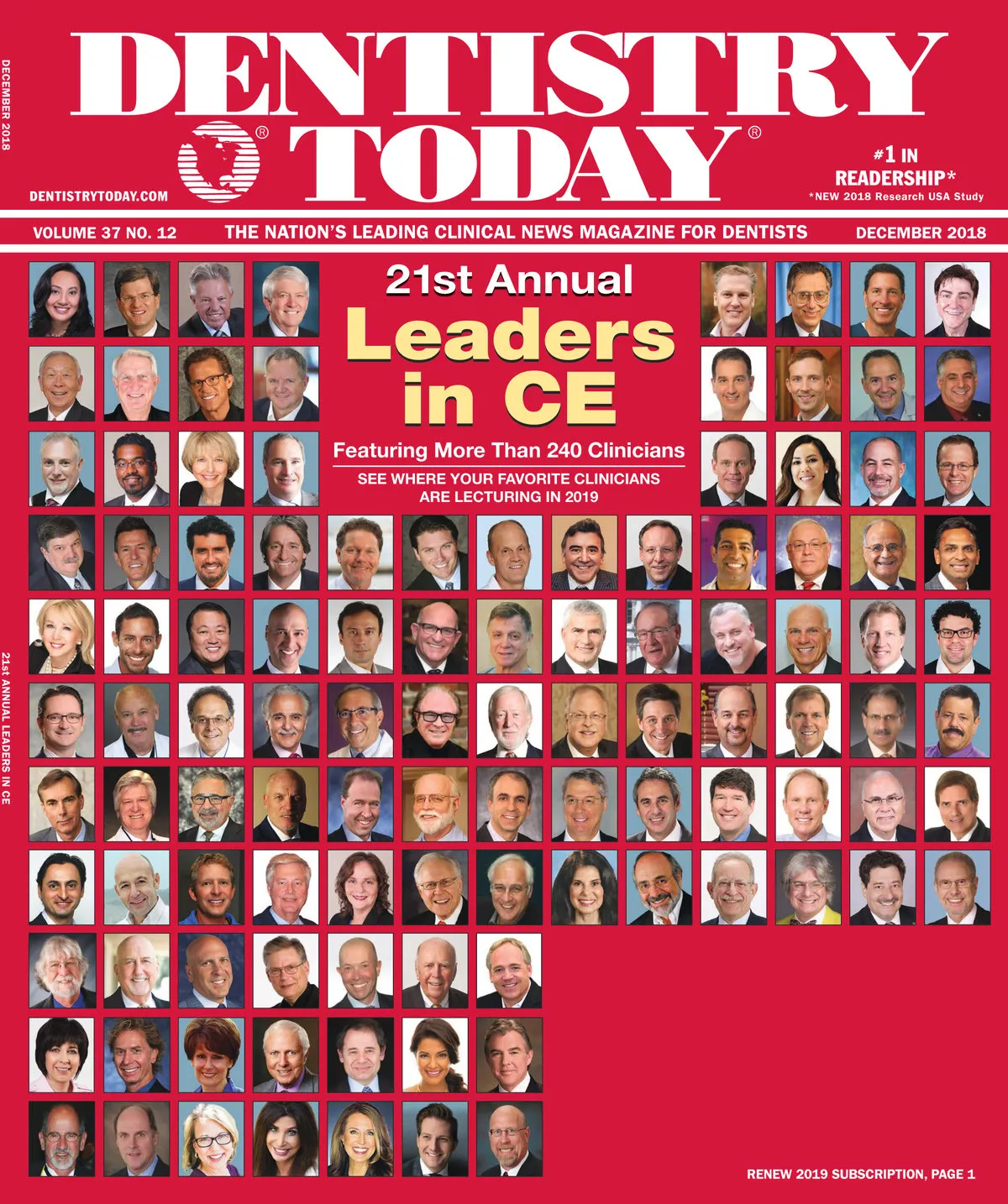
Dentistry Today — December 2018
Clinical articles, techniques, product news and continuing education for dentists. Read the full issue free in the digital edition.
Inside this issue
Excerpts from the issue. Open the digital edition to read any page in full.
- Page 8
Another Year of Change! This issue brings to close yet another amazing year for the dental profession! It was also a productive and rewarding year for our team in our mission to provide our loyal readers with 12 more informative issues of North America's leading clinical news magazine, Dentistry Today. As usual, with our 1st Leaders in Continuing Education issue, we celebrate the end of 2018, and the beginning of 2019, by honoring a distinguished group of lecturers and consultants. These leaders are actively serving the profession by teaching and mentoring others in the practice and/or the business of dentistry.…
- Page 10
Equating Medical and Dental Need to False Economic Demand Undoubtedly, there exists a great deal of need for dental care within our society. This includes disadvantaged children, disabled persons, imprisoned elders, chronic drug and alcohol abusers, those in our prison populations, homeless people, undocumented aliens, those with severe dental phobias, and people who place little value on or concern over their dental services. It is a mistake to conflate the need for dental healthcare services with an economic demand for those services. An early paper from the public health community published in 1971 made the distinction between an ethical medical…
- Page 12
VIEWPOINT continued from page 8 are expanding. Student loan debt is growing. New graduates struggle to find employment venues not enmeshed in an operational model of healthcare fraud, and/or run like a sweatshop mill, with little concern for patients' interests. Not only do recent dental graduates suffer, so does ethical patient care. The "Access to Care" Industry Some of the most visible players in the "access to care" industry are nonprofit groups like Kellogg and few. I believe they truly care about our nation's underserved populations. While their objectives seem noble, their means generate a host of negative, unintended consequences.…
- Page 14
FOCUS ON: HIPAA and Cybersecurity Lorne Lavine, DMD, discusses the HIPAA and cybersecurity issues that dentists are currently facing. Q: What is the single biggest threat that dentists face when it comes to cybersecurity? A: In my opinion, the biggest threat is ransomware. These are the viruses that will lock your critical files until you pay a "ransom" to get the unlock key. The ransom can range from as little as $300 to as high as $5,000 or more. These are a number of reasons why these viruses are so worrisome. First and foremost, they can be incredibly disruptive to…
- Page 16
CLINICAL REVIEWS DA DENTAL ADVISOR iOptima ★★★★½ (91%) Bien-Air | (800) 433-2436 | bienair.com Consultants' Comments • "Patients commented on the high-tech nature of iOptima." • "I'm not an iPod user, but this was intuitive." • "The preprogrammed settings make this system unique and user-friendly." • "Handpiece runs quietly and smoothly." • "A larger screen would be easier to see and navigate." • "There was no setting for reciprocating endo files." Description The iOptima is an Apple iPod interface that allows the operator to convert his or her dental unit to an electric handpiece system. The iOptima app must be…
- Page 18
Thick as a Brick Paul Feuerstein, DMD The game has now changed... with bonded restorations and new zirconia materials. Something as simple as creating an endo access hole now takes on a new dimension. Whether digital or analog, when constructing single posterior crowns, we all have issues with "the bite." I do not want to get into a detailed discussion on occlusion; dentists spend their careers taking courses in this area. Right now, I am talking to the practitioner who does a fair number of single crowns using triple on quadrant trays and gets a case back from the lab…
- Page 20
Transition to Digital: The Time Is Now John C. Cranham, DDS When I began my practice in the late 1980s, computers did not exist in dental offices. Soon, they began to appear at the front desk to perform basic accounting procedures, word processing, and other clerical tasks. By the early 1990s, practice management software that enabled scheduling started to become more common. For a lot of us, trusting a computer with all of our appoint ments was unfathomable. So, for some of us, we had both. We had our front desk employees write down the appointment in an appointment book,…
- Page 22
Figure 2. The pre-op occlusal view of the maxilla. Figure 3. The pre-op maximal intercusps tion (MIC). Figure 4. The pre-op teeth, apart (note cant and wear). Figure 5. The pre-op lower occlusal view. Figure 6. The digital diagnostic wax-up. Figure 7. The provisional restorations. Figure 8. An example of a digital scan of props. Figure 9. The postoperative smile. Figure 10. The left lateral smile. Figure 11. The post-op "E" position. Figure 12. The post-op retracted (teeth apart) view of the completed case. Figure 13. Close-up of the finished restorations. Transition to Digital: The Time is Now continued from…
- Page 23
TECHNOLOGY 21 Therefore, we determined no further diagnostic evaluations were necessary. The Treatment Planning Phase After we completed the diagnosis phase, we began to review the problems and determine the most effective plan of action. A complete treatment plan will solve all the biological issues (caries and periodontal problems), address structural problems with individual tooth design a stable occlusal scheme for the patient, and allow the clinician to visualize the optimal size, shape, and position of the teeth for aesthetics. With all these factors to consider, a programmed approach to analysis is key. Utilizing the photographs and information within The…
- Page 24
Spotlight Pocket-Size Laser Offers Same Power Output as Conventional Soft-Tissue Options LOMPOC, Calif.–This latest evolution in cordless soft-tissue lasers enables one to deliver the benefits of laser dentistry to each patient while increasing practice production across all departments. DenMat's pocket-size, wireless NV Microlaser is completely portable yet just as powerful as conventional soft-tissue lasers. Weighing only 1.9 oz and measuring at 6.9 in., this innovative, hand-held design provides unprecedented freedom in the office and the operatory. The plug-and-play system comes with 12 preset procedural settings optimized for your entire periodontal, restorative, and orthodontic treatment needs. The NV PRO 3 features…
- Page 26
Abutment Provides Aesthetic and Convenient Restorations IRVINE, Calif.-TruAbutment expands its innovative solutions with the addition of the Angulated Screw Channel (ASC) to its custom abutment products. Even though screw-retained solutions have become the standard with the advent of CAD/CAM technology, it has been largely limited to posterior restorations due to the design challenges in the anterior region. The pioneering concept of the ASC Ti bases has allowed users to deal with these challenges by providing a restoration that is aesthetic and convenient. But the launch of TruAbutment ASC will further advance the concept by integrating the ASC into the current…
- Page 27
Slimmer Size Makes Laser Easier To Maneuver Around Operatory NEEDHAM, Mass.–The advancements from Convergent Dental's latest version of Solea provide unprecedented performance, significant software upgrades, improved ergonomics, increased accessibility, and a smaller footprint. Solea earned its reputation for enabling dramatic practice growth and reduced stress for dentists and patients by taking anesthesia, bleeding, sutures, and discomfort out of the dental experience. Before the launch of this new platform, Solea dentists reported doing 4 to 6 more procedures per day while feeling like they were doing less work. With this new generation, Solea dentists will benefit from even more growth while…
- Page 28
Inadequate Occlusal Reduction: 'Not My Problem!' Athas N. Kometas, DMD So you think inadequate occlusal reduction is not a problem in your practice? Regardless of whether you work in corporate dentistry, a solo practice, a group practice, or a fee-chair periodontic practice, inadequate occlusal reduction happens more often than you think. For dentists that prep and the opposing teeth, inadequate reduction is immediately evident; impression dentists rely on acetate models to find inadequate reduction. The unwelcome call from the laboratory occurs too often. I took pride in seldom receiving a call from my laboratory. I thought I was a superstar,…
- Page 30
Spotlight Composite Provides Clinicians With Ideal Flow for Range of Indications ENCINITAS, Calif.–Estelite Universal Flow from Tokuyama Dental America is a new, supranano-filled flowable composite available in 3 viscosities (high, medium, and super low) to provide clinicians with the ideal flow for a range of indications. It has a higher filler content than traditional flowables and offers the benefits expected from less viscous composites, such as great cavity adaptation and easy handling, without compromising strength. Estelite Universal Flow helps clinicians reduce inventory and save costs because one composite shade blends with several tooth shades. The product's spherical fillers are the…
- Page 32
Product Offers Simple Way To Fit Crowns by Accurately Marking Contacts for Adjustment KENNESAW, Ga.–Microcopy announces the launch of Proxi-Chek, the newest addition to the family of single-use articulation products. It offers a simple way for dentists to fit crowns by accurately marking contacts for adjustment, ensuring complete marginal seating, maximizing efficiency, and leading to more predictable results. Its unique, one-of-a-kind handle and articulation film make marking interproximal contacts in all locations of the mouth extremely easy. In addition, the easy grip handle is bendable, allowing the user to reach proximal contacts. The current process when fitting a crown can…
- Page 34
Composite Improves Predictability and Durability of Posterior Restorations SCHAUMBURG, Ill—BISCO Dental Products' REVEAL HD Bulk is a light-cured, bulk-fill composite designed to improve the quality and timeliness of restorations. It is optimized to allow for easier, faster posterior restorations by combining superior levels of handling, placement, and depth of cure. The exceptional ease-of-use allows for simple and convenient placement of the composite in the prep while the category-leading depth of cure ensures a solid restoration from the top down so you can cure with confidence. BISCO's HD Filler Technology allows REVEAL HD Bulk to improve the predictability and durability of…
- Page 35
Restoring Endodontic Teeth in the Adhesive Age A Rationale for Posts and Ferrules Gregori M. Kurtzman, DDS Although adhesive dentistry has improved the quality and longevity of our restorative treatments, tried-and-true principles are still valid today. When teeth are approached from an engineering principles standpoint, long-term prognosis increases. However, if the treatment protocol is from the "bonding holds it all together" approach, success suffers. These principles are especially true when restoring endodontically treated teeth. Frequently, teeth requiring endodontic treatment have either existing restorative material (amalgam or composite) or recurrent decay, and often both are present in the same tooth. Endodontic…
- Page 36
RESTORATIVE FIGURE 3. (a) Cuspal flexure occurs when the tooth is loaded. (b) Greater flexure occurs when the tooth has been restored with an occlusal restoration but has not been endodontically treated. (c) Even endodontically treated, even with greater cuspal flexure is possible. (d) which may lead to cuspal fracture after being restored with a restoration with no cuspal shoeing. (e) Yet, with cuspal shoeing, flexure is prevented and fracture potential is diminished. been replaced by restorative material, cuspal flexure is allowed to increase. When both marginal ridges are missing, the potential of cuspal fracture increases under repetitive loading over…
- Page 37
RESTORATIVE 35 Figure 8. An endodontically treated premolar that has lost both marginal ridges, with greater than one third of the occlusal surface missing. This tooth will be subject to greater cuspal fissure under loading once restored with a direct restoration. Figure 9. An endodontically treated tooth with a native tooth remaining coronally (left) that would yield initial tooth structure to support a core buildup and once prepared for the crown (illustrated in yellow on the right). Figure 10. Illustrating posts in an endodontically treated molar to pin the core to the remaining tooth structure. Figure 11. A clinical case,…
- Page 40
Biocompatible Material... continued from page 36 The researchers see the work as a guide for the development of future materials for implants. "The reason why this works is that we have elevated the number of chemical crosslinks in materials to such a level that the properties we receive are extraordinary," explained Malloch. The researchers used light-initiated thiol-yne coupling (TYC) chemistry to polymerize triazine-trione monomers, in contrast to the standard thiol-ene coupling systems that are currently used. The TYC reaction generates higher crosslink density for more rigid and mechanically stronger materials. "This is due to the nature of the carbon-carbon triple…
- Page 41
Skeletal Stem Cells in "Resting Zone" Actually Are Hard at Work Skeletal stem cells are valuable because researchers believe they can heal many types of bone injury, but they're difficult to find because no one knows exactly what they look like or where they live. Researchers at the University of Michigan have identified a type of skeletal stem cell in the "resting zone" of the epiphyseal growth plate, which is a special cartilaginous tissue and an important driver for bone growth. In this image of the growth plate (the dark band in the middle), the red cells are the ones…
- Page 44
Poor Oral Health Impedes Blood Pressure Control Some studies have shown the benefit of periodontal therapy on blood pressure (BP), but the impact of periodontitis on BP control is unknown. Based on data from the National Health and Nutrition Examination Survey 2009 to 2014, researchers retrospectively analyzed cross-sectional, nationally representative data that treated hypertensive adults aged 30 years and older with and without periodontitis. BP was examined as both continuous (mm Hg) and categorical (treatment goal achievement status according to guidelines: at goal and above goal) variable according to the presence or absence of periodontitis and its clinical parameters (probing…
- Page 48
Aesthetic Success in the Anterior Region Immediate Placement and Temporization Charles D. Schlesinger, DDS Are you providing the very best treatment for your patients in the shortest possible time? With the advances in implant technology and the diagnostic aides available, there are no excuses when treating a patient with an emergent condition. The immediate placement of implants with immediate temporization has recently seen gains in popularity among clinicians. Barone et al¹ demonstrated the validity of this clinical protocol, and Degidi et al² presented a large number of immediately provisionalized implants with a 5-year success rate of 97.2%. The challenge is…
- Page 50
Figure 3. The extracted tooth, with an oblique fracture. Figure 4. Preservation of the hard and soft tissues following atraumatic extraction. Figure 5. The redirected pilot drill. Figure 6. Completion of the osteotomy with the final. Figure 7. Allografт regenerative material. Figure 8. A 3.0 × 13 mm Hahn Tapered Implant (Glidewell Laboratories). Figure 9. The completely seated implant. Figure 10. A radiograph showing platform position. Figure 11. A titanium abutment was used for the provisional restoration. Figure 12. Containment of the graft material. Figure 13. The provisional (temporary) restoration. Figure 14. A 2.5-month postoperative radiograph. Figure 15. A radiograph,…
- Page 52
Aesthetic Success in the Anterior... continued from page 48 phase could proceed without any delay. It should be noted in the 3–5 month radiography (Figure 14) that the inter-radial contact contact and platform switching had contributed to the preservation of bone at the crest. Studies have shown high crest bone stability around conical tapered platform switched implants.11 Platform switching has been shown to have a significant effect in the preservation of marginal bone levels compared with platform-matching restorations.14 A closed-tray impression coping was placed, and full seating was verified using a radiograph (Figure 15). The final impression was taken with…
- Page 54
Simplifying Regenerative Therapy Paul Fugazzotto, DDS Figure 1. A patient presented with a non-space maintaining defect following the extraction of a maxillary central incisor. Figure 2. Bone regenerative therapy was performed with particulate material and a resorbable membrane. Note the non-ideal alveolar crest ridge form. Figure 3. A patient presented with a non-space maintaining defect following the extraction of a maxillary central incisor. Figure 4. An ideal alveolar ridge form was re-attained following therapy with a particular material and a titanium reinforced membrane. Figure 5. The patient presented with significant atrophy due to the maxillary central incisors having been missing…
- Page 55
Material Selection Confidence in the ability to maintain soft-tissue proximity throughout the course of regeneration allows the clinician to choose appropriate regenerative materials based on defect morphology, rather than pragmatic limitations. The importance of such selection criteria is evident when deciding between a resorbable or titanium reinforced covering membrane in a given situation. Clinical Examples A patient presented with significant osseous loss following the removal of a maxillary central incisor. The buccal wall of the alveolar bone was missing, and the residual alveolar defect was non-surgical maintaining (Figure 1). Six months following the use of particulate material and a resorbable…
- Page 56
Exceptional Direct Restorations New Diagnostics, Composite Materials, and Sectional Rings Todd Snyder, DDS As technology and materials science continue to develop in dentistry, patients increasingly expect less invasive, more aesthetic, more durable restorations. Furthermore, patients expect them to be completed in a shorter amount of time. Fortunately, the combination of new diagnostic devices and advanced composite resin materials has made it possible to meet these expectations in many situations, including when treating caries. Early diagnosis expands the clinician's options for treatment,¹ and new materials utilized in conjunction with the appropriate techniques can provide restorations that blend in with the natural…
- Page 58
RESTORATIVE FIGURE 2. A rubber dam was placed for isolation, and a TrsDent Wedgeguard (UltraDent Products) was placed interproximally to minimize risk for iatrogenic trauma. FIGURE 3. A pear shaped diamond bur was used to expose the top of the tooth decay. FIGURE 4. The preparation design after complete removal of the decay and verification with a caries indicator (Caries Detector [Kuraray America]). FIGURE 5. The same technique was utilized to remove interproximal decay from the mesial surface of tooth no. 14. FIGURE 6. With all of the pathology and failing restorations removed, the teeth could begin to be restored.…
- Page 59
RESTORATIVE 57 on top of the flowable material, and it was cured again for 20 seconds (Figure 11). Evanesce offers exceptional handling with no slumping or stickiness. It blends effortlessly in the anterior and posterior dentition as a result of its optimized refractive index, which is similar to tooth structure. The "evanescence effect" is a result of the material's outstanding polishability and its ability to make margins disappear. In many cases, only one shade is necessary to achieve superior aesthetics. The Dual Force Sectional rings were then removed so that excess material could be cleaned off and the occlusion could…
- Page 60
More Precise Way To Re-treat Root Canals Manor Haas, DDS, MSc INTRODUCTION The clinical outcome of teeth with well-done root canal treatments and proper restorative treatments (as indicated) has been shown to be very high, often with success rates around 90% and survival rates at nearly 95.1-3 That being said, there are still some root canal treatments that fail and require nonsurgical endodontic re-treatment. With the incorporation of enhanced instruments, including dental microscopes and cone beam imaging, failing root canals can now be more precisely diagnosed and re-treated. Conventional 2-D radiographs (ie, periapicals and Panorex radiographs) are limited in what…
- Page 62
Figure 3. Buccal view of tooth No. 3. Figure 4. A preoperative 2-D periapical, showing tooth No. 3 with an MB root "J-shaped" lesion (red arrows). Figure 5. Axial view, showing the lesion centered around the untreated MB2 canal in tooth No. 3. Figure 6. Coronal view, showing intact buccal and palatal bone and an apical lesion over the untreated MB2 canal. Figure 7. Sagittal view, showing the MB apical lesion. Figure 8. A volume rendering of the buccal view of the tooth No. 3 site, with no vertical bone loss. Figure 9. The initial view of endo access, showing…
- Page 63
ENDODONTICS one year follow up, the preoperative MB apical lesion healed, and the patient was asymptomatic (Figures 6 to 14). DISCUSSION Traditionally, the case presented would likely be deemed as hopeless. Its J-shaped root lesion has been, and still is, considered to be indicative of a vertical root fracture. Without having to raise an exploratory surgical flap or perform an exploratory endodontic access, we were able to easily and precisely determine the exact nature of the lesion and not run the full length of the MB root. Furthermore, with the 3 D scan, we were able to determine the exact…
- Page 64
Direct Composite Veneers: A Viable Treatment Option Kevin Brown, DDS INTRODUCTION Direct composite veneers are one of those restorative treatments that have mixed opinions. In general, when a veneer is indicated, porcelain is the ideal material as it has strength and beauty. Porcelain is also much easier for the clinist, in terms of fabricating the actual restoration(s), since it is the ceramist who builds the restoration(s). Direct composite veneers, by contrast, can be difficult and frustrating for the dentist to layer, shape, and polish directly in the patient's mouth. In addition, composite will generally not last as long as all-ceramic…
- Page 66
Direct Composite Veneers: A Viable... continued from page 62 position, tooth size/shape/contour, and occlusion. In addition, the diagnostic wax-up can be used as a trial smile for the patient. This is done by taking an impression of the wax-up and then using a provisional crown material (Turbo Temp 2 [Zest Dental Solutions]) to duplicate the wax-up in the patient's mouth. This important step in the planning process allows the patient to see and feel what the intended final restorations will be like and to customize them. Helpful feedback is often received from the patient, replacing any tears and/or anxieties that…
- Page 67
Figure 12. Enamel shade EB1 was feathered onto the incisal third. Figure 13. A thin top layer of MW composite was applied to the incisal half. Figure 14. Layering was completed on teeth Nos. 3 to 14. Figure 15. Shaping and polishing were completed. Figure 16. One-week postoperative photos. by Fahl, the lingual shelf was created on teeth Nos. 8 and 9 with the achromatic milky white (MW) shade, using the silicon putty index as the guide. A clear Mylar strip was inserted into the slot created within the silicon putty index to facilitate the establishment of the midline and…
- Page 78
Test 228 dentalCEtoday.com PERIODONTICS Importance of the Quality of Tissue Supporting Dental Implants This article discusses the importance of soft tissue around implants, in terms of overall treatment success, and the management of peri-implantitis using various methods, with emphasis placed on coordinated treatment. Ahmad Soolari, DMD, MS, is a Diplomate and examiner of the American Board of Periodontology. He has a certificate in periodontics from Eastman Dental and an MS degree from the University of Rochester in New York. He is a former clinical associate professor at the University of Maryland School of Dentistry in Baltimore. Dr. Soolari specializes in…
- Page 79
Figure 1. Pretreatment panoramic view. Figure 2. Pretreatment radiograph, from the maxillary right side. Figure 3. Pretreatment closeup view. CASE REPORT Diagnosis and Treatment Planning An 88-year-old male was referred to our office for periodontal evaluation and treatment. The patient's chief complaint was pain and swelling on the maxillary right side that would not go away with antibiotics and pain medication. Clinical and radiographic evaluation, including cone beam computed tomography (CBCT), disclosed root implants and a micrography deformity associated with an implant-supported prosthesis (Figures 1 to 4). The patient pointed to implant No. 4 as the source of pain. We…
- Page 80
Figure 4. Pretreatment photo of the maxillary and mandibular right side. In comparison with the mandibular right posterior gingiva, the maxilla has no keratinized mucosa and exhibits a shallow vestibule with frenum pull. Figure 5. Pretreatment view of the maxillary right posterior region. Figure 6. A surgical treatment photo, demonstrating bone loss. Figure 7. Microsurgical surgery was performed to generate quality tissue supporting the dental implants. Implant No. 4 was removed. Figure 8. Three months post-treatment, exhibiting the generation of quality tissue. Figure 9. Three years post-treatment, showing excellent-quality tissue surrounding the implants with favorable results for a new implant-supported…
- Page 82
Intraoral Video Cameras ACTEON North America SoproCARE gives the dental professional a visual tool to educate the patient on the importance of good dental hygiene and periodontal health. Utilizing fluorescence technology, SoproCARE eliminates dental tissue to reveal occlusal caries, plaque, tartar, and gingival inflammation. It can also be used as an intraoral camera to perform a complete and time-efficient oral examination. It is Windowsand MAC-compatible and functions in nearly all imaging software applications. SoproCARE is compatible with current previous SOPRO docking stations. For more information, call (800) 289-6367. FREEinfo, Air Techniques Whether for patient education, caries detection, or accurate clinical…
And 2 more pages — read the whole issue.