
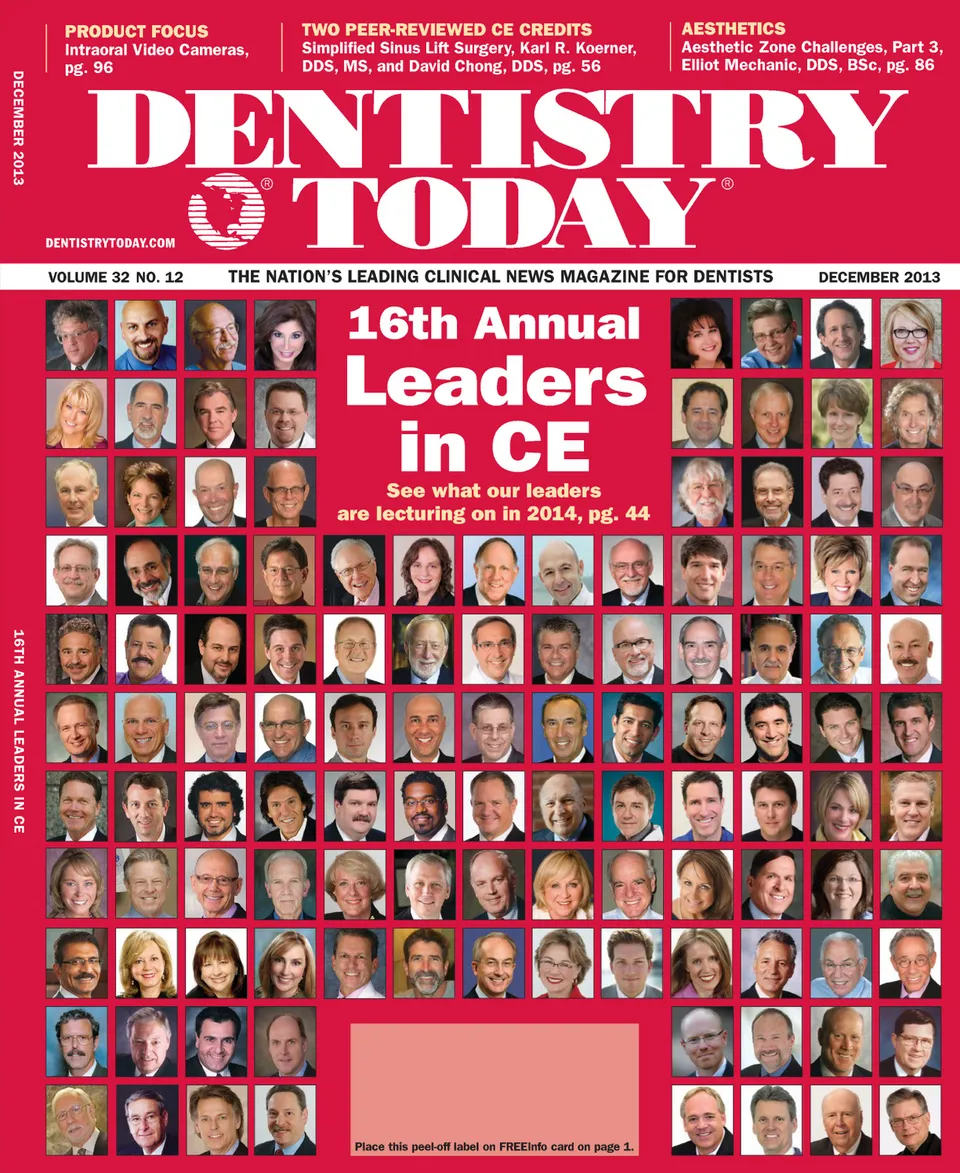
December 2013 · 108 pages
Dentistry Today — December 2013
Clinical articles, techniques, product news and continuing education for dentists. Read the full issue free in the digital edition.
Inside this issue
Excerpts from the issue. Open the digital edition to read any page in full.
- Page 14
Visit Our Site Today! Technique of the Week Endodontic Rotary System In this video on the Dentistry Today homepage, learn about TF Adaptive, an advanced endodontic rotary system from AxisSybronEndo. Viewers will get tips on how to safely, accurately, and efficiently clean and shape root canals. The adaptive motion technology puts the clinician in control as it changes the motion of the file based on the applied load. For more information, and to watch the video, visit . FREE CE Course Year-End Offer Due to the overwhelming positive response from the continuing education (CE) course offer that took place earlier…
- Page 16
FOCUS ON: Myofascial Pain Louis Malcmacher, DDS, discusses the link between facial pain and facial esthetics and treatment options. Q: Where does most facial pain come from and what does it have to do with facial esthetics? A: Well, like anything else, we always start with the evidence-based studies. Those dealing with myofascial pain show that 85% of temporomandibular joint (TMJ) dysfunction and orofacial pain come from muscles of the head and neck. It's finally time to understand the muscle trigger point mechanisms that have been studied and identified for more than 50 years. In short, a trigger point is…
- Page 18
From the September 2013 Issue INSTRUMENT WASHER SciCan HYDRIM C61w G4 uses fresh water and cleaning solution for every cycle to ensure superior washing results, and its unique combination of safety, efficiency, and instrument protection simplify reprocessing and maximize your return on investment. It has a capacity of 6 full-size cassettes, allowing offices to turn over 120 instruments in 35 minutes. For more information, call (800) 572-1211 or visit scicanusa.com. FREEinfo, GERMICIDAL CLEANER/DEODORANT GC America COE FOAM II, a rinseless, dripless foaming germicidal cleanser and deodorant, (1) kills more viruses, including MRSA, on treated surfaces, (2) has a cleaner fresh…
- Page 20
Spotlight Matrix System Components Now Available in Multipack Options SOUTH JORDAN, Utah–Trident and Ultradent Products announce the availability of the V4 ring for purchase in multipacks of 2 and 3, offering clinicians who already own Trident's V4 Clearband Matrix System the convenience of replacing and replenishing the V4 rings as necessary. The multipacks also give clinicians unprecedented value, with the V4 Ring 3 Pack offering the lowest price per ring available. V4 Ring multipack options include the following: a mixed 2-pack that includes a molar and premolar ring, a premolar 2-pack, a molar 2-pack, and a V4 Ring 3-pack that…
- Page 22
Web-Based Dental Software Now Offered With Online Patient Payment and Appointment Reminder Options ONYX, Utah–Curve Dental, months after introducing Web-based dental software, introduces Curve Connex, a package of patient communication tools that include (2) a patient portal for online payments and (2) an automated appointment reminder system. The patient portal is an online extension of the practice wherein patients can make payments, review statements, and view past pay materials. In addition, it provides the visiting patient with a library of more than 60 fully automated and professionally produced educational videos. And whenever a visiting patient watches a video at any…
- Page 24
Spotlight Feature-Laden Ultrasonic Unit's Versatility Cited Internet-Ready Instrument Washer Designed to Ensure Superior Washing Results CANONSBURG, Pa–With SciCan's Internet-ready HY-DRIM C6rw G4, instrument cleaning has never been faster or smarter. It uses fresh water and cleaning solution for every cycle to ensure superior washing results, and its unique combination of safety, efficiency, and in-instrument protection simplifies reprocessing and maximizes your return on investment. The HYDRIM C6rw G4 has a capacity of 6 full-size cassettes, the largest of its kind, allowing offices to turn over 120 instruments in 35 minutes, start to day, and its tabletop footprint allows for under-the-counter or…
- Page 25
Caulk's Aquasil Ultra Cordless Tissue Managing Impression System Take Crown-and-Bridge Impressions Without Retraction Cord or Retraction Paste Jason H. Goodchild, DMD Crown-and-bridge impression errors such as voids, tears, pulls, and drags may lead to unwanted remakes and mistakes. Unequivocally recording the details of the prepared tooth and surrounding structures is vital to the success of crown-and-bridge procedures. Despite advancements in almost every facet of impression taking, dentists are still faced with 3 major challenges when attempting to accurately record conventional crown-and-bridge impressions: (1) tray managing the soft tissue, (2) placing material precisely around the properly prepared tooth, and (3) dispensing…
- Page 26
INNOVATIONS . 1 Spotlight Dental Shells Facilitate Smile Design and Include Patient in Design Process ALBANY, NY–Nobilium's Visionaire Dental Shells, developed by Joseph Massad, DDS, are single-piece, 8-tooth temporary aesthetic veneers used to preview the final smile design for a complete denture. Working together, the dentist and the patient can design and agree upon the final aesthetic setup, including tooth shape and positioning. The shells optimize occlusion, phonetics, aesthetics, and lip support. There are 3 shell sizes—small, medium, and large—and 4 mold forms that vary according to the patient's vertical dimension of occlusion and facial form. The shells are warmed…
- Page 28
Spotlight Self-Adhesive Flowable Composite Helps Practices Maximize Efficiency ENGLEWOOD, NJ–To help modern practices maximize efficiency, DMG America now offers Constic, a 3-in-1 self-adhesive flowable composite. Engineered for multiple clinical procedures, it offers etching, bonding, and filling in a single step. This enhanced efficiency not only saves clinicians time, but it also helps eliminate potential mistakes by simplifying the application procedure. Constic was created for use on Class I and II restorations, for application as a base/liner under traditional composites, or for pit and fissure sealing. When compared to other self-adhesive flowable composites, it provides one of the strongest bonds to…
- Page 29
Nanohybrid Composite's Aesthetics Cited CLINTON TOWNSHIP, Mich.–NANOCERAM light-cure nanohybrid composite is formulated with a special blend of microfillers and nanofillers that produce superior restoratives, and high aesthetic results have been achieved through the development of a sophisticated method for the integration of the nanoparticles in the resin matrix. These nanoparticles, with an average particle size of 20 μm, assist in a quick polish after placement and create ultralow wear. For more information, call Exacta Dental at (800) 474-7665. FREEinfo, Five-Stage Aligner Offered SAN JOSE, Calif.–Align Technology and Henry Schein Dental have partnered to distribute Realine, a straightforward, 5-stage clear aligner…
- Page 31
Single-Tooth Anesthesia System Facilitates Administration of Injections WOODINVILLE, Wash.—Ideal for pediatric, endo, implant, oral surgery, and general dentistry, the Wand STA (Single-Tooth Anesthesia) All-Injection System allows the clinician to gently, precisely, and quickly administer dental injections (PDL, block, palatal, etc) without the anxiety of traditional syringes. Single-tooth injections eliminate numbness of the cheek, lips, and tongue for a more pleasant experience during and after procedures, and the immediate onset of profound anesthesia means no waiting time. Doctors can perform bilateral dentistry during a single visit. Featuring a dosimeter and depth guide, the Wand STA provides real-time audio/visual feedback, and it's…
- Page 32
Four-Step Kit Facilitates Complete Anterior Irrigation RACINE, Wis.-Vista Dental Products' recently introduced CanalClean AA Kit, the first research-based (data on file) 4-step irrigation kit, is designed to provide the best approach to single or double root canal irrigation. The kit's complete anterior anatomy irrigation regimen optimizes time spent on irrigation. There's no need to fill syringes, and costs are no more than basic individual components. Included in the kit are the following items: (Step 1) Chlor-XTRA, a patented 6% sodium hypochlorite formula enhanced with powerful wetting agents and proprietary surface modifiers; (Step 2) EDTA, which opens dentin tubules and facilitates…
- Page 33
The Application of Polydentia SA's F-Split-Aid Slim in Periodontics Polydentia SA's F-Split-Aid Slim, a fiberglass ribbon preimpregnated with an adhesive agent, is the first of its kind in the world. Packaged in a resealable bottle, it offers the following benefits: it's ready to use—only a few steps are required to achieve an outstanding result; it's extremely aesthetic—splinting a similar color to the natural teeth; it's made of proprietary material—the fiberglass ribbon ensures excellent durability; it's easy to package—the dark plastic bottle protects against light; it's simple to open and close, prevents oxidized material, and ensures a long expiration date; and…
- Page 34
CLINICAL REVIEWS THE DENTAL ADVISOR MIXPAC Automix Tips +++++ Sulzer Ltd | sulzer.com Consultants' Comments • "Homogeneous mix and less waste." • "I found the MIXPAC tips to be an excellent product, providing a savings to the office without changing procedures." • "Easier to extrude material." • "Got a good mix every time." • "Shorter tips are easier to handle." • "Tight fit onto some cartridges." Description MIXPAC Automix Tips are designed to minimize material waste while providing high-quality mixing results. Their design allows for a more compact shape by incorporating a higher number of mixing layers internally. The tips…
- Page 36
NEWS/TRENDS Industry News 3M ESPE Announces Managerial Appointment 3M ESPE announced recently that Kathy Gaertner has been appointed director of US marketing and business operations. In her new role, she will oversee 3M ESPE's domestic marketing efforts, business operations, and relationships with distributors. Ms. Gaertner most recently served as 3M ESPE's direct solutions global business team leader, overseeing a category of 3M ESPE's dental business that includes such products such as Filtek Supreme Ultra Universal Restorative and Scotchbond universal Adhesive. Prosthodontists Group Honors Lee Culp, CDT During its 2013 Annual Session held recently at the American College of Prosthodontists in…
- Page 38
NEWS/TRENDS Give Kids a Smile Program Honors Two Dedicated Supporters Two dedicated supporters of the Give Kids A Smile (GKAS) program—Candy B. Ross of KaVo Kerr Group and Kathi L. Woodard of the Ohio Dental Association—were presented with GKAS "Smile Champion" Awards at the GKAS Gala held at the ADA's recent Annual Session in New Orleans. The award recognizes their efforts to expand the GKAS program to reach even more underserved children. One of the GKAS program's most powerful champions, Ms. Ross has worked to expand GKAS by carrying its message within her marketing events, and at local events. Representing…
- Page 39
NEWS/TRENDS ADA Installs New President and President-Elect Charles H. Norman III, DDS, of Greensboro, NC, was recently installed as the 2014 ADA president during its Annual Session held recently in New Orleans, and Maxine Feinberg, DDS, who maintains a periodontics practice in Cranford, NJ, was chosen as the ADA's president-elect. Dr. Norman, a 1977 graduate of the University of North Carolina at Chapel Hill School of Dentistry, will lead the 157,000-member ADA for one year. Prior to becoming president, he served as the ADA's president-elect from 2012 to 2013. Dr. Feinberg, a graduate of New York University and New York…
- Page 42
In First Impressions, George Freedman, DDS, gives readers a brief summary of products that have recently been introduced to dentistry, based on his clinical experience. EQUIA Fil GC America The restorative dentist's primary objective (which happens to coincide with patient goals as well) include a minimally invasive preparation de-sign, minimizing operative time and trauma, and the preservation of healthy tooth structure. Since not all procedures can be accomplished under ideal conditions, some moisture tolerance is preferable. For long-term benefits, resin resistance and sustained fluoride release are also important. GC America has recently introduced EQUIA Fil, a comprehensive, glass ionomer-based, bulk-fill…
- Page 56
Test 168 dentalCEtoday.com Simplified Sinus Lift Surgery Dental implants for edentulous areas of the mouth have become the standard of care in the United States, and the number of dentists, particularly general dentists, placing them is increasing. One challenging location for these implants, however, is the posterior maxilla. Even with adequate crestal bone width, implant placement may be limited by a lack of vertical bone height. In the past, surgical techniques to overcome this obstacle were daunting, and the thought of approximating the maxillary sinus was out of the question for most conservative clinicians. With the development of new innovative…
- Page 57
MOVING BEYOND THE SUMMERS TECHNIQUE—LESS TRAUMA, FEWER COMPLICATIONS Other, newer rhinoplasty/home sinus elevation/bone augmentation devices and techniques are now available to more safely accomplish this procedure and lessen the problems listed above. Included in the various brands currently available are HIOSSEN's Crestal Approach Sinus (CAS) Kit (shown in Figures 3 and 1b and described in the paragraphs below), Zimmer Dental's Sinus Crestal The maxillary sinus is a pyramid with its base facing medially (toward the nose). Approach Kit, and Neobiotech's SCA Kit, which despite their differences in design, all provide a minimally invasive transalveolar osteotomy and bone grafting technique for…
- Page 58
ORAL SURGERY any disease, condition, or medication that might compromise healing or osseointegration.5 A consultation with a specialist can be obtained if needed. There should be sufficient bone buccal and lingual to the proposed osteotomy and at least 5 mm of vertical bone height (Figures 2a and 2b). With this system, the sinus floor does not have to be completely flat, but septa are avoided if possible as they can increase the chance of membrane perforation. Table. Amount of Graft Needed* Lift Height | Bone Graft 3 mm | 0.4 cc 4 mm | 0.5 cc 5 mm | 0.7…
- Page 59
periodic radiographs, it can be used at any time to confirm depth and to verify that the membrane has been lifted with the last drill. For safety, the stoppers can also be used with depth gauge but with the caution of not letting it penetrate beyond one mm into the sinus itself. There is quite a bit of variability in the thickness of the sinus membrane. The thickest mean values range from 2.16 to 3.11 mm in the midsagittal (vertical-center) area of the sinus but it can be as thin as 0.16 mm. Sinus perforation is infrequent with this system.…
- Page 60
ORAL SURGERY much bone graft material is inserted, and (2) the width of the sinus. Once the sinus membrane has been cleanly disengaged from the sinus wall, bone graft can be tunneled through the osteotomy. Bone graft material is deposited into the osteotomy with a bone carrier (amalgam carrier) and then pushed beyond the osteotomy into the newly created subantral compartment using the bone condenser with stopper tacked. The bone condenser is a double-ended instrument with a different diameter on each end to accommodate different widths of osteotomies. The stopper prevents the condenser from going beyond the sinus floor level…
- Page 61
Test 168 Expiration date of this CE article is December 1, 2016. To submit Continuing Education (CE) answers, use the answer sheet below. Or, use our easy online option at dentalcetoday.com. This article is available for 2 hours of CE credit. The following 10 questions were derived from the article "Simplified Sinus Lift Surgery" by Karl R. Koerner, DDS, MS, and David Chong, DDS, on pages 56 to 60. Learning Objectives: After reading this article, the individual will learn: (1) background information on surgical considerations for sinus displacement/bone graft procedures, and (2) a modified and less traumatic version of the…
- Page 62
ce dentalCEtoday.com Go online to earn credit for reading this CE article. IMPLANTS Predictably Solving a Prosthetic Dilemma A Partially Edentulous Mandible Opposed by a Worn Maxillary Denture Almost all dentists have seen the following scenario when a new patient presents to his or her office: The patient is wearing a very old and worn maxillary denture, opposed by a partially edentulous mandible with the dentition broken down, exhibiting extensive periodontal involvement that makes the cast partial denture he or she is wearing almost useless. The patient has been delaying a definitive solution to this situation because of cost concerns…
- Page 64
Figure 3. Clinical presentation of the Ankylos (DENTSPLY Implants) implants, after uncovering and with the system's sulcus formers in place. Figure 4. The implants with their male attachments, torqued to place. Figure 5. The impression (used to convert the immediate full lower denture into the final prosthesis) with the abutment analogs in place. a b Figure 6a. The clinical result 15 months in service (retracted smile). Figure 6b. The clinical result 15 months in service (full smile). Figure 7. Seventeen months after placement (13 months in function), bone growth over the shoulders is noted on both Ankylos implants. Predictibly Solving…
- Page 66
TECHNOLOGY dentalCEtoday.com Go online to earn credit for reading this CE article. A New Day in Dentistry Technology Supports Collaboration With the Laboratory Team [Photo of Jerry Hu, DDS] Jerry Hu, DDS Figures 1a and 1b. Preoperative photos. Figure 2. Shade photo for the lab team. INTRODUCTION Advances in CAD/CAM technologies make it possible for clinicians to choose whether to mill crowns chairside or send digital impressions to the dental laboratory team for fabrication. With minimal training, digital impressions can be captured in a short amount of time. Studies show that digital impression methods may improve the accuracy of crown…
- Page 67
And lastly, but most importantly, the patient considered the case to be a success. DISCUSSION In this case, the E4D Sky feature allowed the dental practice to take advantage of the benefits of digital impression taking and the expertise of the dental laboratory. Throughout the entire process, there was no need for the clinician or the lab technician to be concerned about impression errors (such as bubbles, pulls, distortions, or shrinkage). Traditionally, if these errors are present, and any miscommunication develops, notable time can be wasted. Moreover, patients with temporary units on for an extended amount of time often develop…
- Page 68
dentalCEtoday.com Go online to earn credit for reading this CE article. RESTORATIVE Full-Mouth Restoration of a Severely Decayed Dentition INTRODUCTION Patients present to the dental office with a variety of needs with pressing and unique; some require a hygiene appointment and routine clinical examination, while others present with much greater challenges. In all cases, patients present with hope that their teeth are cavity free, the nagging pain in one of their molars is a simple fix, a cosmetic concern can be corrected, or perhaps years of poor oral hygiene and the resulting decay can be repaired, allowing a fresh start…
- Page 70
Figures 4a and 4b. During the clinical examination, a gingivobuccally cyst was discovered between the roots of the maxillary right cuspid and lateral incisor. It was surgically removed and sent for evaluation. Figure 5. Following crown lengthening surgery, sutures were placed to secure the gingival flap; they were removed 2 weeks later. Figure 6. Gingival tissues were allowed to heal for 3 months before beginning the restorative phase of treatment. Healing progressed without incident. Patients present to the dental office with a variety of needs both pressing and unique; some require a hygiene appointment.... Full-Mouth Restoration of a Severely... continued…
- Page 71
RESTORATIVE lain veneers (Figures 10a and 10b). Impressions were taken and provisional restorations fabricated exactly like those of the mandibular anterior teeth and bicuspids, with the exception that the extraction cord (in Van R Dental Products) was placed in the facial sulci of the maxillary anterior teeth as well as the bicuspids prior to impression taking. An arbitrary face-bow record was taken as well as a VPS occlusal registration record (IPS Iline RF paste Set [Coltene]) of the prepared teeth. The provisional restorations were trimmed and polished, and then tried on the teeth; care was taken to ensure correct incisal…
- Page 72
RESTORATIVE ry team to observe the seated provisional restorations in relation to the papillary line, gingival line, and lips. Quality allegations (dentic tic Alginmate [DUX Dental]) were taken of the provisional restorations and poured in stone, and a face bow record was taken of the provisionals. The lab oratory team can use the mounted models of the provisionals for a custom incisal guide table or VPS matrix guide for the final restorations. The final restorations (Kidspasic porcelain veneers and all-ceramic crowns [Ivoclar Dental Laboratory]) were fabricated by our lab team and returned to our office. The maxillary and mandibular provisional…
- Page 73
RESTORATIVE time for 16 veneers (10 upper, 6 lower) was 68 minutes. Final luting cement removal was accomplished with dental floss and scalers. If required, the margins may be further polished with ultra fine diamond burs (Brasseler USA Fluted Carbide Bur No. Ha.jFLFT3-0:2) with a light touch and high water volume, followed by rubber wheels and diamond polishing paste in a prophyaxis cup. The occlusion was adjusted so that there were no premature contacts on the anterior teeth, and oral contacts were bilateral and simultaneous on the cuspid and bicuspid teeth when the condyles were seated in CR. The incisal…
- Page 74
Optimizing Core Buildups and Post and Core Restorations Improving Clinical Techniques With New Resin Materials INTRODUCTION Core buildups and post/core restorations can be a challenge when adhesives are utilized to cure the base due to inadequate light output to polymerize the resins. This issue becomes increasingly problematic when deeper prior preparations are being restored. In these cases, unpolymerized adhesive may contribute to marginal leakage, leading to bond failure throughout time and subsequent caries at the margins. This has been addressed by the manufacturers with the development of self-cure promoters that can be added to light-cured adhesives. Yet these can lead…
- Page 75
Ready to make stunning Class IIs even easier? With the unique advantages of Triodent's ultra-versatile NEW V4 ClearMetal Sectional Matrix System™ and the renowned, multi-award-winning V3 System, you can easily cater for the complete range of Class II situations. V4 CLEARMETAL MATRIX SYSTEM™ New tine shape for added stability, matrix adaptation and grip V4 grips low on the tooth and is shaped to follow natural tooth anatomy - offering superior performance on a large box or a missing cusp without collapsing into the embrasure. Durable, easy-to-clean transparent tines Please of mind tines are made with bulk-fill composites or deep cavities.…
- Page 77
RESTORATIVE (just covering the dentin) was placed and then light-cured for 20 seconds (Figure 11). Placement of a thin layer followed by light-curing has been shown to improve bond strength of the resin to the core as compared to bulk filling the preparation; this ensures that the material in contact with the dentin surface has been cured with the light, not relying on the self-cure mode only (Figure 12). The preparation was then bulk filled with additional CLEARFIL DC CORE PLUS, then light-cured for 40 seconds from the occlusal (Figure 13). Next, the restorative was allowed to self-cure for 4…
- Page 78
Composite Resins 2.0 Entering a New Age of Posterior Composites INTRODUCTION Farag R. Kachalu, DDS Dental practitioners have been placing composite resin restorations for more than 50 years,1 and throughout this time, scientists around the world have invested numerous resources to create materials with great physical properties. Unfortunately, while physical properties of composite resin have improved, the time-consuming technique required to place these tooth-colored restorative materials has undergone little change. In fact, bulk fill composites first made their debut with the original paste-paste system. These composites were placed in larger increments, taking a few minutes to harden. In the 1970s,…
- Page 80
Figure 8. Restored with SonicFill and polished. Figure 9. (Case 2) Tooth No. 14: Preoperative condition showing fractured mesial marginal ridge. Figure 10. Protection device placed in the interproximal space. Figure 11. Caries and existing alloy removed and clear through sectional system placed. Figure 12. Maximum depth of restoration measured with periodontal probe. Figure 13. Adhesive applied and light-cured. Figure 14. View of restorations immediately after curing and removing sectional matrix system. Figure 15. Restored with SonicFill and polished. Composite Resins 2.0... continued from page 78 in 5.0 mm increments with no capping layer. The SonicFill system includes a handpiece…
- Page 81
RESTORATIVE the buccal and lingual surfaces for an additional 20 seconds each. After removing the rubber dam, a minor occlusal adjustment was made utilizing a 16-fluted carbide composite finishing bur (FT Series [Brasseler USA]). Finally, the restoration was polished utilizing a 3-step silicone-impregnated rubber point system (Jiffy Polishers [Ultradent Products]). The final result can be seen in Figure 8. Case 2 A 49-year-old male patient presented at his 6-month recall examination with a fractured mesial marginal ridge on tooth No. 14. Radiographic examination did not reveal any obvious signs of caries on the mesial approximal surface; however, the fractured mesial…
- Page 82
Isthmus Gifts Lisa Germain, DDS The construction of the Panama Canal, which created a water passage from the Atlantic to the Pacific Ocean, was a difficult and lengthy process. Early explorers of the Americas and European colonists of central America recognized the potential, but it was not attempted until technological advances allowed first France, and then ultimately the United States, to carry out the deep excavations necessary to complete the project. Opened in 1914, and still in operation today, it cuts across the isthmus of Panama, serving as an important conduit of international maritime trade. In a parallel world in…
And 13 more pages — read the whole issue.