
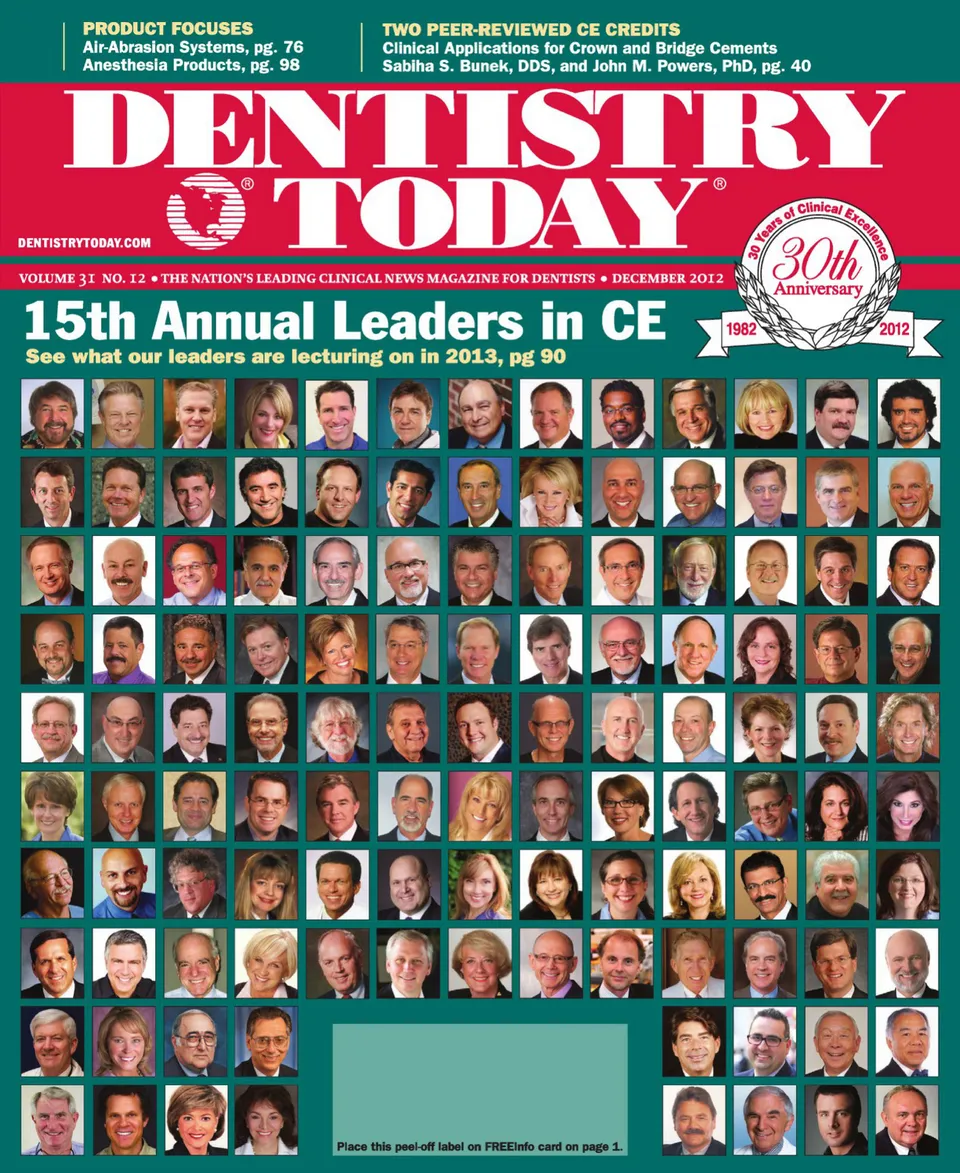
December 2012 · 108 pages
Dentistry Today — December 2012
Clinical articles, techniques, product news and continuing education for dentists. Read the full issue free in the digital edition.
Inside this issue
Excerpts from the issue. Open the digital edition to read any page in full.
- Page 8
Neither Wind nor Rain nor Sandy... Some of our readers may not be aware that the offices of Dentistry Today are located in Millville, NJ, seven miles from the region and especially New Jersey and parts of New York with a vengeance. Many people in this densely populated area felt the nasty effects of the storm. We were sad to learn that some of our own Dentistry Today team members' families' homes suffered severe damage. Our offices were shut down due to the lack of power and, even after opening up again one week later, a great number of area…
- Page 10
High-Tech, High-Touch: Use or Abuse? It used to be that the art of conversation meant a verbal exchange between one or more people. Now it is the art of texting! Nonverbal communication seems to be the way of the world, wherever you are in the world. Some might call it "conversation lite"! The whole genre of social media goes beyond texting or e-mail. It goes to the use of Facebook, Twitter, and YouTube, to name just 3 of the more popular social media venues. What is most interesting is that there seems to be age limitations or barriers to actively…
- Page 12
VIEWPOINT continued from page 10 them some advance money and/or providing your bank information. As adults, we are hopefully savvy to this unrealistic expectation and intrusion on our time, but what about our children, grandchildren, nieces, and nephews who are subject to electronic bullying? They may not be understanding the complexities of posting a derogatory remark or photograph electronically. We must continue to educate and monitor the use by these young individuals while walking the fine line of freedom of speech versus censorship. Nonverbal communication seems to be the way of the world, wherever you are in the world. Some…
- Page 14
FOCUS ON: Restorative Dentistry Martin B. Goldstein, DMD, discusses recent trends in restorative dentistry. Q: What are some of the trends in operative dentistry (the placement of direct restorations) in 2013 and beyond? A: Wow! The answer to that question alone could fill an entire publication. While amalgam remains on the menu in many dental settings throughout the country, you won't see it featured in dental advertisements. Composite is certainly the industry's focus, with manufacturers providing new and improved methods of placement. You don't have to look far to find promos on flowable composites that possess properties that now allow…
- Page 16
From the September 2012 Issue DESENSITIZING AGENT Tokuyama America The new Shield Force Plus desensitizing agent is a one-component, single-application, light-cured protective sealant designed for the treatment of hypersensitive dentin. It effectively infiltrates and seals exposed dentinal tubules to inhibit the flow of fluid. It also prevents loss of dentin due to abrasion and/or erosion of exposed cervical areas. For more information, call (877) 378-3548 or visit tokuyama-us.com/shieldforceplus. FREEinfo, SEALANT Ultradent Products UltraSeal XT hydro, a new sealant with a hydrophilic chemistry, incorporates advanced adhesive technology and fluorescent properties to offer exceptional, patient-centered results. Based on the proven, award-winning chemistry…
- Page 18
Exacta Dental By taking the successful original formula and utilizing new nanoparticle technology, the new generation of EXACTA Xtra temporary material allows users to create provisionals that are much stronger and appear more natural. Its unique ability to bond to itself allows for easy repair of voids, and it is ideal for single units yet strong enough for long-span bridges. For more information, call (800) 474-7665. FREEinfo, AUTOCLAVES SciCan The newest addition to the STATIM family of autoclaves, the STATIM G4 series boasts a contemporary new look and technology that provides a direct channel of communication through the Internet to…
- Page 20
To assist practitioners in their selection of essential dental products, Dentistry Today presents items reviewed by THE DENTAL ADVISOR's staff of editors and consultants. Established in 1984, THE DENTAL ADVISOR, based in Ann Arbor, Mich, has provided dental professionals worldwide with objective, accurate information using in vivo and in vitro results on the performance of materials and equipment based on clinical and laboratory research. For more information, visit dentaladvisor.com or call (800) 347-1330. TheraCal LC +++++ Bisco Dental Products | (800) 247-3368 | bisco.com Consultants' Comments • "I would switch; I love this product." • "No mixing required, and it's…
- Page 22
Spotlight Software Features Powerful New Cosmetic Imaging Module and Expanded Integration Capabilities HATFIELD, Pa.-Building on its legacy of having the easiest to use dental imaging program with the fastest workflow (data on file), DEXIS introduces DEXIS Imaging Suite 10.0.4, which offers progressive software architecture and new features that include a cosmetic imaging module, expanded video capabilities, an enhanced implant-planning module, and integration with select 3-D products. The cosmetic imaging module allows clinicians to plan, simulate, and present total cosmetic procedures and tooth-whitening treatments in just minutes, and powerful, easy-to-use blending, matching, and sculpting tools deliver realistic results. Expanding its function…
- Page 24
Spotlight Software Creates Truly Open Network of Chairside Restorative Solutions for Patient Treatment RICHARDSON, Tex-With the release of E4D DentaLogic software v 4.5, featuring E4D Sky, D4D Technologies introduces the creation of a truly open network of chairside restorative solutions for patient treatment. The E4D Sky communication network enables E4D system operators to exchange case data via the Internet with internal and external service providers, greatly extending the range of treatment they can provide their patients. With E4D v 4.5 and E4D Sky, a digital practice has chief flexibility and a full range of options for (2) assistance with more…
- Page 26
Spotlight Easy-to-Use Temporary Crown and Bridge Material Yields Optimal Aesthetic Results HUNTINGTON BEACH, Calif.–Kettenbach introduces Visalys Temp Temporary Crown and Bridge Material, a 2-component resin made without BPA, based on a multifunctional acrylic composite. It can be used to make highly aesthetic temporary crowns, partial crowns, bridges, inlays, onlays, and veneers, including long-term provisionals. Utilizing Visalys Temp, dentists can now make provisional restorations—even long-span provisionals—that are remarkably stable and fracture-resistant due to the material's unique monomer structure. In addition, Visalys Temp is easy to use and yields optimal aesthetic results. It can be precisely milled, minimizing dust formation, and its…
- Page 29
New Attachments Offered IRVINE, Calif.-J. Morita USA introduces TorqTech geared straight and contra angle attachments. Compatible with both air and electric motors, they include a 1:1 straight nose cone, 1:1 contra-angle, and a 1:5 speed up contra-angle. Designed with a new, high precision gear system, the attachments offer reduced operational noise and excellent bur stability, making large preparations quicker and easier. A long lasting chuck provides a strong grip on the bur, and a built-in water filter helps prevent spray line clogging and is easily removed for cleaning. For more information, call J. Morita USA at (888)JMORITA (566-7482). FREE info,…
- Page 32
Improved Caries Light Guide Added to Diagnostic System's Accessory Line DANBURY, Conn— AdDent's improved Proximal Caries Light Guide, an accessory to its Microlux Diagnostic System, features a 0.75 mm-diameter disposable fiber light guide that enables dentists to easily slide the fiber through the posterior interproximal space. This technique permits visualization of proximal caries as a shadow on the occlusal surface with the use of transillumination, and it can often show incipient proximal caries not visible on a standard x-ray. For additional information, call ADent at (203) 778-0200 or visit the Web site addent.com. FREEinfo, Restorative Material's Beauty and Durability Cited…
- Page 33
INNOVATIONS 33 System Facilitates Oral Cancer Exams and Assessment of Lesions SANTA MARIA, Calif.-In addition to the conventional oral cancer screening involving palpation and visual inspection, more and more dental practices are responding to the surprising growth in oral cancer by regularly examining patients with the VELscope Vx enhanced oral assessment system, now being distributed exclusively by DenMat. The VELscope Vx has been proven in numerous clinical studies to help discover cancerous and precancerous lesions and other lesions that might not be apparent to the naked eye. An exam takes only 2 minutes and involves no discomfort, rinses, or dyes,…
- Page 34
NEWS/TRENDS Industry News Ultradent Names Erwin Fischer Executive Vice President Ultradent announced recently the promotion of Erwin Fischer to executive vice president, where he will work with Dr. Dan Fischer, president and CEO of Ultradent, to continue to build upon the company's vision to improve oral health globally. For the past 6 years, Erwin Fischer served as Ultradent's vice president of information technology. His achievements include management of 2 major ERP implementations, certification as an Oracle DBA Master, and experience as an Oracle developer and business analyst. For more information, call (800) 552-5512 or visit ultradent.com. Minoa Marketing Launches New…
- Page 36
ADA Installs President and President-Elect The ADA announced recently that it has installed Robert A. Faiella, DMD, MMSC, of Osterville, Mass. as president and Charles H. Norman III, DDS, of Greensboro, NC, as president-elect. As the ADA's new president, Dr. Faiella will lead the 157,200-member organization for one year. Prior to becoming president, Dr. Faiella served as the ADA's president-elect from 2010 to 2012. Formerly president of the Massachusetts Dental Society, he earned his predoctoral education from Villanova University and a DMD degree from Fairleigh Dickinson University School of Dental Medicine. He earned his graduate training in periodontology as a…
- Page 37
Melatonin Levels and Periodontitis A study published in the Journal of Periodontology measured melatonin levels in the gingival crevicular fluid and saliva of patients with healthy oral tissues and varying degrees of periodontitis. A total of 70 subjects were examined and assigned to the following 4 groups: healthy periodontium (10 subjects), plaque-induced gingival inflammation (20 subjects), chronic periodontitis (20 subjects), and aggressive periodontitis (20 subjects). Gingival crevicular fluid and saliva samples were collected from each subject and analyzed using enzyme linked immunosorbent assays. The study found that melatonin levels in both gingival crevicular fluid and saliva were lower in patients…
- Page 38
In First Impressions, George Freedman, DDS, gives readers a brief summary of products that have recently been introduced to dentistry, based on his clinical experience. Optima MX2 INT Bien Air Electrical handpieces are better for preparation, less tiring for the practitioner, and far less noisy for both the dentist and the patient. It is well-established that the constant torque and speed of electrical handpieces make tooth preparation faster, more effective, and more efficient. Bien Air, the original developers of the electric handpiece, has recently introduced the Swiss-engineered Optima MX2 INT, a very versatile unit that offers preprogrammed modes for all…
- Page 44
Crown and Bridge Cements... continued from page 42 tion. Ease of use, cost, strength, solubility, and postoperative sensitivity are just a few. To add to the confusion, there are a large variety of cements to choose from. One type/category of cement is not ideal for every situation; therefore, it is imperative to understand the differences in the physical and mechanical properties, as well as handling characteristics. The following recommendations are based on the clinical experience of the Runels. Metal or ceramic-metal restorations: RMGI cements are excellent choices, especially if the patient is a high-caries-risk patient and could benefit from fluoride…
- Page 46
Test 156 Expiration date of this CE article is December 1, 2015. To submit Continuing Education (CE) answers, use the answer sheet on page 47. Circle the letter corresponding to the answer you believe is correct, detach the answer sheet from the magazine, and mail to Dentistry Today Department of Continuing Education. Or, use our easy online option at dentaltoday.com. This article is available for 2 hours of CE credit. The following 16 questions were derived from the article "Crown and Bridge Cements: Clinical Applications" by Sabiha S. Bunek, DDS, and John M. Powers, PhD, on pages 40 to 45.…
- Page 48
An Aesthetic Application for Lithium Disilicate Treatment of Missing Maxillary Lateral Incisors and Canine Substitution Jonathan L. Ference, DDS INTRODUCTION Dentists frequently see patients with missing or malformed teeth. Yet while congenitally missing teeth (particularly the maxillary lateral incisors, which are the second most common congenitally missing teeth) may be a common occurrence, providing optimal treatment for correcting the condition is anything but a simple process. Apart from the functionality and the health of teeth and tissue affected, aesthetics also plays a major role. The challenge of achieving optimal orthodontics and prosthetic treatment is extremely high due to the impact…
- Page 50
An Aesthetic Application... continued from page 48 tion, for all anterior teeth; there is no one "ideal" aesthetic standard when creating space for the replacement of missing lateral incisors.11,12 Instead, studies indicate that aesthetic "ideal" preferences vary by nationality/ethnicity, social norms, gender, and individual morphological facial proportions as well as individual cultural characteristics and perceptions of beauty.12 It All Comes Down to the Execution of a Good Plan What there is agreement on, however, is that for optimal results, planning and execution of restorative treatment must consider the following: smile design, width/length ratio of teeth, differences among the teeth, concepts…
- Page 51
DENTAL MATERIALS 51 ment plan would involve placing 6 pared to resemble the canines (Figure and interproximally. lithium disilicate veneers on teeth Nos. 9). Once in place, the white wax ap- Excellent results were achieved 5, 6, 8, 9, 11, and 12 to create a fuller peared to resemble the canines (Figure (Figures 12 to 14), with the patient more natural-looking smile. The 8), after which it was expressing satisfaction in the funccanines would be shaped to look like removed and used as the basis for cretion, comfort, and, most of all, aesthetlaterals, and the first premolars would ating provisional…
- Page 52
Endodontic Diagnosis: There's an App for That! INTRODUCTION Before you run and pick up your iPhone to download the endodontic diagnosis app, I must clarify that the app I am referring to is the "application," in the true sense of the word for endodontic diagnosis! I graduated from dental school with a "tooth mechanic" mentality. Then, for the better part of 25 years since dental school, I have been developing an "oral physician" thought process when it comes to practicing dentistry, and specifically with regard to endodontic diagnosis. Early in my dental career as a tooth mechanic, I would make…
- Page 53
carries on tooth No. 29. A periapical radiograph of tooth No. 29 (Figure 2) is taken. The caries on tooth No. 29 leads to the diagnosis that this tooth is the etiology of the patient's chief complaint. The dentist's treatment plan is to remove the caries and to place a filling if the pulp is not exposed, or the addition of endodontic treatment if pulp is exposed during treatment. Commentary: Although the caries on tooth No. 29 is in need of dental treatment, tooth mechanic mentality comes into play as the dentist is immediately drawn to the caries as the…
- Page 54
Along with the current periapical radiograph, it may be necessary to take multiple-angle periapical films, bite-wing radiographs, and cone beam tomography, if indicated. The dentist further examines the virtual patient using the additional 4 objective tests. Cold is placed on teeth Nos. 28, 29, 30, and 31; tooth No. 28 tests normal (cold dissipates within a few seconds); tooth No. 29 does not respond to cold test, EPT, and heat test; and tooth No. 30 elicits a lingering response to cold test beyond 5 seconds (reproducing the patient's chief complaint). Percussion test, palpation test, periodontal examinations are within normal limits…
- Page 55
Figure 7. Periapical radiograph of tooth No. 22. Commentary: This total disregard of a tooth (or teeth) testing within normal limits to the objective clinical exam, in favor of treating a diagnosis derived from the subjective findings, is not uncommon. After all, if you were trained as a tooth mechanic, as I had been, any pain in the mouth has a very high percentage of being tooth related. Whenever the objective diagnosis tests either do not correlate with the subjective patient symptoms or are within normal limits, you must take a mental step back to re-evaluate the etiology and diagnosis.…
- Page 56
The CT/CBCT-Based Team Approach to Care Part 3: Identifying Prosthetic Options Through Team Communication This is part 3 of a 3-part article series. Part 2 of this series by Tischler and Ganz's article was published in the October 2012 issue of Dentistry today and can be found in our archived articles at the Web site . Michael Tischler, DDS Scott D. Ganz, DMD INTRODUCTION This is the final article in a 3-part series on how cone beam computed tomography (CBCT) can bring the implant team together to deliver ideal treatment for the patient. Part 1 of this series discussed the…
- Page 58
The CT/CBCT-Based Team Approach... continued from page 56 cation between the restorative doctor and patient, creates a technologically advanced and yet personal experience for a patient. AVAILABLE PROSTHETIC OPTIONS AND THE TREATMENT PLAN PRESENTATION The clinician has 4 general choices to present to a patient when considering replacing missing teeth with an implant supported restoration: A screw retained fixed prosthesis (Figure 1); a screw retained fixed prosthesis (Figure 2); a splinted bar-retained removable prosthesis (Figure 3); and a nonsplinted removable implant prosthesis (Figure 4).4 Each one of these choices has different variations in prosthetic design, componentry, and materials. The ultimate…
- Page 60
The CT/CBCt-Based Team Approach... continued from page 58 and less occlusal space requirement. The general disadvantages to a fixed implant-supported prosthesis versus removable options are as follows: more exacting placement position of implants because of aesthetic concerns; diminished hygiene access; potential for bone and soft-tissue grafting in order to obtain correct implant positions and emergence profiles; increased difficulty to repair prosthetic fractures; and the higher cost of treatment (Figure 9). The advantages of a removable implant supported prosthesis versus fixed options are easier hygiene maintenance of implants once the prosthesis has been removed; the prosthesis can provide improved lip support;…
- Page 61
CEMENT VERSUS SCREW-RETAINED FIXED PROSTHESIS OPTIONS If a fixed prosthetic implant supported option is determined to be the final restorative plan, the next step is to decide whether the prosthesis will be cement retained or screw retained. The choice of a cement-retained or screw retained prosthetic design affects the surgical placement of the implants, cost of the prosthetic components, treatment sequencing for the patient, hygiene protocol for the patient, and final material choices.46 Good communication by the team members will help to explain the advantages and disadvantages of each option, allowing the patient to determine the final choice based on…
- Page 62
IMPLANTS process.14 To ensure intraoral accuracy of fit, acrylization is required for the stone or epoxy model. The screw access holes of the zirconia milled bridge are not susceptible to chipping as with acrylic or porcelain.19 The hardness of zirconia allows for screw access holes to be larger if needed for screw access without susceptibility to chipping. After screw tightening, the screw access holes are covered with composite; shades will blend well due to the lack of a metal substructure otherwise found in acrylic metal or PFM restorations. The zirconia screw-retained bridge is impervious to staining or occlusal wear, unlike…
- Page 64
Titanium-Zirconium Implants: A Case Report Immediate Provisional and Restoration Using a Small-Diameter System Mariana A. Polack, DDS, MS Joseph M. Arzadon, MD, DDS Figures 1a to 1c. Clinical (a and b) and radiographic (c) preoperative presentation of right primary maxillary canine. INTRODUCTION The original implant protocol required an undisturbed healing period of 6 months before exposure and loading. Reducing this waiting period was believed to prevent osseointegration and cause implant failure. The timing options for the placement of a provisional restoration and loading of dental implants have since expanded. Currently, there is increased interest in immediate and accelerated loading protocols;…
- Page 66
Titanium-Zirconium Implants... continued from page 64 complaint. After the treatment plan and clinical procedures were explained, the patient requested to minimize the time she would wear a provisional RFD, as well as the overall treatment time. The permanent maxillary right canine had been removed more than 20 years earlier because of impaction. The primary canine presented with gingival recession and lack of keratinized tissue. The mesiodistal space was limited at 6.7 mm, compared to an average permanent maxillary canine width of 7.6 mm.12 The alveolar ridge was narrow buccolingually, with a buccal undercut. In addition, the patient wanted to avoid…
- Page 68
Titanium-Zirconium Implants... continued from page 68 Immediately after implant placement, the healing cover was removed and a polymer provisional abutment (NC Temporary Abutment [Straumann USA]) was connected to the implant. The abutment was prepared intraorally using an electric handpiece (NSLuage Electric System [DentalEZ Group]) (Figure 2). To fabricate a provisional crown shell, a diagnostic cast was made, followed by a full-contour diagnostic wax-up of the maxillary right canine. An impression was taken of the wax-up with vinyl polysiloxane (Extrude [American]), and the maxillary canine restoration. The provisional crown was polished to a high shine with medium and fine grade flour…
- Page 70
New Approach to Implant Provisionalization With implants being the fastest growing restorative procedure we have in dentistry, a number of hurdles have presented themselves that we must address to avoid certain pitfalls. The hurdle that will be addressed in this article is the issue of the healing site, post-extraction, and how this plays a crucial role in the aesthetic outcome for implant crowns placed by the restorative dentist. Prefabricated multipurpose restorative appliances (such as Snap-On Smile [DenMat]) (Figure 1) when used properly for implant cases, in both postextraction as well as postimplant placement, can help the clinician prevent the aesthetic…
- Page 72
A New Approach to Implant... continued from page 70 Intraoral radiographs showed extensive bone loss in several teeth, both upper and lower arches (Figure 4). The teeth had 2+ mobility with extensive bone loss, deeming them hopeless. The patient's medical condition was uneventful and was not deemed to be a hindrance in any of the planned dental treatment. After several treatment planning sessions, it was determined that the patient's main goal was to have as many teeth as possible. He also wanted to have the ability to function throughout the course of his treatment. A decision was made between the…
- Page 74
New Approach to Implant... continued from page 72 A stock tray can be used for both arches. First, the trays were tried-in to make sure they each incorporated the entire dentition in the arch. The impression must envelop the buccal and lingual aspects when inserted into the mouth. After the selection of trays was completed, the impression was then taken using very-light body impression technique with a vinyl heavy polysiloxane (VPS materials [SPLASH] [DenMat]; PRECISION [DenMat]). An accurate technique must be employed in order to capture all the anatomic intricacies of the teeth. In this case, the initial step was…
- Page 75
Dentistry Today.com Providing you with news and information from the industry leader in clinical content. Visit Our Site Today! Technique of the Week Preparation for Bonding Procedures George Kirtley, DDS George Kirtley, DDS, of Indianapolis, Ind. demonstrates a bonding technique by cleaning bacteria, controlling micro leakage, and addressing stains before adhering the new bonding work. Dr. Kirtley shows how to seat each individual ceramic tooth using crown pressure and cement tack. To hold the restoration into place permanently, he cures the area. For more information and to watch the procedure, visit our home page, . Dentistry Today CE Leaders On…
- Page 76
Air-Abrasion Systems Velopex International Aquacut Quattro is painless, drill-free dentistry. It is the ideal tool for minimally invasive and cosmetic dentistry. With no direct contact to the tooth, it produces no vibration, turbine noise, heat generation, or smell, and it greatly reduces the need for local anesthesia. The twin powder chambers permit both cutting and prophy using air slurry polishing. You can combine it with Syf for Aquacut, a densitizing bioactive powder for enhanced prophy, cleaning, and stain removal. For more information, call (888) 835-5939 or visit velocross.com. FREEinfo, Groman The unidose EtchMaster tip is the ultimate powder blasting instrument…
- Page 78
Monolithic Zirconia: Minimizing Adjustments INTRODUCTION There has been an ongoing search for a tooth-colored alternative to gold for posterior restorations. Gold has been the standard for many years due to its biocompatibility and excellent physical properties. The advantages of gold are well-documented, but its single greatest flaw is its lack of aesthetic appeal. Contemporary dental practitioners with high aesthetic demands are resistant to having gold restorations placed.¹ Several alternatives exist, each with its own limitations. Numerous esthetic all-ceramic systems are available, but most lack sufficient flexural strength to withstand the occlusal demands associated with second molars. Metal based ceramic restorations…
And 8 more pages — read the whole issue.