
December 2011 · 116 pages
Dentistry Today — December 2011
Clinical articles, techniques, product news and continuing education for dentists. Read the full issue free in the digital edition.
Inside this issue
Excerpts from the issue. Open the digital edition to read any page in full.
- Page 10
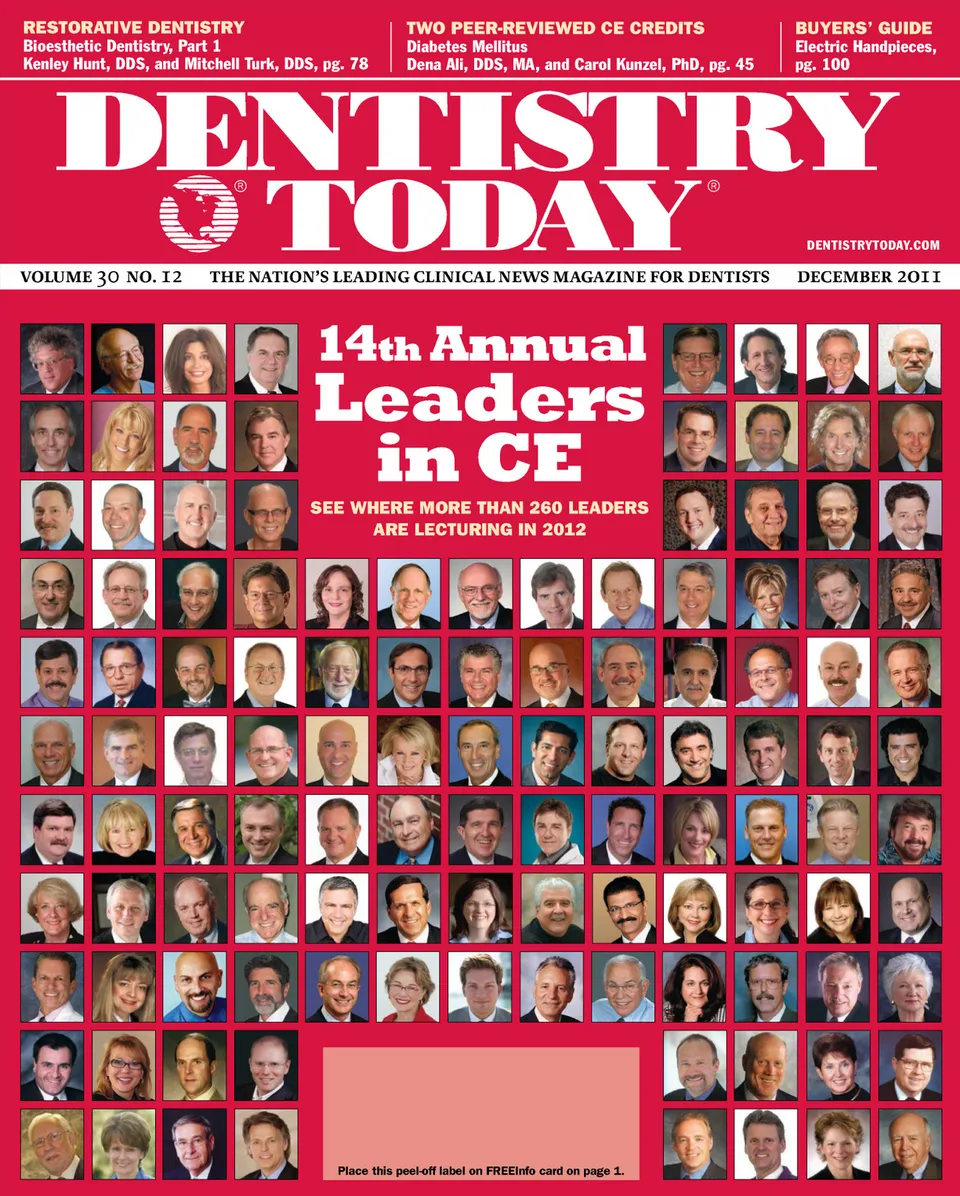
Leaders in the Spotlight In this issue of Dentistry Today, we proudly present our 14th Annual Leaders in Continuing Education directory. Each year in December, we honor and celebrate some of the top educators and consultants in dentistry. Nothing gives us more pleasure than to bring each a distinguished group of leaders into the spotlight. Being a leader in any profession is an honor, but with this distinction comes both rewards and challenges. Putting one's knowledge, experiences, and opinions on the line takes a good dose of courage and humility. Looking back at this past year, many of our leaders…
- Page 12
Below are letters the editors Dentistry Today received in response to articles by Lorin Berland, DDS, that ran in the October 2011 issue and by Martin Goldstein, DDS, that ran in the November 2011 issue. The articles are available on our Web site, . Dear Editors, I want to thank Dr. Berland for the article entitled "Dentistry is Challenging: Cosmetic Dentistry Even More," by Lorin Berland, DDS, in the October 2011 issue of Dentistry Today. I never completed a case very similar to that one and it left me with a sense of failure and discouragement. It's great to know…
- Page 14
Guidelines and Specialty Bias It is the usual state of affairs for any clinical healthcare specialist to believe that his or her specialty is the most important concern for the patient. This is true for prosthodontists, endodontists, periodontists, oral and maxillofacial surgeons. It is the usual state of specialty practice to define the focus of your particular specialty viewpoint with time. In time, after years and years of utilizing a particular specialty viewpoint, the specialist can't help but form a narrowed view regarding the importance of his or her individual specialty concerns versus all other areas of health concern. After…
- Page 16
VIEWPOINT continued from page 14 for dental procedures more than 6 months after the procedure is not compromised, provided that there is no residual defect from the repair. The AHA/ADA guidelines also noted that historically, antibiotic coverage for the prevention of IE has decreased with each new published guideline. The change in the past several decades from extensive to reduced ABP regimens is owed to the risk of developing microbial resistance, as well as a lack of evidence that ABP is effective in preventing distant site infections.10 However, the American Academy of Orthopaedic Surgeons (AAOS)—independently and apparently without consulting dental…
- Page 20
From the September 2011 Issue WHITENING FILM CAO Group Sheer White! teeth-whitening films are easily applied, stay where placed, and whiten teeth fast. This proprietary product completely replaces custom trays and molds tight to the teeth to ensure complete contact of its 20% carbamide peroxide whitening gel to enamel, reducing patient sensitivity and preventing washout or leakage of gel. For more information, call (877) 236-4408 or visit the Web site caogroup.com/dental. FREEinfo, INJECTION COMFORT SYSTEM DentalVibe The new DentalVibe Gen II features many advances over the previous model. It has twice the power, increasing the amplitude at the vibrating tip.…
- Page 22
NEW PRODUCTS ALL-CERAMIC RESTORATIONS Assured Dental Lab Calypso New-Generation All-Ceramic Restorations are supported by a high-strength zirconia framework, and given the translucent nature of zirconia, all restorations closely mimic the appearance of natural dentition. The zirconia framework is available in 8 VITA classic core shades to optimize color and clarity. Indications are anterior, posterior, and up to 6-unit bridges. For more information, call (877) 283-3854 or visit assureddentalllab.com. FREEinfo, SLEEP APNEA TEACHING TOOL Great Lakes Ortho The obstructive sleep apnea (OSA) demonstrator is an effective teaching tool to show patients the differences between normal breathing and OSA by demonstrating their…
- Page 24
Caulk's New Palodent Plus Sectional Matrix System Virtually every restorative dental office has some form of matrix band and retainer on hand for Class II direct restorative procedures. There are numerous configurations available, some with designs dating back decades. As restorative materials have evolved, so have matrix systems. Dentists now placing posterior composites are finding challenges related to contact creation, surface contour and anatomy, flash, and time spent on finishing when using systems designed when amalgam is the direct restorative material choice. DENTSPLY Caulk's new Palodent Plus Sectional Matrix System (Figure 1) employs a Ni-Ti retaining ring, an interproximal wedge,…
- Page 26
Spotlight System Virtually Eliminates Risk of Accidentally Locking Dentures to Implant; Cuts Procedure Time in Half BRIARCLIFF MANOR, NY-VOCO introduces Quick Up, a complete implant pickup system that virtually eliminates the risk of interlocking and cuts procedure time in half. Designed specifically for bonding attachments such as ball, locator, and telescopic attachments as well as other attachments in acrylic-based dentures, Quick Up can also be used for reattaching secondary elements in a denture such as bar retainers. With everything in one system, Quick Up improves workflow and chairside efficiency, saving time and money. The Quick Up system includes the following…
- Page 28
Spotlight Lasers' Affordability, Ease of Use, and Procedural Capabilities Cited INDIANAPOLIS, Ind.-Designed for the first time laser dentist and hygienist, Picasso Lite's affordable price, ease of use, and sleek design make it the perfect replacement for a sealed and electrosurgery for the use of treating soft tissue. It cuts and coagulates tissue with reduced trauma, ablation of tissue and is used for soft tissue surgical procedures, offering 2-6W of power and 3 customizable presets. It comes complete with accessories, a wireless foot control, a 2-year warranty, and more. With an unprecedented level of affordability, the multifunctional Picasso soft-tissue laser offers…
- Page 30
Spotlight Bulk, Sculpt, and Cure Using a Single Material AMHERST, NY—Ivoclar Vivadent introduces Tetric EvoCeram Bulk Fill, a unique nanohybrid composite material developed specifically for the fast, efficient bulk placement of direct posterior composite restorations. With Tetric EvoCeram Bulk Fill Composite, restorations can be placed with one material, in one increment, without the need for additional layers or dispensing equipment. The efficiency of Tetric EvoCeram Bulk Fill is a result of a unique patented technologies, including (1) Shrinkage Stress Relievers to ensure superior marginal integrity, (2) a Polymerization Booster within the initiator system that enables 4-mm-thick layers of composite to…
- Page 32
Kit Facilitates Removal of Broken Instruments From Root Canal WOODSIDE, NY–Even though many so-called easy methods and techniques are available to remove metal fragments from the root canal, they almost always result in pushing the metal object farther down the root canal and past the apex, resulting in the need for apical surgery. Offered by Medidenta, the Massermann Kit has been developed to ensure a rapid, safe, predictable method to safely separated root canal instruments, burs, posts, and other metal objects from the canal. The kit accomplishes this task with minimal if any loss of tooth structure, with predetermined positive…
- Page 33
Disposable Syringe Tips Offered JERICHO, NY-Darby Disposable AirWater Syringe Tips are comprised of a durable steel inner core that guarantees dry air or fresh water on demand. They provide air and/or water exactly when needed while protecting patients. By using disposable syringe tips, patient safety is improved by eliminating the concerns of cross contamination, and office efficiency is improved by eliminating the cost and time needed to sterilize metal tips. For additional information, visit the Web site darbydentalsupply.com. FREEinfo, Glasses' Light Weight and Comfort Cited CHERRY HILL, NJ-Vision USA's telescope glasses can be worn over prescription, safety, and safety laser…
- Page 34
Bonding Agent Hailed as the "Complete Adhesive Tool Kit" SOUTH JORDAN, Utah- Hailed as the "complete adhesive tool kit," Ultradent's Peak Universal Bond, a light-cure resin adhesive with chlorohexidine (0.2%), offers unmatched versatility, providing the ability to bond to dentin, enamel, porcelain, metal, composite, and zirconia. It's the only light-cure adhesive that contains chlorohexidine, which helps ensure long-term bond strengths. Peak Universal Bond is the ideal agent for indirect and direct bonding as well as post and core procedures, working equally well with selfand total etch techniques. With such versatility, there's no need for multiple agents to complete technique. Peak…
- Page 35
Custom-Fit Appliance Provides Maximum Patient Comfort ST. LOUIS–Offered by Keller Laboratories, the new NTI-tss Plus Soft, a custom fit appliance consisting of a hardsoft thermoformal material with clinically unbreakable Clear 450 Discluding Element (DE), provides maximum patient comfort and significantly reduces chair time. The hard/soft material makes NTI-tss Plus Soft delivery a breeze, minimizing the pressure placed on anterior restorations or slightly mobile teeth, and the DE ensures the appliance can withstand forces from even the most intense parafunctional habits. The NTI tss Plus Soft's standard design is extended to the second bicuspids, ensuring sufficient retention, and although its shell…
- Page 36
Attachment's Self-Aligning Feature, Retention, Durability, and Low Profile Cited ESCONDIDO, Calif.–When a case requires an overdenture bar, Zest Anchors' LOCATOR Bar Attachment provides the same self-aligning feature, superb retention, exceptional durability, and low-profile design as the LOCATOR implant Attachment. Its innovative ability to pivot increases the attachment's resiliency and tolerance for the high mastication forces an attachment must withstand, while its unique dual retention innovation that includes inside and outside retention ensures long-lasting performance. The LOCATOR Bar Attachment offers 3 options for the fabrication of a resilient attachment on an implant-supported cast alloy or milled titanium bar: (1) casting the…
- Page 37
Resin-Preimpregnated Reinforcing Tapes Save Time and Costs CZECH REPUBLIC–Ideal for splint setups, postorthodontic retainers, frameworks for composite bridges, and stress-free posts, Dentapreg represents a new generation of preimpregnated light-curing reinforcing tapes. When using Dentapreg, it's not necessary to impregnate the tapes with resin before use, thereby creating a simple and time-efficient procedure for both the dentist and technician, saving costs and increasing caseload. For more information, visit dentapreg.com or e-mail sales@dentapreg.com. FREEinfo, Cordless Device Facilitates Warm Gutta-Percha Techniques BALA CYNWYD, PA–B&L Biotech's cordless Beta Obturation device has been designed for warm gutta-percha techniques such as backfilling a canal with warm…
- Page 38
NEWS/TRENDS Industry News CLINICIANS REPORT Announces Change in Leadership CLINICIANS REPORT (CR) announced recently that Dr. Paul L. Child Jr., CEO for the past 3.5 years, will be leaving CR this month to pursue other interests as he continues his contributions to the dental profession. He will continue to serve the CR Foundation as a member of the CE directors. "Dr. Gordon J. Christensen, co-founder of CR, has been appointed CEO. He will lead an experienced team of more than 1,400 clinicians in 19 countries and 40 on-site basic scientists, engineers, and support staff. Additionally, he will continue to practice,…
- Page 42
In First Impressions, George Freedman, DDS, gives readers a brief summary of products that have recently been introduced to dentistry, based on his clinical experience. Ensure SciCan Sterilization is a must in every dental practice. It protects patients, staff, and practitioners from transmitted diseases and cross infection. Every nondisposable dental tool must be thoroughly disinfected in between patients. Is your sterilizer functioning as effectively as it should? Unfortunately, most sterilizers do not have a built-in monitoring system that can routinely verify their ongoing safe operation. Sterilizers can break down and sometimes they do malfunction; it is essential that the dental…
- Page 43
PrepStart H2O Danville Materials Microabrasion has been available to dentists since the 1930s. It is essentially a finely controlled and specifically limited sandblasting of selected tooth (hard tissue) surfaces. However, the technique was totally incompatible with amalgam dentistry. Microabrasion experienced a major revival with the rise of adhesive procedures in the 1990s. The advantages of microabrasion are many; it is very conservative of tooth structure; it is easy to learn and apply to many routine dental procedures; it can typically be used without the need for local anesthetic; and it leaves an excellent roughened surface that is ideal for bonding.…
- Page 45
Diabetes Mellitus: Update and Relevance for Dentistry Diabetes mellitus (DM) is a growing public health problem worldwide. Although there are advanced diagnostic tools for DM, the etiology of DM is fully understood. DM is a metabolic disorder characterized by chronic hyperglycemia resulting from defects in beta cells in the pancreas (insulin producing cells), insulin action, or both. The American Diabetes Association (ADA) classifies DM based on disease etiology into type 1 DM and type 2 DM. There are also other relatively less common types of diabetes such as gestational DM and drug-induced or secondary DM. This article reviews the most…
- Page 46
Medical complications that are commonly associated with DM include renal disease (diabetic nephropathy), retinopathy (visual impairment, blindness), peripheral vascular disease, and coronary heart disease (CHD) including accelerated atherosclerosis, and stroke.11 Diabetic kidney disease, or nephropathy, is the most common cause of kidney failure in the United States. One third of patients with type 1 diabetes develop kidney disease. Diabetes damages the small blood vessels in the kidneys, impairing their ability to regulate body fluids and filter blood to remove impurities by excretion in the urine. People with kidney failure must have a kidney transplant or rely on dialysis as a…
- Page 48
Diabetes Mellitus... continued from page 46 been widely recommended for all patients.33 In 1999, the UKPDS reported results similar to those found in the DCCT research. The UKPDS was designed to determine whether a reduction in long-term diabetes complications would be experienced by type 2 diabetes patients given intensive management to control blood glucose levels compared with patients given standard care. The UKPDS was a 20-year clinical trial coordinated by the Diabetes Research Laboratories at Oxford.34 UKPDS mirrored the findings of the DCCT in people with type 2 diabetes, showing that tighter blood glucose control reduced the development of diabetes…
- Page 49
ORAL MEDICINE vided for treating those patients. Therefore, the importance of measuring the dentists' willingness and knowledge has been emphasized.43 Many patients are unaware that they have DM or are at risk for DM. Routinely, in the dental office, patients will complete the medical history questionnaire and have an oral interview during their initial visit. Although the medical history questionnaire may not reveal anything suspicious, upon being asked about general well-being, a patient may mention the classic signs and symptoms of diabetes (the triad of polypuria, polydipsia, and polyphagia).46 Patients with findings such as headache, dry mouth, repeated skin infection,…
- Page 51
Test 144 Expiration date of this CE article is December 1, 2013. To submit Continuing Education (CE) answers, use the answer sheet on page 44. Circle the letter corresponding to the answer you believe is correct, detach the answer sheet from the magazine, and mail to Dentistry Today Department of Continuing Education. Or, use our easy online option at dentalcetoday.com. This article is available for 2 hours of CE credit. The following 16 questions were derived from the article Diabetes Mellitus: Update and Relevance for Dentistry by Dena Ali, DDS, MS, and Carol Kunzel, PhD, on pages 45 to 50.…
- Page 52
Revolutionary Advances, Part 3: Pursuit of the 3-D Cork This is part 3 of a 3-part article series. Parts 1 and 2 of "Recent articles" were published in the May and August 2011 issues of Dentistry Today and can be found in our archived articles at dentalproducts.com Wyatt Simmons, DDS Exciting times are upon us! As in many areas of dental specialty, the recent boom in technology has revolutionized the practice of endodontics. These technological advances have allowed us to evolve and increase our ability to provide ever-improving successful outcomes. This forward thinking enables us to confidently face challenges that…
- Page 54
Figure 3. Pigmentation, due to pulpal degradation and bacterial biofilms, can be visualized at the apex of this failing maxillary molar. Courtesy of Dr. Marga Ree. Revolutionary Advances, Part 3... continued from page 52 sively. Hill's stopping was a preparation consisting primarily of bleached gutta-percha, carbonate lime, and quartz.15 In 1867, Bowman was the first to demonstrate gutta-percha's use as a root canal filling material.16 By 1887, the S.S. White Company was manufacturing and distributing gutta-percha points. In the infancy of its use in endodontics, the techniques advocated for filling cleaned canals was to stuff as much gutta-percha into the…
- Page 55
Purchase $1000 of any EDS products throughout Q4 2011 and get a $100 Gift Card FREE $100 [gift card image] [gift cards shown: appears to be store gift cards including Amazon.com, Barnes & Noble, and others] Choose one of the above cards Visit www.edsdental.com for details challenging anatomical complexities encountered clinically. Again, Figure 4c highlights this current limitation to warm gutta-percha for 3-D molding in deep, difficult-to-reach areas of pulpal systems such as at the apical end of the maxillary molar's long, curved DB canal. CORONAL SEAL Discussion of the 3-D seal of the entire root canal system would be…
- Page 56
Figure 7a. Two-dimensional (2-D) digital periapical radiograph. Figure 7b. Cone beam computed tomography (CBCT): Note the branching of the lateral canal into 2 portals of exit. Figure 7c. File fed into the lateral pulpal branch. Figure 7d. Straight-on postoperative image. Note the branching of the lateral system leading to 2 portals of exit. Figure 7e. Mesially angled postoperative image. Figure 8a. Two-D digital periapical radiograph. Figure 8b. CBCT: Note the apical split of the main canal into 2 root tips. Also note the lateral canal feeding the lateral lesion. Figure 8c. Image documenting disassembly and a file in the lateral…
- Page 58
Efficient Placement of Implant Overdenture Attachments George Priest, DMD INTRODUCTION Attachment-retained implant overdentures are functionally superior to conventional dentures and are effective and cost-saving alternatives to fixed implant dental prostheses. In the mandible, the 2-implant overdenture is the least costly implant option.¹ It offers a significant increase in retention and stability over a complete denture,² and demonstrates a considerable improvement in quality of life.³ For these reasons, the mandibular 2-implant overdenture has been described as a standard of care for dentulous mandibles.⁴⁻⁶ Furthermore, solitary attachments have been shown to be effective as bars for overdenture retention; there is no difference…
- Page 60
Chairside Attachment A novel gingival colored composite resin luting system (Quick Up [VOCO America], ideal for the chairside placement of implant attachments, was used to complete the implant overdenture. The kit (Figure 16) also includes Fit Test C&B, a silicone for checking interferences and for blocking out undercuts; Quick Up Adhesive to enhance retention between the denture base and Quick Up resin; and Quick Up IC, a light-cured flowable composite resin for filling voids in the cured material. Another important application before the overdenture was removed (Figure 18). Potential interferences that were detected between the denture base and attachments were…
- Page 62
Figure 24. Quick Up luting resin was then injected about two thirds the height of each recess and the overdenture was seated. Figure 25. The prosthesis was gently held in place during curing of the resin. Figure 26. After 3 minutes, the overdenture with the incorporated caps was removed. Figure 27. Slight voids around the caps and in the access openings were filled with Quick Up LC flowable composite resin. Figure 28. Appropriately retentive Locator males were seated into the overdenture. Figure 29. The open palate prosthesis helped the patient overcome his gag reflex. Figure 30. The implant retained overdenture…
- Page 64
The "First Implant": Protocol for the GP, Part 3 This is part 3 of a 3 part article series. Part 2 of Drs. Tischler and Ganz's article was published in the October 2011 issue of Dentistry Today and can be found in our archived articles at our Web site, . Michael Tischler, DDS Scott D. Ganz, DMD The first 2 articles in this 3 part series: "The 'First Implant': Protocol for the GP" covered treatment planning and surgical aspects of a dentist placing his or her first dental implant via "the first implant protocol (FIP)." In the third and final…
- Page 66
The "First Implant": Protocol... continued from page 64 protrudes through the tray, and is unscrewed in the mouth after the impression sets; and (2) the second option is the "closed-tray impression" technique, where a traditional type crown and bridge impression is taken of the impression coping after it is secured to the implant with the reusable impression transfer coping.¹ The FIP utilizes the 3inOne abutment (BioHorizons) and a reusable Ball Top Screw (BioHorizons) impression transfer coping. The use of the 3inOne abutment and closed-tray impression technique provides for simplicity and accuracy for the FIP. When the impression utilizing the implant…
- Page 68
The "First Implant": Protocol... continued from page 66 pression. The flat side of the abutment and corresponding impression markers on the incisal abutment are placed accordingly in the impression. There are other orientations on the incisal abutment that allow for a secure orientation into the impression. There should be a solid "snap" seating into the impression with a secure type feeling (Figure 10). The impression, the registration, and counter impression (if it isn't a full arch dual-arch tray) is sent to the dental laboratory. The fourth step in the FIP is to return the temporary restoration with prepared 3inOne abutment…
- Page 70
Combining Orthodontics With Conservative Restorative Care Arthur R. Valker, DDS, MSEd David Clark, DDS CASE REPORT Diagnosis and Treatment Planning The following case describes the use of prerestorative orthodontic care, Bolton Analysis, Gingival Proportion analysis, tooth whitening, and a simplified and minimally invasive restorative protocol to achieve a predictable, systematic, and aesthetic smile enhancement. A 25-year-old male presented to the practice with a chief complaint of, "I want the space between my front teeth closed." There was a 5-mm diastema present between teeth Nos. 8 and 9 (Figure 1). The patient stated that he was interested in Invisalign (Align Technology)…
- Page 72
Combining Orthodontics... continued from page 70 lower vinyl polysiloxane (VPS) impressions (Flexitime [Heraeus Kulzer]) were taken of the maxillary and mandibular arch. A VPS bite registration (Blu Mousse [Parkell]) was also taken. Required photographs and radiographs were also submitted. Figure 3 shows the initial ClinCheck capture, while Figure 4 shows the ClinCheck capture of the proposed alignment at the completion of the Invisalign treatment. The invisalign proposal was approved, and treatment was initiated. The total orthodontic treatment called for 70 aligners, with aligners to be worn sequentially for 2 weeks at a time to achieve the desired alignment. Figure 5…
- Page 73
AESTHETICS proximator. It was anticipated that the situation would resolve itself as there was now approximately 5 mm from the newly established contact point to the crest of bone, a distance which has shown to allow predictable papillary fill between restorations.3 The aggressive cervical curvature of the BioClear Matrix allows for a more apical contact point, thereby maximizing the probability for a papillary fill. The one-week follow-up shows resolution of the black triangle as well as symmetrical, aesthetically pleasing restorations (Figure 12). Following the restorative treatment, new impressions were taken and the patient was given clear removable retainers to maintain…
- Page 74
Prerestarative Ortho to Maximize Aesthetics and Function INTRODUCTION Attempting to achieve ultimate facial and dental aesthetics can be challenging for a dentist. "Some dentists may not consider that facial aesthetics has much to do with them." Nevertheless, using an interdisciplinary approach allows the practitioner to set a challenging goal to dramatically improve a patient's facial appearance. "Interdisciplinary treatment gives the dental team the opportunity to change, shape, or develop an individual's appearance, character, or self-image, and at the same time provide a restoration that is functional and enduring."2 In his article, Rodriguez Flores3 says: "Interdisciplinary treatment that combines orthodontics, implantology,…
- Page 76
Prerestorative Ortho... continued from page 74 Prerestorative Orthodontic Treatment Orthodontic treatment started with the use removable functional-orthopedic appliance (Schwarz appliance) in order to eliminate the constriction of the maxilla and bring its size into proper relation with the mandible. Several months later, 6.0 mm expansion of the maxilla was achieved. Once the size and width of the maxilla was deemed sufficient, braces were then placed on both upper and lower arches in order to move the teeth into more favorable positions for the future restorative phase of treatment. Four months later, the objectives of this part of the treatment with…
- Page 77
INTERDISCIPLINARY DENTISTRY alveolar plate by moving teeth in a facial direction.56 On the contrary, data from Lindskog-Stöckland et al5 and Nielsen,13 advocate that the dentoalveolar complex is much more malleable than previously believed. The interdisciplinary approach to aesthetic dentistry, as described in this article, sides firmly with the latter conception. In their article "Beyond the Ligament: A Whole Bone Periodontal View of Dentofacial Orthopedics and Falsification of Universal Alveolar Immutability," Williams and Murphy11 wrote: "When a theoretical basis for manifestly successful clinical Figure 18. Retracted view after restorative phase of the treatment was completed (Case 2). Figure 19. Lateral facial…
And 15 more pages — read the whole issue.