
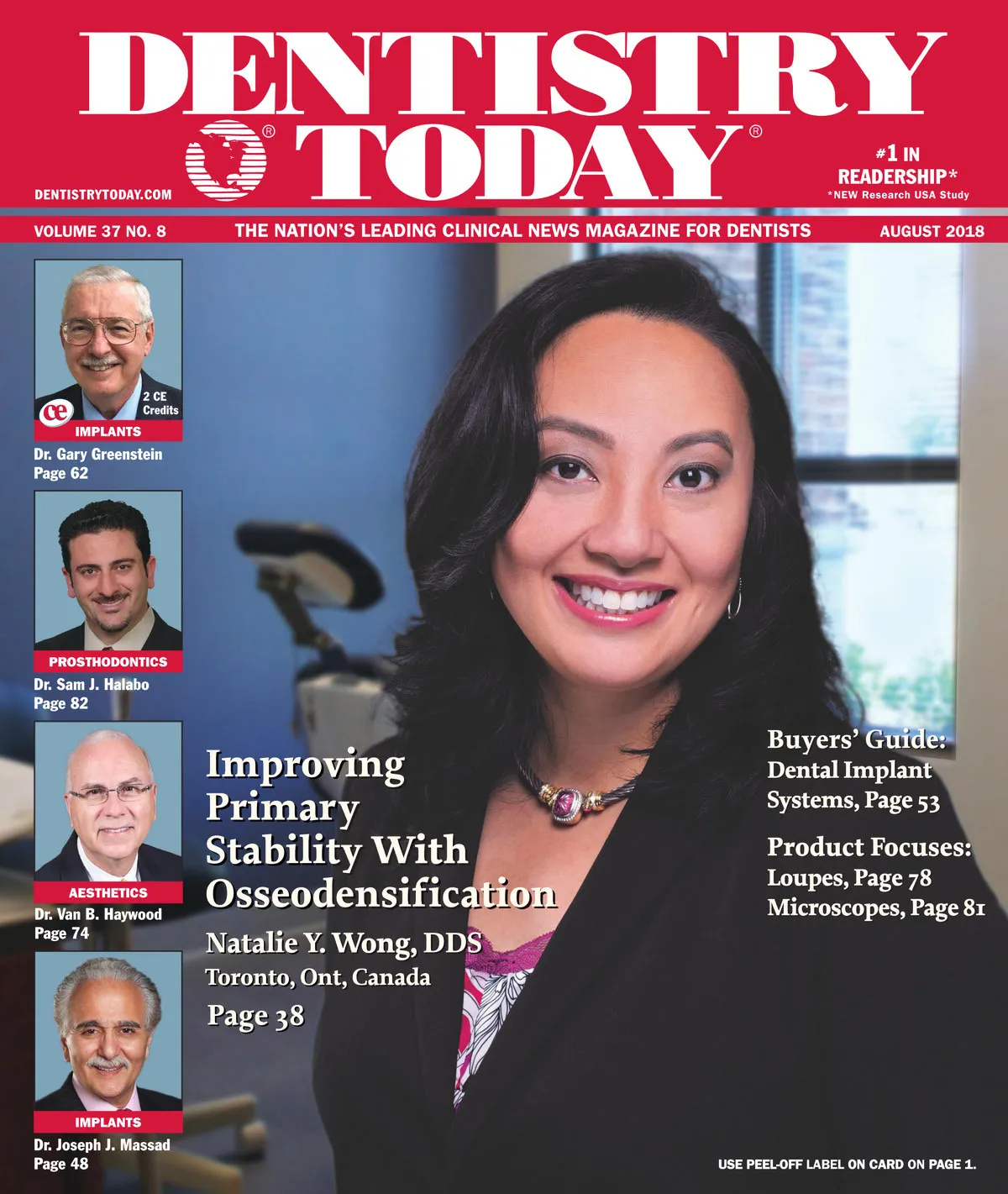
August 2018 · 92 pages
Dentistry Today — August 2018
Clinical articles, techniques, product news and continuing education for dentists. Read the full issue free in the digital edition.
Inside this issue
Excerpts from the issue. Open the digital edition to read any page in full.
- Page 8
Implant Dentistry in the Spotlight It is no surprise that our Implants Today section of Dentistry Today continues to be of great interest to readers who are general practitioners (GPs). In all, implant dentistry is one of the fastest areas of growth in the industry! Our most recent readership surveys confirm to show that articles on various implant topics are highly rated. Implants Today made its debut in the September 2015 issue of Dentistry Today under the capable watch of Dr. Michael Tischler, who serves as our implant editor. With the GP foremost in mind, we are selecting quality evidence-based…
- Page 10
On CBCT Scans in Endodontics Everyone wants to have the latest gadget, and, nowadays, it seems any are willing to pay a premium to have it. Think of the iPhone X with face recognition, but priced at more than $1,200. Is it really necessary? Dentists are no exception. Take, for example, cone beam computed tomography (CBCT) scanners. The technology has an average price tag of about $60,000 to $90,000. Granted, it is one of the most significant advances in dentistry in the last decade; however, is it really necessary for all clinicians? CBCT Use in Endodontics: The Standard of Care?…
- Page 12
VIEWPOINT continued from page 10 for the interpretation of it. Furthermore, as an example, some endodontists are under the misconception that they are only responsible for the endodontic interpretation of the volume. Whatever data is captured in that image, it is the clinician who is responsible for interpreting and properly documenting the scan and explaining any findings to the patient. Also, any clinician who performs a CBCT on a patient or held a patient held to the same standard of care as a board-certified radiologist, regardless of the intent of the exam, in the same way as if a CT…
- Page 14
FOCUS ON: Patient-Centered Outcomes David J. Clark, DDS, defines patient-centered outcomes vs process outcomes and promotes a more minimally invasive mindset in the profession that favors preservation and restoration of the natural tooth. Q: What are patient-centered outcomes? A: Patient-centered outcomes are the treatment results that are important to patients. We may contrast this with process outcomes, which are the things clinicians do in an effort to attain the desired patient-centered outcome. An example of targeting process outcomes is when an endodontic treatment is recommended because the obturation does not meet the standards of contemporary endodontic practice. For instance, there…
- Page 16
Bulk: Today's Composite for Every Day in the Posterior Zone Johan Figueira, DDS John Monges, DDS INTRODUCTION Early advances in resin-based materials broadened their use to direct posterior restorations. Conventional composite resin restorations (designed to be placed in 2-mm increments) are subject to problems associated with polymerization contraction, which may generate microfracture, air trapped resins, void inclusion, and secondary caries. To address these problems, as well as optimize clinical efficiency, BISCO has created REVEAL HD Bulk, a high-viscosity material that is placed in increments up to 6 mm. BACKGROUND Bulk-fill composite materials are characterized as having a lower shrinkage stress…
- Page 18
Build Me Up Buttercup Paul Feuerstein, DMD ...a 3-D printer looks at the software design as if it was a CT scan with thousands of layers....[It] stacks...slices on top of each other and..."welds" them into the end product. For years, we have been watching restorations being created before our eyes in desktop mills. CEREC (Dentsply Sirona) and PlanMill (Planmeca) were, of course, the first and continue to dazzle us and our patients with new and more complex restorations. Looking at the actual process, software is used to design a restoration, and it creates a file that is sent to the…
- Page 20
Spotlight Guided Prosthetics Delivery System Enables Clinicians To Provide Consistently Aesthetic Restorations GOLDEN, Colo.—FirstFit is a guided prosthetics delivery system that utilizes the latest digital technology to provide 3-D printed prep guides and the final, ready-to-see restoration at the same time. The use of this guided system enables clinicians to provide predictable and consistently aesthetic restorations while reducing the patient's time in the chair. Using proprietary CAD software, a designer creates a digital prep for the tooth using a series of prep guides while also creating the final restoration to fit this preparation. This revolutionary system provides a precise and…
- Page 21
Device Uses Pink Light To Improve Microhardness of Restorations RACINE, Wis–In a sea of bluecuring lights, Vista Dental Products differentiates with a unique technology. Using pink light, a combination of near-infrared and standard blue light, VALIANT PINK significantly improves microhardness of composite restorations and generates less heat than standard curing lights. VALIANT dual-wavelength curing lights are capable of polymerizing all light-cured dental materials, making them some of the most versatile curing lights available on the market. VALIANT precision optics and a unique arrangement of LEDs produce a uniform beam of high-intensity light, with 1,200 to 2,500 mW/cm² in the 395-…
- Page 22
Automatic Cycle Autoclave Unit Showcases Unique Features TORONTO–Beyes Dental Canada recently launched the highly advanced Masteri Class B automatic cycle autoclave unit. It has several distinctive main attributes, including (1) speed, with its thoroughly sterilized instruments available in 21 minutes; (2) security, with a built-in data logger, storing your information on a USB drive that is waterproof and shockproof and has an internal printer available as an option; (3) simplicity, with a range of sterilization options that can be easily selected via an intuitive touch display; and (4) safety, meeting all the latest regulatory requirements. The Masteri also includes a…
- Page 23
Software's Technology Detects and Labels Patient's Dentition ATLANTA–Carestream Dental's CS Model+ software is giving clinicians back an important step in the treatment planning process: the ability to automatically segment, set up, analyze, and present digital models within minutes. The manual process of analyzing models and creating treatment setups is valuable, yet time consuming. By eliminating the most tedious parts of the process, CS Model+ lets doctors analyze every patient's model with the same dedication and attention to detail that was once reserved for only the most complicated or unique cases. CS Model+ automatically detects, segments, and labels the patient's dentition…
- Page 24
Spotlight Tetric CAD Block Portfolio Enables Efficient and Aesthetic Indirect Restorations AMHERST, NY–Ivoclar Vivadent announces the introduction and availability of Tetric CAD blocks, rounding out the company's broad portfolio of blocks and enabling dental practices to use materials from Ivoclar Vivadent for all of their indirect digital restorations. The aesthetic, hybrid ceramic resin blocks offer unique benefits, like fast milling and polishing, combined with low wear. The block is a resin matrix with ceramic and glass fillers. This combination creates composite material that also offers an advanced chamfer effect, allowing restorations made from Tetric CAD to "disappear" in the surrounding…
- Page 26
Bulk-Fill Products Provide Protection By Releasing Fluoride After Placement RIDGEFIELD PARK, NJ—DMG America's Ecosite Bulk Fill and Ecosite Bond are 2 new bulk-fill products designed with practice efficiency in mind. They are engineered to deliver superior aesthetics and adaptation with one quick, 20-second light cure. Unlike other bulk-fill composites that have dramatically different particle sizes, Ecosite's submicron nano-technology allows for low shrinkage stress and a high-gloss finish for exceptional, natural-looking aesthetics. Thanks to its unique chemical formulation, Ecosite provides protection by releasing fluoride after placement. Extremely versatile, Ecosite is indicated for dental fillings, Class V restorations, and core buildups. Ecosite…
- Page 28
Flowable Base Restorative Displays Ability To Be Applied Without Undesirable Dripping Thanks To Flowability INDIAN LAND, SC—VOCO's Admira Fusion x-base, an all-ceramic-based flowable base restorative, is the fourth product release in the well-established Admira Fusion nano-ORMOCER product line. It is fast, reliable, strong, and easy to use. Due to its extremely low shrinkage and shrinkage stress, it can be used to place increments of up to 4 mm in just one working step without layering. It is suitable for Class I and II cavity linings and Class III and V restorations. Thanks to its flowability, the highly viscous Admira Fusion…
- Page 29
Primer's Design Provides High Adhesion Between Zirconia and Metal Surfaces SOUTH JORDAN, Utah–Ultradent Products introduces Peak-ZM zirconia and metal primer, which is specifically designed to provide high adhesion between zirconia and metal surfaces and the luting material. Thanks to the chemistry containing the methacryloyldecyl dihydrogen (MDP) monomer, Peak-ZM primer can increase bond strengths by 5 times more than using a resin cement alone. With this primer, clinicians can feel confident in their zirconia and metal restorations. Peak-ZM zirconia and metal primer is a single-component surface treatment that enhances bond values when applied to zirconia, alumina, and metal/alloys. It contains a…
- Page 30
NEWS/TRENDS Industry News DenMat's Snap-On Smile Earns US Patent The United States Patent & Trademark Office has awarded DenMat Holdings (DenMat) a patent for its line of Snap-On Smile removable dental appliances. US Patent No. 9,901,429 is for an appliance fabricated to enhance the appearance of a patient's smile, including a plurality of simulated teeth, improving the smile without altering the structure of the existing dentition. "This latest patent broadens DenMat's existing intellectual property assets covering Snap-On Smile," said David Casper, DenMat CEO. "The newly issued patent recites, among other things, the use of acetyl resin, the ability for the…
- Page 31
NEWS/TRENDS Images Reveal Neovascularization to Improve Healing After Implant Surgery Researchers at the University of Toronto have uncovered new information that could accelerate post-surgical healing for dental implant treatments and other diverse medical devices such as skin dressings. Their study describes how different implant surface textures affect a fundamental process in the body's ability to heal the area surrounding the implant. "We have known for decades that creating nanoscale implant surface texture improves clinical success rates," said John E. Davies, BDS, PhD, DSc, professor with the school's Faculty of Dentistry and Institute of Biomaterials & Biomedical Engineering and senior author.…
- Page 32
MEETINGS/SEMINARS CERP Recognition in Hawaii ADA 2018 will host ADA CERP Recognition: A Workshop for Continuing Dental Education Providers on October 21 from 7:30 to 10 am in Honolulu. The course will discuss the ADA CERP Recognition Standards for quality continuing dental education and provide an overview of the CERP application process. It also will review specific CERP standards and will help providers identify ways to demonstrate compliance with those standards. ADA 2018 AMERICA'S DENTAL MEETING October 18-22 Honolulu The course is designed for providers who are ADA CERP recognized and those applying for the first time. After the course,…
- Page 34
Drug-Filled, 3-D Printed Dentures Could Fight Off Infections Nearly two-thirds of the denture-wearing population in the United States suffer frequent fungal infections that cause inflammation, redness, and swelling in the mouth. To better treat these infections, called denture-related stomatitis, University at Buffalo (UB) researchers have turned to 3-D printers to build dentures filled with microscopic capsules that periodically release Amphotericin B, an antifungal medication. A study describing the work in Materials Today Communications found the drug-filled dentures can reduce fungal growth. Unlike current treatment options, such as antiseptic mouthwashes, baking soda, and microwave disinfection, the new development can also help…
- Page 35
CLINICAL UPDATE 35 Conventional Implant Impressions Beat Digital In Accuracy A recent study published in the Journal of Prosthodontics evaluated the accuracy of a digital implant impression technique using a 3Shape TRIOS intraoral scanner (IOS) compared to conventional implant impression techniques (pickup and transfer) in clinical situations. The research involved 36 patients who had received two implants (Implantium, International) measuring in diameter between 3.8 and 4.8 mm in posterior regions. Thirty-six reference models (RMs) were fabricated by attaching two impression copings intraorally, splinted with autopolymerizing acrylic resin, verified by sectioning through the middle of the index, and rejoined again with…
- Page 36
Future Trends in Implant Dentistry Michael Tischler, DDS Platelet-rich fibrin can be used to enhance healing in sinus graft procedures, soft-tissue grafting and periodontal procedures, extraction site healing, and bone grafting procedures. This autologous-derived addition to the surgical site is relatively easy to produce with a simplified process that takes just minutes. My mentor, Dr. Carl Misch, used to talk about dental implants from the perspective of how they are replacing millions of years of evolution. In implants today this month, I would like to talk about future trends in implant dentistry, and how they are reshaping Dr. Misch's analogy…
- Page 38
Improving Primary Stability With Osseodensification A Comparison of Techniques Natalie Y. Wong, DDS In current times, dentists must be able to create clinically sound treatment plans that take into consideration their patients' needs. This includes patient expectations to have timely dental treatment and "feel" when leaving the office. While immediately loaded prostheses may be preferred by patients, as clinicians, it is essential that there is stability and long-term predictability in the delivered work. In order to deliver an immediate prosthesis that is functional, it is extremely important that primary stability of the implants has been achieved. Clinically, this translates to…
- Page 40
IMPLANTS FIGURE 1. Clinical and radiographic information was merged digitally. FIGURE 2. The anterior view of a prepared maxillary digital wax-up. FIGURE 3. The occlusal view of a maxillary digital wax-up. FIGURE 4. The occlusal view of a mandibular digital wax-up. FIGURE 5. The check-bite step, done on the day of surgery using a hard, acrylic bite, fabricated from the records sent to the dental laboratory team. FIGURE 6. The patient biting into the monostrut to verify the midline and occlusion. FIGURE 7. Bone reduction was achieved using a round carbide bur. FIGURE 8. A Versah C-Guide is shown in…
- Page 42
Improving Primary Stability With... continued from page 40 to prepare the digital wax-up (Figures 1 to 4). The detailed treatment plan was reviewed and discussed through a virtual meeting. The use of the radiographic markers in the dentures facilitated the reproduction of the VDO and tooth position in the patient's arch. In addition, the digital representation enabled visualization of the quantity of bone, including sites where bone reduction and/or augmentation may be required. In this particular case, only bone reduction was required. The CBCT scan provided an estimate of the bone quality, which was determined to be poor for this…
- Page 43
IMPLANTS 43 Osstell readings were recorded in the chart. Once primary stability was achieved, the lower fixed provisional was delivered according to the steps outlined above for the upper arch. The immediate lower fixed provisional was checked for fit and occlusion against the upper provisional with the acrylic bite registration that was provided by the dental laboratory team, then finished. At the end of the surgical procedures, the patient left with immediately loaded upper and lower fixed long-term provisionals (Figures 20 to 23) constructed from a monolithic polymethylmethacrylate. His occlusion was noted to be stable, with simultaneous, bilateral posterior contacts.…
- Page 44
Screw Retained: The Future of Implant Dentistry! Conrad J. Rensburg, ND, NHD INTRODUCTION Our industry seems to have come full circle. What was once considered old and outdated is now considered new and exciting! This statement accurately describes the evolution we have seen in implant dentistry over the last 2 decades. In the early 2000s, most of our implant-retained restorations were either screw-retained or cemented with a stock abutment. Screw-retained options allowed for retrievability, but the screw access, especially in the anterior zone, caused unpredictable aesthetic results. Stock abutments solved the screw access issues but, in turn, caused emergence and…
- Page 46
Figure 5a. The natural flare of anterior implants, corrected with Angulated Screw Access (ASA) (Dentsply Sirona Implants). Figure 5b. The Atlantis ASA. Figure 5c. The angulated screw access correction. Figure 5d. The digital dual scan for design. Screw Retained: The Future of... continued from page 44 nonprecious material intraorally is biocompatibility. Most of those issues were caused by the addition of nickel in the alloy makeup. CoCr alloys are currently used in both the orthopedic and dental fields. They are very similar in alloy composition, and neither contains any nickel or beryllium elements. The rare elements making up the alloys…
- Page 47
IMPLANTS 47 Figure 7a. The metal structure for tryin. Figure 7b. Verifying fit. Figure 7c. Digital shade photos are shared with the laboratory team. Figure 7d. Framework tryin and model verification. dental cement was a challenge that was overcome with the ASA feature for Atlantis suprastructures.+ Acknowledgment The author would like to thank master ceramist Yunsoo Kim at Absolute Dental Services in Durham, NC, for the excellent dental laboratory work; David Hedgepeth, DDS, of Hedgepeth Dentistry in Fayetteville, NC, for his restorative dentistry skills; and Cary Dames, DMD, of Sandhills Oral & Maxillofacial Surgery in Fayetteville, NC, for his surgical…
- Page 50
Figure 4. The all-in-one package assembly of the LOCATOR R-Tx Attachment System. Figure 5. The dual-sided LOCATOR R-Tx tool. Figure 6. A panoramic radiograph of Case 1, depicting 4 maxillary and 2 mandibular implants. Figure 7. Porcelain-fused-to-metal screw-retained crowns, fabricated to restore the mandibular implants. Figure 8. Right and left lateral radiographic views, demonstrating divergence between the maxillary implants. Figure 9. A definitive maxillary open-tray impression, made using direct transfer coping. Figure 10. An implant-level cast. Figure 11. A maxillary wax trial denture. Figure 12. Maxillary implant-supported removable dental prosthesis, incorporating a metal framework with recesses for DAHs. Figure 13.…
- Page 51
IMPLANTS technique as used for the conventional LOCATOR attachment system. The purpose of this article is to report a case utilizing the LOCATOR R-Tx attachment system to facilitate fabrication of an aesthetic and functional implant-retained removable prosthesis. CASE REPORT Diagnosis and Treatment Planning Case 1 A 46-year-old female patient presented to the author's clinic for restoration of 4 maxillary and 2 mandibular implants (teeth Nos. 6, 9, 11, 13, 19, and 20 locations) (Figure 6). The implants were planned by the restorative dentist and then placed by the oral surgeon. Five implants were initially planned and placed in the maxillary…
- Page 52
Figure 1.8. In Case 2, (a) LOCATOR R-Tx attachments were used to retain and support a mandibular implant overdenture. (b) A mandibular denture with LOCATOR R-Tx attachments on implant analogs. (c) An improvement in mucosal health was observed 2 weeks later at the follow-up appointment. Note: This patient had a fixed implant-supported restoration. A lack of oral hygiene resulted in (a) mucosal inflammation and soreness that led to treatment failure. (b) The fixed restoration was removed and replaced with a removable implant-supported restoration. (c) An improvement in mucosal health was observed 2 weeks later at the follow-up appointment. chosen based…
- Page 54
BioHorizons The Tapered Internal family of dental implants provides excellent primary stability, maximal bone maintenance, and soft tissue attachment for predictable results. All tapered implants can be placed with the same instrument kit, giving you surgical convenience and flexibility to choose the ideal implant for each patient's needs. The Laser-Lok implant surface has been developed from more than 25 years of research and has been shown to establish a physical connective tissue attachment. It achieves superior osseointegration, helping to preserve crestal bone. For more information, call toll-free at (888) 246-8338 or visit biohorizons.com. FREEinfo, Dentatus Designed to complement your current…
- Page 55
DENTAL IMPLANT SYSTEMS and initial stability because of its optimal body design. Last March, the ETIII NH implant was released. It has a nanolayer of bioresorbable apatite coating with hydrophilic properties. In addition, the new ETIII SA with a 2.5-mm diameter is a conventional implant for restrictive spaces of the esthetic zone. For more information, call (888) 678-0008 or visit biossen.com. FREEinfo, Implant Direct The Legacy System offers surgical and prosthetic compatibility with Zimmer Dental's Tapered Screw Vent Implant with considerable versatility and design advantages. With 7 diameter options and 6 length options, Legacy offers the greatest range of choice.…
- Page 56
Implants From inventing the new locking taper activation method to utilizing a solid body implant design with a single platform, KAT Implants is changing conventional implant dentistry. The KAT System includes implants ranging in diameter from 2.3 to 6.0 mm and in lengths from 6 to 14 mm. All abutments of the KAT System can fit any KAT implant, and, since the connection between implant and abutment is accomplished via a locking taper, neither cement nor retaining screws are needed. For more information, call toll-free at (877) 528-7978 or (603) 427-0084 or visit katimplants.com. FREEinfo, MIS Implants Technologies V3's unique…
- Page 57
DENTAL IMPLANT SYSTEMS 57 PerioSeal The PerioSeal Implant System provides today's general dentists and specialists the simplest yet most advanced system marketed in the United States for addressing the issues of highest concern to patients and dentists. Its unique design incorporates safety features, lower costs, simple crown-and-bridge dentistry, and a superior coating that incorporates conventional dentistry principles (ferrule crown attachment) to implant dentistry. For more information, call (888) 446-7126 or visit the website perioseal.com. FREEinfo, Ritter Implants The Ritter SR/LA implant is German-engineered and manufactured to ensure the highest quality standards. The progressive thread design creates high initial stability, making…
- Page 58
Corporation PREAT offers abutments and attachments for nearly every implant system on the market, coupled with exceptional customer service. Solutions include precision copings, analogs, LOCATOR, Hader bars, click, O-rings, and even CAD/CAM-printed bars to fit a patient's specific needs. Whether you need help with case design, abutment choices, or figuring out which attachments to use, a highly trained technical support team will offer you timely and reliable solutions. For more information, call (800) 232-7732 or send email to info@preat.com. FREEinfo, Shatkin F.I.R.S.T. Designed for single-tooth and multiple-tooth replacements, the 2.5 mm diameter One Piece mini-dental implant features a blossomthread design…
- Page 62
Test 224 dentalCEtoday.com Replacing Two Mandibular Incisors With One Implant: A Commentary This commentary addresses replacing 2 mandibular incisors with one implant to support 2 crowns. Two techniques are compared: cantilevered pontic vs 2 crowns geminating off the implant. Gary Greenstein, DDS, MS, is a clinical professor in the Department of Periodontics at the Columbia University College of Dental Medicine in New York. He is a graduate of the New York University College of Dentistry (1972) and received his periodontal training at the University of Rochester Eastman Dental Center (1980). Dr. Greenstein is on the faculty of several universities and…
- Page 63
Sizes of Mandibular Anterior Teeth and Space Needed to Accommodate 2 Implants The m-d width of mandibular lateral and central incisors is, respectively, 6.31 mm and 5.98 mm in males and 5.98 mm and 5.55 mm in females.¹ The length of mandibular lateral and central incisors is, correspondingly, 12.75 mm and 12.58 mm in males and 1 1.55 mm and 11.29 mm in females.² At the CEJ, incisors are approximately 3.5 mm thick.³ Replacing 2 incisors with a narrow dental implants may be difficult due to lack of m-d space. For example, to place 2 narrow implants that are 3.3…
- Page 64
Therefore, if a patient has a smile line that shows the mandibular gingiva or there is a concern regarding papillary height between the implant and the cantilevered crown, its height can be enhanced. This is accomplished by augmenting the gingiva in the pontic area (eg, via connective tissue graft) and developing an ovate pontic that is usually placed 2 mm within the tissue. Ovate pontics give the appearance of the crown emerging from the tissue. This does not correct the lack of tissue interproximally, but it does create an illusion of a papilla. In contrast, with geminating crowns, there will…
- Page 65
IMPLANTS 65 Table 1. Comparison of Features Related to Implant Prosthesis Design FEATURE | CANTILEVER | GEMINATING CROWNS Prosthesis design | One implant, cantilevered pontic | One implant, 2 geminating crowns Implant position | Close to the adjacent tooth, parallel to adjacent roots | Center of edentate site, implant placed in the middle of ridge to avoid adjacent roots Width of ridge | Recommended width: 7 mm | Recommended width: 7 mm Surgery | Harder (implant placed close to the tooth and at cingulum for screw-retained prosthesis) | Easier (implant placed at cingulum for screw-retained prosthesis) Prosthetics | Easier (need…
- Page 66
TEST 224 Expiration date of this CE article is August 1, 2021 To submit Continued Education (CE) answers, use the answer sheet below. Or, use our easy online option at dentalcetoday.com. This article is available for 2 hours of CE credit. The following 10 questions are derived from "Replacing Two Mandibular Incisors With One Implant: A Commentary" by Gary Glassman, DDS, MS; Joseph Carpentieri, DDS; and Ben Greenstein, DMD, on pages 62 to 65. Learning Objectives: After reading this article, the individual will learn: (1) the criteria for deciding to insert one implant to replace 2 mandibular incisors, and (2)…
And 17 more pages — read the whole issue.