
March 2020 · 100 pages
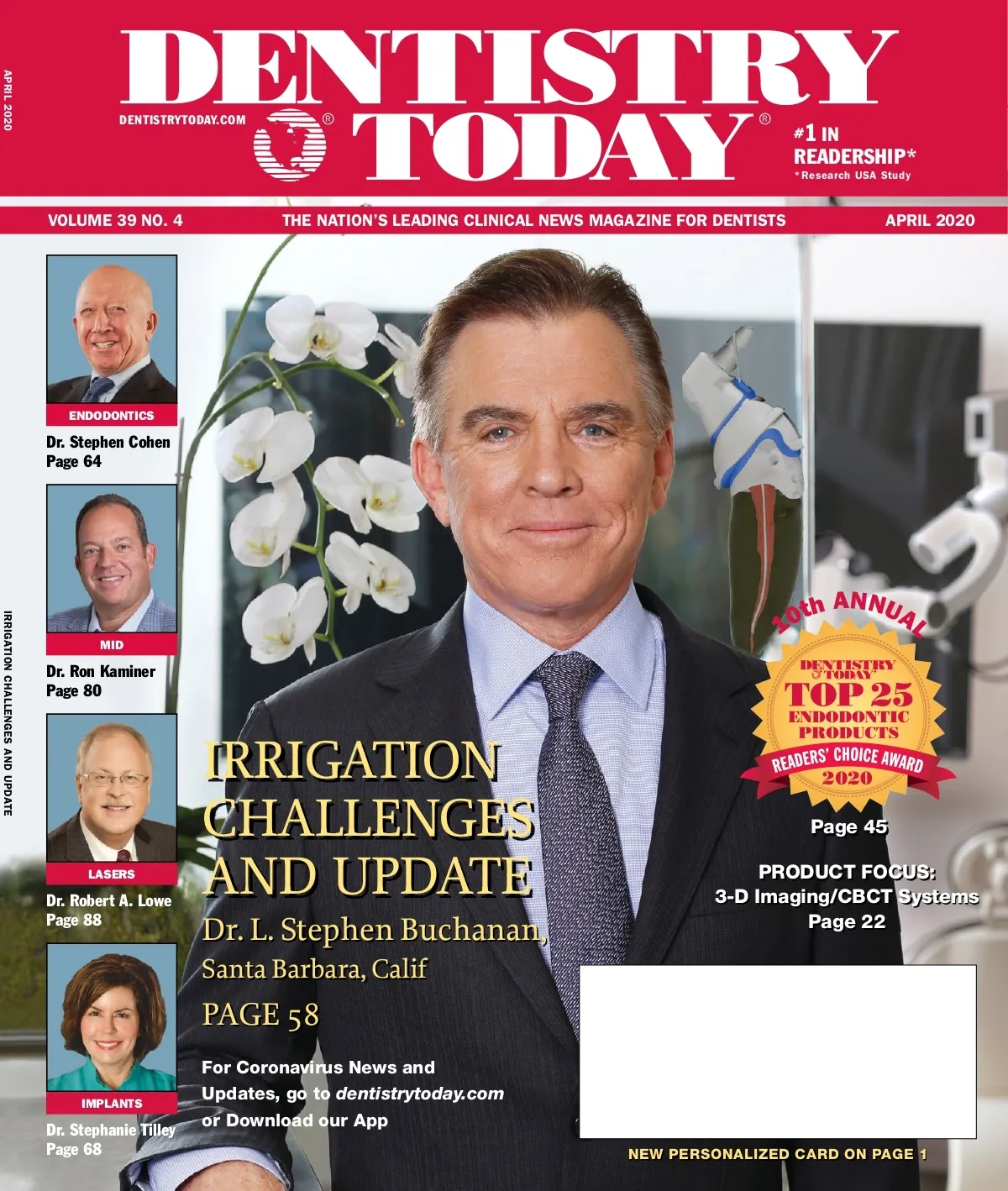
Dentistry Today — April 2020
Clinical articles, techniques, product news and continuing education for dentists. Read the full issue free in the digital edition.
Inside this issue
Excerpts from the issue. Open the digital edition to read any page in full.
- Page 6
Coronavirus! Putting the Outbreak in a Different Perspective As we arrive once again at Oral Cancer Awareness Month, COVID-19 has been absolutely dominating the news cycles. At the time of writing this, first in the United States, actions by the CDC and DHS are being taken in an attempt to stay one step ahead of this new coronavirus as its spread continues throughout the world. This will prove to be a daunting task, considering that the respiratory viruses are so well equipped to move easily and quickly from one host to another. To add to the challenges, the world's population,…
- Page 8
Know Your Leukoplakias to Identify Oral Cancer As an oral and maxillofacial pathologist, I have the unique perspective of both seeing patients who are referred to me for assessment of oral lesions as well as analyzing biopsy specimens that are sent to me for microscopic diagnosis. With regard to both aspects of what I do, I frequently encounter the term leukoplakia. To patients, this word is scary and vague, and it often connotes something had. To clinicians, it represents a lesion that may be challenging to manage and difficult to explain. The guidelines set forth by the ADA, while thorough,…
- Page 10
Figure 1. A thin, faint leukoplakia of the left lateral tongue. A slight granular appearance can be seen at the anterior aspect of the lesion. The biopsy revealed severe epithelial dysplasia. Figure 2. A thick, relatively homogenous-appearing leukoplakia of the ventral oral tongue. Biopsies were taken of the anterior, middle, and posterior aspects of the lesion and showed mild epithelial dysplasia. Figure 3. A "speckled" leukoplakia demonstrating a thick, whiter anterior segment and a thin, red posterior aspect. The biopsy revealed invasive squamous cell carcinoma. continued from page 8 have both red and white areas (Figure 3). These speckled leukoplakias…
- Page 12
Disruptive Technologies for 2020 Lou Shuman, DMD, CAGS, discusses some new technologies that can make a significant impact in your practice. I love what I do. Introducing companies to the dental market and helping accelerate the impact of existing ones. I get a front row seat to the innovations that are reshaping critical aspects of our industry, from clinical care to practice management. As founder of the Cellerant Best of Class Technology Awards, I have the privilege of hearing what our panel of technology experts—including Dr. Paul Feuerstein, technology editor of Dentistry Today—consider cutting edge. I've selected 4 from the…
- Page 14
Aseptico Designs Equipment to Meet Advancing Needs of Dentistry Figure 1. The Aseptico 7000 Series Motor has been named as a Readers' Choice Top 25 Implant Product and a Readers' Choice Top 25 Endodontic Product by Dentistry Today. Figure 2. Aseptico manufactures a full line of dental motors for dental practices and dental labs, as well as for mobile and portable dentistry. Figure 3. The Aseptico Global Dental Catalog now features more than 300 products designed to help dentists practice more effectively, including implant innovations, the Penguin RTA Implant Stability Monitor, and the Spotter Smart Implant Detector. Established in 1975…
- Page 16
Doctor-Lab Communication in the Digital Age INTRODUCTION "Communication is key." "It's all about communication." Sound familiar? The Merriam-Webster Dictionary describes communication as "a process by which information is exchanged between individuals through a common system of symbols, signs, or behavior." Communication is a two way street. It involves a verbal exchange that includes speaking or writing and, importantly, listening. After the dentist writes on a prescription pad, it is then up to the dental laboratory team to understand exactly what the dentist wants. The clinician envisions how the restoration should look, then often communicates details verbally to the lab technician…
- Page 18
Doctor-Lab Communication in the... continued from page 16 ing steps between conventional and digital workflows. Digital Workflow Diagnostic digital wax-up: Using a laser intraoral scanner (eg, TRIOS [3Shape]), the dentist will send scans of the existing dentition to the technician who then creates the proposed restorations in the virtual 3-D model using dental design software. The dentist then views the design remotely and has an exchange with the technician about any aspects of the design. It can then be improved or modified, and the process continues until both are satisfied with the results. Cone-beam computed tomography (CBCT): Central to the…
- Page 20
Doctor-Lab Communication in the... continued from page 18 ibility issues can pose obstacles to the digital workflow. Each manufacturer uses some proprietary file format that may or may not require the lab to have the same licenses to view and work with those files. While there is some interoperability between different scanners and the design software in the laboratory (eg, i3Shape and exocad Dental CAD), challenges persist in sharing designs across different platforms. Solutions Digitally communicated workflows have become ubiquitous in implant planning for restoratively driven implant placement. The sharing of STL and DICOM files on a variety of platforms,…
- Page 21
DIGITAL DENTISTRY 21 placed, and were scanned at the fixture-tissue level. Figure 10 shows virtual relative angulation of the screw access holes and implants. Teeth Nos. 22, 27, and 29 were virtually extracted, and a full arch, mandibular, implant-supported provisional was then added. Next, teeth Nos. 22, 27, and 29 were extracted, and the screw retained provisional was assureed to the 6 implants (Figure 11). Care allowed for sue healthy, and a definitive screw retained, milled zirconia prosthesis was placed (Figure 12). CLOSING COMMENTS The case example above serves to demonstrate how complex implant restorative dentistry can be achieved. This…
- Page 22
PRODUCT FOCUS 3-D Imaging/CBCT Systems Owandy Radiology When it comes to owning a 3-D panoramic unit, cost and physical space are the most common obstacles. The iMax 3D offers both issues thanks to (1) being sleek and lightweight (4.45 lbs); (2) incredible ease of vision, from 12 x 10 cm to 9 x 9 cm, 9 x 5 cm, and 5 x 5 cm; (3) an intuitive, user-friendly human-machine interface; (4) being CAD/CAM ready and equipped with QuickVision 3-D software and having the ability to share STL files from a dental lab or a digital scanner; and (5) implant surgical…
- Page 24
24 3-D IMAGING/CBCT SYSTEMS continued from page 22 PreXion With the launch of the Excelsior line, PreXion still has one of the smallest focal points in the industry. The company has also advanced all other core CBCT technologies, including the x-ray tube and Flat Panel Detector. The new Excelsior CBCT scanner couples the smallest focal spot (0.3 mm) with the following: a voxel size of 1 to 2, a 1,024 voxel size, a 360° gantry rotation, and advancements in the PreXion software. Because of these advances, PreXion can deliver 30% lower radiation exposure without compromising image quality. For more information,…
- Page 26
It Keeps Me Runnin' Paul Fuerstein, DMD The Chicago Midwinter Meeting in February did not disappoint with new product introductions as well as enhancements of existing products. I can only touch on some high lights here, which summarize 3 days and over 30,000 steps on my FitBit. It is difficult to assess a new product on a meeting floor with tabletop demonstrations, so I have a lot of work to do in the coming months to report accurately on what I have seen. Of course, new impression scanners, mills, 3D printers, and software caught my eye first, but there are…
- Page 28
Laser Adapter Provides Ability to Treat Myriad of Conditions SOUTH JORDAN, Utah—Ultradent Products recently revealed its latest tool for non-invasive treatments—the photobiomodulation (PBM) adapter for the Gemini 810 + 980 soft tissue diode laser. When paired with the Gemini laser, the PBM adapter gives clinicians the ability to treat a myriad of conditions—specifically pain management, even with such conditions as TMJ disorders—with one easy-to-use device. The PBM adapter marks another technological advancement for Ultradent Products, following tireless research into the benefits of photobiomodulation treatments. It functions on the 810 wavelength, the optimal wavelength to be absorbed for photobiomodulation. It is…
- Page 30
Treatment Planning System Helps Clinicians, Patients Visualize Options SAN JOSE, Calif.–Align Technology announced the launch of the ClinCheck "In-Face" Visualization tool for the Invisalign Go system, the company's innovative tooth movement system designed for general dentists. The ClinCheck In-Face Visualization tool enhances the digital treatment planning experience for doctors and their patients by incorporating a front-facing smile image of a patient's face into his or her ClinCheck treatment plan. Initially available with the Invisalign Go system, the visualization tool will roll out across the Invisalign portfolio throughout the year as the technology is optimized for Align's extensive network of more…
- Page 31
Aesthetic Formula Engineered to Avoid Chips, Fractures NEWPORT BEACH, Calif.—Glidewell involved a new aesthetic formulation of its popular BruxZir Implant Prosthesis, a product that was launched in 2013 as a durable, itable alternative to the acrylic hybrid denture. The BruxZir Esthetic Implant Prosthesis, which features superior translucency paired with a high flexural strength of 870 MPa, is constructed of 100% solid zirconia and, like the original version of the product, is engineered to avoid chips, fractures, and premature wear. With the addition to the extensive line of BruxZir restorative solutions, clinicians now have an option for edentulous implant patients with…
- Page 32
New Intraoral X-Ray Sensors Build on Previous Models HATFIELD, Pa- KaVo Imaging recently unveiled an all new addition—KaVo IXS—to its sensor portfolio. KaVo IXS intraoral x-ray sensors come to fruition after years of product development and customer feedback. [Image of layered sensor components] KaVo IXS size 1 and size 2 sensors feature KaVoTough engineering in the sensor and the cable. KaVo IXS sensors are 3 times more resistant to damage and functional failure than Carestream's CS-7500. The KaVo IXS cable can withstand double the bitefore without cosmetic damage than the CS-7500. The KaVo IXS cable can withstand more than 240,000…
- Page 34
All-Purpose, Universal Cleaner Designed for Use on Tooth Structure and Prosthetics NEW YORK CITY—Kuraray Noritake has once again reinvented a dental category by launching its latest innovation: KATANA Intraoral and Restoration Cleaner. One common problem encountered during the trial fitting of a restoration is the weakening of bond strength after cementation. This happens as a result of contamination from saliva and blood in the oral cavity. With the new KATANA Cleaner, this obstacle is virtually eliminated, thanks to its thoughtful formulation. It has a high cleaning effect due to its surface active characteristic MDP Salt, and a low pH value…
- Page 35
Curing Light Incorporates Latest LED Technology ITASCA, Ill-SDI's RadiiXpert is a smarter curing light that incorporates the latest in LED technology to deliver targeted, consistent light for optimally cured restorations. Precision curing is achieved with unique target assist technology. A positioning light ensures light is correctly placed over the restoration being cured with the right angulation to improve operator technique. An optimally collimated beam ensures Radii Xpert's light intensity is maintained on the restoration being cured. Light intensity remains consistent over clinically relevant distances for better performance. The 1,500 mW/cm² light intensity over a 4 mm aperture and wave length…
- Page 36
Anesthesia System Allows for Use of Standard Dental Anesthetic Cartridges [Image of dental anesthetic delivery device] LANCASTER, Pa.–Septodont's Dentapen is a self-contained CCLAD that enables the dentist to utilize standard dental anesthetic cartridges and needles. It is entirely portable, meaning that a single device may be all that a dentist needs to purchase. It runs on disposable batteries and enables the local anesthetic to be delivered at 3 speeds and in 3 modes, including (1) full speed, (2) ramped up (blue light), and (3) pressure mode (purple light). For more information, call Septodont at (800) 872-8305. FREEinfo, Wipes Demonstrate Effectiveness…
- Page 38
Implant Scaling Tip Allows Easy Access and Leaves No Scratches on Abutments FAIRFAX, Va.—B&L Biotech introduces a new IS Tip, the smart choice for implant scaling. The tip is bendable, which allows easy access and leaves no scratches on implant abutments and porcelain restorations. There is no pain for hypersensitive patients and no scratches on veneer restorations. For more information, visit B&L Biotech's website at bnlbio.com or email customerservice@bnlbio.com. FREEinfo, Post System Enables Easy Insertion Into Converging Canals ORLANDO, Fla.—POST from Filhol Dental is a prefabricated post system that can be customized to suit restorations for root post and core…
- Page 40
Device Detects if Suspicious Caries Lesion Breaches Dentin/Enamel Junction ROSLYN HEIGHTS, NY–Ortek Therapeutics' ECD is a revolutionary electronic caries detection device. It is specifically designed to help diagnose suspicious caries lesions on occlusal surfaces of posterior teeth. The ECD demonstrated 100% sensitivity and 93% specificity in a clinical study, helping solve an everyday challenge for dental professionals. By measuring the conductivity of enamel, the ECD can instantly and accurately detect if a suspicious caries lesion has breached the dentin/enamel junction, advanced and progressed further into the dentin, or is confined to the enamel. Using the ECD is fast and easy.…
- Page 41
Impression Material Provides Extreme Precision CLINTON TOWNSHIP, Mich.—Dynax Silicones from EXACTA Dental are easy to use and provide extreme precision. In total, the entire impression process for each model takes less than 3 minutes. They have been expertly formulated with specific aspects to ensure all impression for every patient. These revolutionary silicones easily integrate into a practice's workflow. The impression process functions the same as other materials but with shorter processing and less time in the patient's mouth. With their scannable surfaces, Dynax Silicones do not need powder. This hybrid material provides an accurate traditional impression that can be easily…
- Page 42
Industry News Coronavirus News and Updates As news about COVID-19 changes on a daily basis, we encourage you to visit and download our mobile app for the most up-to-date information about guidelines, treatment, and more. Glidewell Renames Expanded Surgical Solution Lineup Glidewell has renamed its Newport Biologics brand to Newport Surgical to reflect the addition of instruments, blades, and sutures to its portfolio of straightforward bone grafting solutions. Established in 2016 as a simplified collection of regenerative materials and resorbable membranes, the Newport Surgical line now includes everything clinicians need for the most common bone grafting applications, including socket regeneration,…
- Page 43
Citizen Scientists Uncover Correlation Between Dental Visits and Treponema Abundance Colorado State University (CSU) and the Denver Museum of Nature & Science used a crowd sourced, citizen science driven study to find a correlation between people who do not visit the dentist regularly and increased abundance of Treponema, which causes periodontal disease. Carried out in the Genetics of Taste Lab at the museum, a wide cross section of museum visitors submitted to a cheek swab and answered simple questions about their demographics, lifestyles, and health habits. Microbial DNA sequencing data revealed, broadly, that oral health habits affect the oral microbiome.…
- Page 45
DENTISTRY TODAY TENTH ANNUAL TOP 25 Endodontic Products Dentistry Today's Readers' Choice Top 25 Endodontic Products, selected on the basis of lead generation, represent some of the profession's most innovative endodontic products. The products appear in no particular order. Ultradent Products VOCO UniCore Posts are composed of glass fibers. The translucent and radiopaque UniCore Post responds to compressive forces as dentin would without compromising the durability of the restoration. The gentle taper of the UniCore Post corresponds to the natural anatomy of the tooth and perfectly matches the post space created by the UniCore Drill. The 5 sizes and colors…
- Page 46
Top 25 Endodontic Products CLINICIAN'S CHOICE Dental Products MACRO-LOCK ILLUSION X-RO posts ensure restorative longevity and unsurpassed strength while also providing excellent aesthetics and outstanding radiopacity. With a flexural strength of 1,800 MPa and an elastic modulus close to dentin, the MACRO-LOCK ILLUSION X-RO absorbs stress and prevents post fracture and stress on the root, especially in lower incisors. Furthermore, several design enhancements ensure unmatched micro and macro retention to the cement and core material. Composed of extra radiopaque fibers, MACRO-LOCK ILLUSION X-RO features cophenol command illusion technology, which turns the post's color transparent upon seating. For more information, visit…
- Page 48
Top 25 Endodontic Products Kerr Endodontics TF Adaptive features Adaptive Motion Technology, which uses a patented feedback algorithm to change the motion of the file based on the applied load. The TF Adaptive files are up to 70% more flexible than other files on the market and are the only endodontic files that are twisted, rather than ground, into their shapes. This makes them up to 58% more resistant to fracture than other leading file systems. For more information, call (800) KERR123 (537-7123). FREEinfo, Aseptico A product with 30 years of motor manufacturing experience, the 7000 Series Motor is one…
- Page 50
Top 25 Endodontic Products Brasseler USA The XP-3D Shaper addressed the shortcomings of traditional NiTi instrumentation and ushers in a new biologic standard of care in endodontic debridement. Featuring Brasseler's exclusive MaxWire Technology, the XP-3D adapts to the canal's natural anatomy by expanding once exposed to body temperature. Unlike traditional round files, a single XP-3D Shaper instrument is able to gently debride virtually every size and type of canal safely and efficiently. It is minimally invasive and offers 3-D anatomical cleaning, single-instrument debridement, virtually no stress on the tooth, and high resistance to cyclic fatigue. For more information, visit xp-3d.com.…
- Page 55
Top 25 Endodontic Products EdgeEndo The EdgeTaper Platinum is an assortment of shaping and finishing files that set a new standard in safety and canal centering by significantly improving the resistance to cyclic fatigue and flexibility. The proprietary FireWire heat treatment vastly improves the NiTi metal allurgy, delivering unmatched strength and flexibility. EdgeEndo was founded on a revolutionary idea of creating superior endodontic products for less and passing the cost savings on to the customers. Staying true to that promise not only defies industry wisdom but has made EdgeEndo one of the world's largest rotary NiTi suppliers in 4 years.…
- Page 56
Top 25 Endodontic Products Zest Dental Solutions ICE Light light-transmitting composite posts provide clinicians and their patients with predictable, functional, and aesthetic results for the placement and management of endodontic posts. Filled with 70% fiberreinforced resin, the ICE Light system combines high flexural strength with dentin-like physical attributes, making it an excellent alternative to metal posts. Specifically, the stress-diffusing property is advantageous in helping mitigate the risk of cervical and root erosion. Available in different lengths and reamer sizes, ICE Light posts are highly radiopaque, noncorrosive, and, when properly bonded, will polymerically seal at the margins to extrude the occurrence…
- Page 57
Top 25 Endodontic Products Dentsply Sirona Endodontics WaveOne Gold delivers next-generation performance engineered with advanced nanotechnology. The single-file shaping system enhances control of endodontic preparations through consistent, predictable performance, promoting patient safety and clinical confidence. Pioneering design features developed by leading endodontists optimize the tip diameters, tapers, and cross sections to establish a gold standard in preparing canals. WaveOne Gold offers you the simplicity of a one-file shaping system combined with higher flexibility (compared to WaveOne) to respect the canal anatomy. With lower bending resistance and a variety of file sizes, the endodontic file and its accessories cover a range…
- Page 58
Closed-System Negative Pressure Irrigation A Serious Inflection Point in Root Canal Cleaning The previous 25 years have seen great strides in improving endodontic instrumentation1 and obturation methods,2 yet advances in our ability to clean root canal systems have been disappointing, to say the least. We have seen little improvement in the irrigating solutions we use and, until recently, no significant improvement in the application of these irrigants to root canal system (RCS) complexities. In general, irrigation efficacy has suffered in proportion to the time saved by rotary instrumentation. When it took 10 to 20 minutes to shape canals with hand…
- Page 59
Remote Hands-On Training Online education has taken adult education by storm, empowering individuals to upgrade their intellectual capital without sitting in lecture halls; however, procedural training has remained limited to training centers and dental schools. The advent of 3D printed teeth has irrevocably changed that. Dr. Buchanan has developed this groundbreaking remote hands-on course based on his 30+ years of teaching at his academy in Santa Barbara. Clinicians can access this course anywhere in the world from the comfort of their own office, while avoiding costs associated with traveling to a training facility and the overwhelming lost practice production. THE…
- Page 60
Closed-System Negative Pressure... continued from page 58 ion in the process), it becomes inactive.5 While a pool of NaOCl can continually bring fresh, active chemistry to bear, the volume of solution available in canals at the dissolution front is severely limited. Irrigation efficacy in RCS spaces is further limited by the accumulation of gases liberated by this process. Much has been made of a supposed "Vapor Lock" cavitation (of gas liberated by this chemical process) that requires negative pressure irrigations (NPI) to eliminate.6 However, my research shows that the gases displacing active NaOCl are simply and immediately removed by our…
- Page 62
Closed-System Negative Pressure... continued from page 60 methods are used in multi-annular teeth, clinicians must hang on to the activation instrument for 20 to 40 minutes in a 4-canal molar instead of letting a longer passive soak time do the job without much hands on time required. Photon-induced photoacoustic streaming (PIPS) was never shown to achieve promised cleaning efficacy,12 but my primary attraction to it was its multi-annular approach to RCT cleaning. My good friend Dr. Daniel Czerny says the most effective way to activate NaOCl is to combine its use with espresso. Chill, have a cafe latte while your…
- Page 63
Figure 7. Prototype PS System anterior/premolar device (DELabs/Vista) attached to a Truelaw (DELabs) central incisor replica (left). Illustration (center) of PS System showing details of sodium line and cannula supply function in a central incisor. Prototype PS System molar device (right) attached to a Truelaw molar replica. Figure 8. A research isthmus simulation block showing PS needles in adjacent canals, dissolving pulp analog in 13 hands-off minutes. free of clogging impediments, this reversed CSNPI device digested all of the pulp analog in the simulated isthmus space (Figure 8) in just 13 minutes! Beyond that exciting result, the hands-on time required…
- Page 64
Root Resorption: Causes and Remedies Root resorption (RR) is the progressive loss of dental and cementum by the action of odontoclasts. RR may occur as a physiologic or pathologic phenomenon, and it presents in many different forms. There is external root resorption (ERR) appearing initially on the apical of the root, for example: • Cervical, meaning it is limited to the cementalenamel junction • Localized, meaning it is limited to the coronalmiddle or apical third of the root • Generalized, meaning it may affect more than one third of the root surface • Inflammatory. Though RR is usually inflammatory, a…
- Page 65
the patient return 2 weeks later and repeat the testing. If the test findings 2 weeks later are like the first findings, then have the patient return in 6 weeks and compare the findings to the initial testing. If there is no evident change in the response to treatment, then the patient should return for follow-up testing every 3 to 4 months for at least 2 years. Clinicians are urged to keep all radiographic images and test findings for at least 5 years. In this digital era, this should not be a problem. Later, the patient may request access to…
- Page 68
Simple Maxillary Sinus Tenting and Implant Placement INTRODUCTION Patients often present with bone quality or quantity that is not conducive to support a proper dental implant. Thus, a secondary surgical procedure is used to augment the bone so that the implant can be ideally positioned and stabilized. Dental implants have become a well-accepted mode of treatment to our patients. They present with missing teeth and request permanent replacement with fixed prostheses. The success of our modern dental implants is reliant on their ability to integrate into the bone. This requires a relatively healthy patient with no uncontrolled healing properties and…
- Page 70
Figures 2 and 3. Implant placement and tenting began with proper angulation mesially-distally using a 2.4-mm-diameter pilot bur. This bur initiated the osteotomy. Thinking tooth-down, an 8-mm-wide maxillary molar tooth replacement was planned. Thus, placement was approximately 4.0 mm distal to the adjacent tooth. Knowing that there was minimal bone height available, the pilot bur was positioned only about 4.0 mm into the available hard tissue, or approximately 1.0 mm short of the assumed floor of the sinus. The soft tissue in this site was about 2.0 mm thick. A flapless procedure was chosen in this case, and the pilot…
And 17 more pages — read the whole issue.